
Job growth slows from 184,000 to 113,000
First release of employment data for ages 15–34
Manufacturing payrolls rise for first time in over 2 years
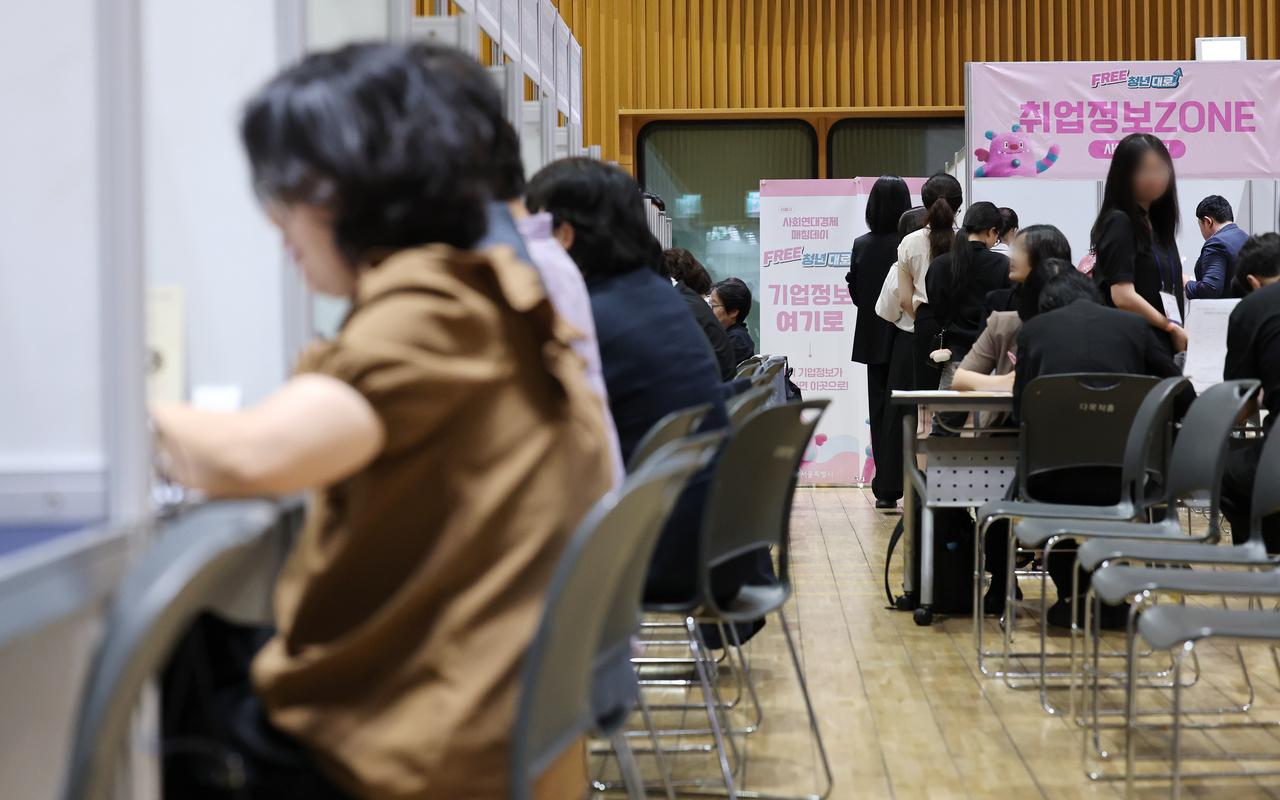
South Korea added 113,000 jobs last month compared with a year earlier, but the chill gripping youth employment showed no sign of lifting. Even when the definition of "youth" was expanded from age 29 to 34, employment in that group still fell by 98,000. The employment rate for those aged 20 to 24 dropped 2.7 percentage points, and the broader trend of older workers driving job growth while young people are squeezed out of the labor market continued.
According to the September 2026 employment survey released by the Ministry of Statistics on Friday, total employment stood at about 29.266 million, up 113,000 from the same month a year ago. The pace of job growth had been accelerating — from 63,000 in June to 108,000 in July and 184,000 in August — before pulling back last month.
Starting with this release, the Ministry of Statistics began publishing employment indicators under an expanded youth age bracket of 15 to 34, following a revision to the Special Act on Promoting Youth Employment that widened the legal definition of youth from ages 15–29 to 15–34. Employment among those aged 15 to 34 came to about 6.412 million last month, down 98,000 from a year earlier, with the employment rate falling 0.4 percentage points to 56.1 percent.
Under the previous 15-to-29 bracket, employment totaled about 3.417 million, a decline of 147,000 from the same month last year — a steeper drop than the 143,000 decrease recorded in August. The employment rate in that group fell 1.1 percentage points to 44.0 percent. Workers aged 30 to 34, newly included in the expanded bracket, added 49,000 jobs and partially offset the decline, but not enough to reverse the overall weakness in youth employment.
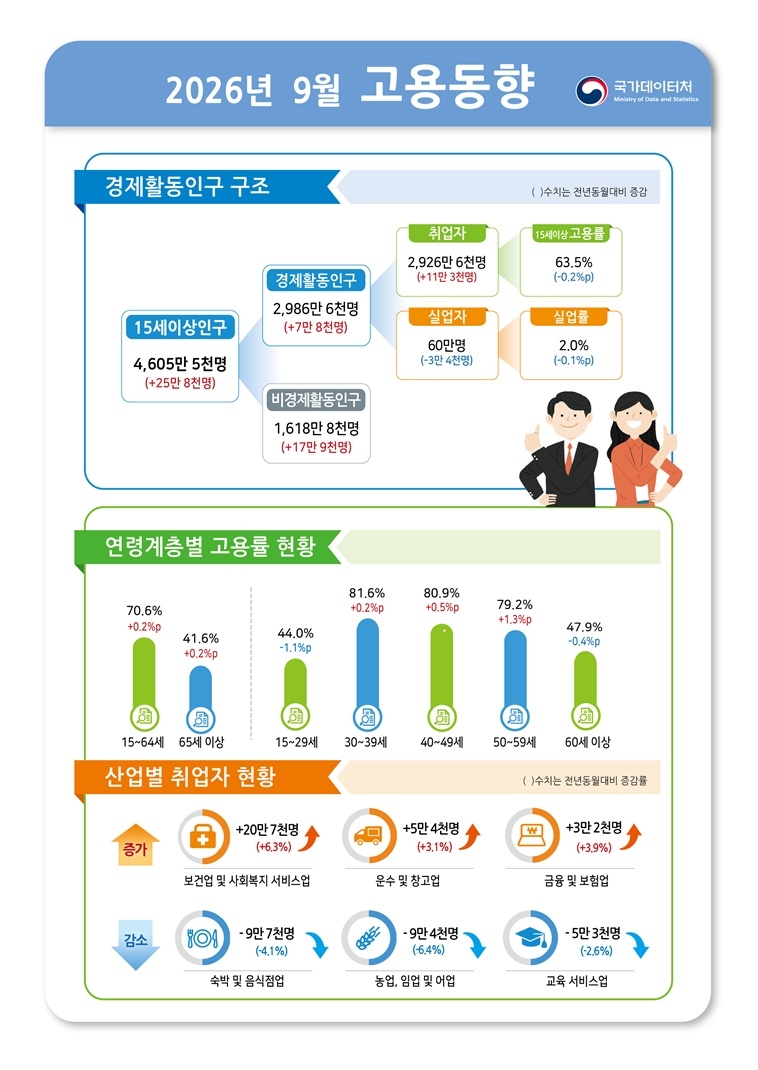
By age group, workers in their early 20s — those just entering the labor market — fared the worst. Employment among those aged 20 to 24 fell by 103,000, with the employment rate dropping 2.7 percentage points to 41.9 percent. The 25-to-29 group also shed 68,000 jobs, pushing its employment rate down 0.1 percentage point to 71.7 percent.
Workers aged 60 and older accounted for 172,000 new jobs, surpassing the total net increase for the entire economy. Those in their 30s and 50s added 81,000 and 48,000 jobs, respectively, while workers in their 20s shed 170,000 and those in their 40s lost 42,000.
By industry, health care and social welfare services led gains with 207,000 new jobs, followed by transportation and warehousing with 54,000 and finance and insurance with 32,000.
Manufacturing employment rose by 16,000 — its first increase since June 2024, when it gained 9,000 — ending a 26-consecutive-month streak of declines. Construction shed 48,000 jobs. Accommodation and food services lost 97,000, agriculture, forestry and fishing fell by 94,000, and education services declined by 53,000.
Total unemployment fell by 34,000 from a year earlier to 600,000, pushing the unemployment rate down 0.1 percentage point to 2.0 percent. Youth unemployment moved in the opposite direction: the rate for those aged 15 to 29 rose 0.6 percentage point to 5.4 percent, while the rate for the expanded 15-to-34 bracket climbed 0.1 percentage point to 4.2 percent.
The economically inactive population rose by 179,000 to about 16.188 million. Among activity categories, those engaged in household duties increased by 99,000 and those in school or taking courses rose by 73,000. The number of people classified as "resting" — neither working nor actively seeking work — fell by 25,000 to about 2.497 million. Among youth, the "resting" population declined by 44,000 in both age brackets, standing at 364,000 for those aged 15 to 29 and 548,000 for those aged 15 to 34.
fact0514@heraldcorp.com




