
Average processing time has grown 2.4 times since 2023's 76 days; courts overturn more than 1 in 5 rulings after review; video testimony system launched this year drew zero users through September
![The Korea Workers' Compensation and Welfare Service headquarters in Jung-gu, Ulsan [Yonhap]](https://wimg.heraldcorp.com/news/cms/2026/10/16/news-p.v1.20250513.22f59d3e897648769f862d8f6855252b_P1.jpg)
The average time to process workers' compensation review cases has stretched to 184 days this year, more than double the 2023 figure, while courts are overturning original rulings in more than one in five cases that proceed to administrative litigation after review.
A video testimony system introduced this year to ease the burden on workers who live far from the review body recorded zero uses through September, drawing criticism that the appeals process needs to be both faster and more accessible.
Data submitted to Democratic Party of Korea lawmaker Park Jeong of the National Assembly's Climate, Energy, Environment and Labor Committee by the Industrial Accident Compensation Insurance Review Committee and the Korea Workers' Compensation and Welfare Service showed that the average processing time for workers' compensation review cases rose from 76 days in 2023 to 108 days in 2024, 138 days in 2025 and 184 days as of July this year — an increase of 108 days, or about 2.4 times the 2023 figure.
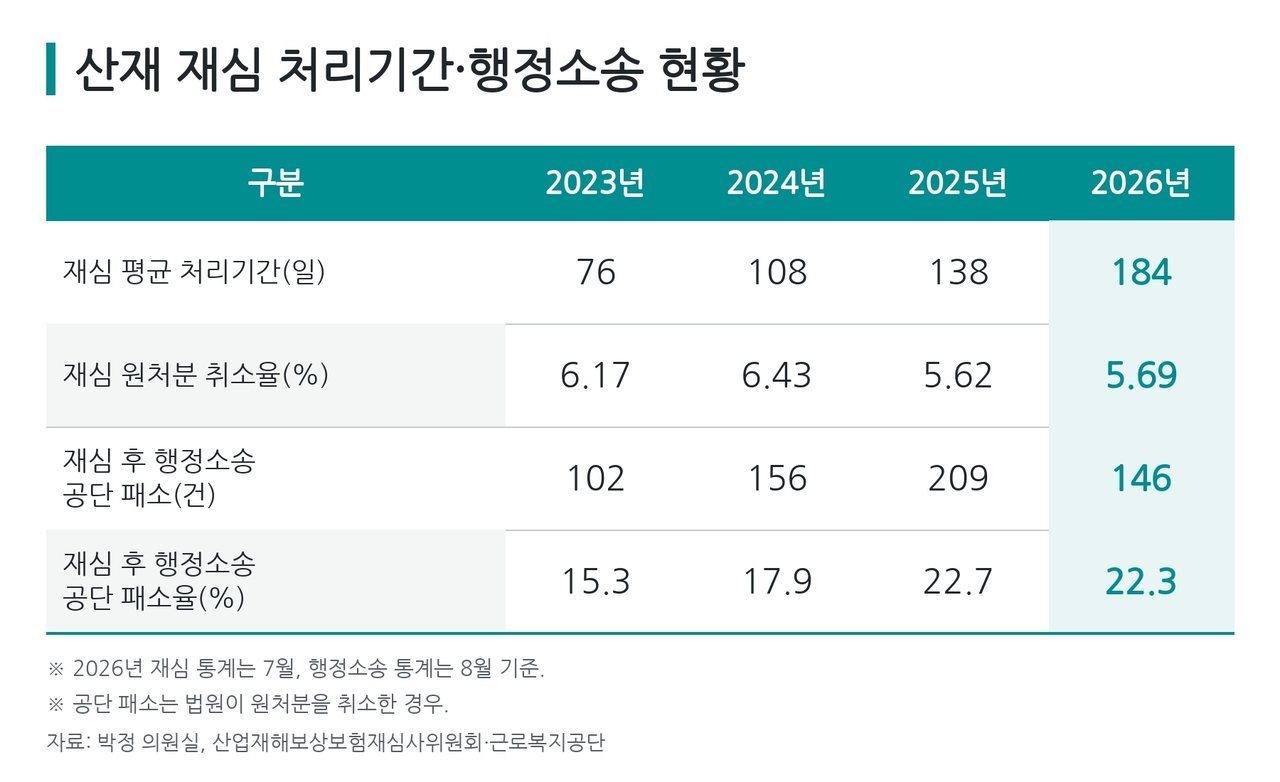
Despite the longer wait times, the rate at which original rulings are overturned at the review stage has remained low, hovering between 5 and 6 percent. The overturn rate was 6.17 percent in 2023, 6.43 percent in 2024, 5.62 percent in 2025 and 5.69 percent as of July this year.
By contrast, the Korea Workers' Compensation and Welfare Service's loss rate in administrative litigation following review committee decisions climbed from 15.3 percent in 2023 to 17.9 percent in 2024 and 22.7 percent in 2025, standing at 22.3 percent as of August this year. Courts overturned original rulings in 102 cases in 2023, 156 in 2024, 209 in 2025 and 146 through August this year, for a combined total of 613 cases.
The overturn rate at the review stage and the litigation loss rate are not directly comparable because they cover different sets of cases. However, the continued pattern of courts reversing decisions even after the review process has prompted calls to examine how effectively the review stage is protecting workers' rights.
Cases in which workers bypassed the review committee and filed administrative lawsuits directly against the service's rulings totaled 4,586 from 2023 through August this year — 1,167 in 2023, 1,297 in 2024, 1,250 in 2025 and 872 through August this year. The service's loss rate in those direct-litigation cases rose from 12.68 percent in 2023 to 23.12 percent in 2025, and stood at 20.07 percent as of August this year.
The video testimony system, introduced to make it easier for workers to participate in reviews, has also seen little use. After recording no users from its launch through September, it was used for the first time on Oct. 2. The system allows claimants to present their case by video without traveling in person to Sejong.
The review committee said most claimants prefer in-person testimony. Yet the committee's official website, YouTube channel and blog contained no promotional materials explaining the system or how to use it, and no budget had been allocated or spent on publicizing it.
In-person testimony sessions ran at 90 to 146 cases per month from January through August this year, while video testimony sessions totaled zero over the same period. Critics say the committee created a system to reduce the travel burden on distant claimants but failed to adequately inform the very people it was meant to help.
Demand for reviews from workers in distant regions was far from negligible. Filings for reviews of initial medical treatment approvals and survivors' benefits from Busan, Ulsan and South Gyeongsang Province came to 787 in 2023, 934 in 2024, 1,177 in 2025 and 1,033 through August this year, for a combined total of 3,931 cases over the period.
"If the review process meant to protect injured workers' rights is delayed for extended periods and hearings are not thorough enough, it will be hard to earn public trust in the system," Park said. "The statutory processing deadline must be met as closely as possible, and sufficient deliberation time must be secured for individual cases so that the review process is both swift and substantive."
Park added that "a system created to ease the burden on claimants from distant regions is, in effect, nonexistent if it goes unused due to a lack of publicity — no matter how well-designed it may be." He called on the service to work with the review committee to assess regional demand for reviews and to strengthen guidance and outreach so that claimants far from Sejong can actually make use of the video testimony option.
fact0514@heraldcorp.com




