
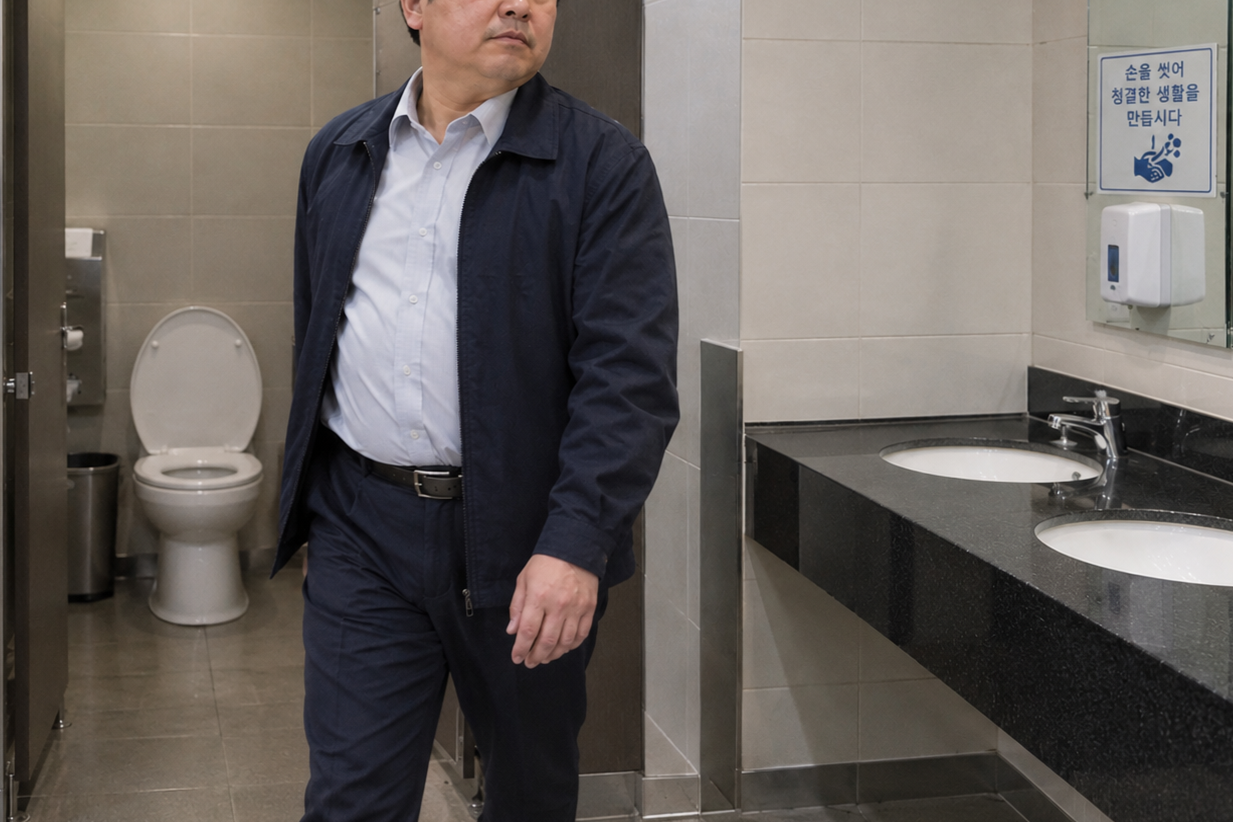
"I don't wash my hands after using the bathroom. My hands are clean."
One in 10 Koreans does not wash their hands after using a public restroom, and among those who do, nine in 10 fail to do so properly, according to new government data. The deeper problem, experts say, is that many people who skip handwashing do not see it as an issue — believing their hands are already clean.
It is a common sight in public restrooms around the city: people finishing at the urinal and walking straight out without stopping at the sink. Even after using a toilet stall, some leave without washing their hands at all.
Only 1 in 10 washes hands with soap for 30 seconds
![[Getty Images Bank]](https://wimg.heraldcorp.com/news/cms/2026/10/15/news-p.v1.20261015.15f929aa6f5745ff8a7a0eee0528ef92_P1.jpg)
The Korea Disease Control and Prevention Agency released the results of its "First-Half 2026 Survey on Infectious Disease Prevention Behavior" on Thursday.
The survey was conducted jointly with the National Medical Center over roughly one month beginning May 28, covering 120 public restrooms at multi-use facilities nationwide. It included observational data from 4,560 adults aged 19 and older and exit interviews with 1,800 people.
The survey found that 86.0 percent of people washed their hands after using the restroom, up 1.9 percentage points from 84.1 percent the previous year. The rate was 83.5 percent among men and 88.5 percent among women.
However, only 46.7 percent used soap, while 39.3 percent rinsed with water only. Some 14.0 percent did not wash their hands at all.
Particularly striking was the rate of "proper handwashing" — defined as scrubbing with soap under running water for at least 30 seconds — which stood at just 11.4 percent. While that was up 1.1 percentage points from 10.3 percent the previous year, the figure has hovered around 10 percent for the past three years with little meaningful improvement.
Observed handwashing lasted an average of 13.9 seconds — less than half the recommended 30 seconds. The time spent actually lathering and scrubbing with soap averaged just 5.8 seconds.
Despite this, many respondents believed they were doing fine. More than half — 51.2 percent — said they practiced proper handwashing, a stark contrast to the observed rate of 11.4 percent.
Invisible germs spread through the air — and can cause serious complications
![[Getty Images Bank]](https://wimg.heraldcorp.com/news/cms/2026/10/15/news-p.v1.20261015.dd3e828a50d249e5acc6f5326052021a_P1.jpg)
The danger of skipping handwashing lies in contamination that cannot be seen. Fecal matter can harbor pathogens capable of causing intestinal illness, including E. coli, Salmonella and norovirus.
The US Centers for Disease Control and Prevention notes that human and animal feces are a primary source of pathogens, and that unwashed, contaminated hands can transfer microorganisms to other people and surfaces. According to CDC data, a single gram of human feces can contain up to 1 trillion microorganisms.
Flushing a toilet can also send droplets and fine aerosols into the air. A 2022 study published in the journal Scientific Reports found that aerosols generated by flushing a commercial toilet reached a height of about 1.5 meters within eight seconds.
When hands contaminated by touching such surfaces then come into contact with the mouth, nose or eyes — or with food and utensils — pathogens can enter the body. High-touch surfaces such as restroom door handles, faucets and mobile phones are particularly effective conduits for hand-to-surface transmission.
The infection risk from toilet aerosols varies depending on toilet design, ventilation and the degree of contamination, and the mere presence of dispersed particles does not confirm that infection has occurred. Still, transmission through contact with hands and surfaces warrants serious caution.
Even E. coli, one of the most common pathogens, varies widely in its health effects depending on the strain. Some pathogenic strains can cause abdominal pain, diarrhea, vomiting and fever. Infection with Shiga toxin-producing E. coli can trigger hemolytic uremic syndrome in some patients — a serious complication involving the destruction of red blood cells and kidney damage that can lead to renal failure, long-term health problems and, in rare cases, death.
After using the restroom, people should apply soap under running water and scrub thoroughly — covering the palms, backs of the hands, between the fingers, the thumbs and under the fingernails. The KDCA recommends scrubbing with soap for at least 30 seconds as the standard for proper handwashing, noting that soap is more effective than water alone at removing contaminants and microorganisms.
123@heraldcorp.com




