
Survey of 462 young workers in greater Seoul finds median monthly income of 1.65 million won; Ministry of Employment and Labor pushes for basic labor law by year's end
![A freelancer performs data-labeling work. [The Herald Business DB]](https://wimg.heraldcorp.com/news/cms/2026/10/15/news-p.v1.20260414.a715a4b1a14d459c925b466f1cefe82f_P1.png)
Young platform workers and freelancers who rely on gig work as their primary job earned a median monthly income of just 1.65 million won ($1,230), a new survey shows. More than half of those working freelance as their main occupation brought in less than 2 million won a month, and one in three earned less per hour than the minimum wage. More than half worked without a written contract.
Faced with precarious incomes and a thin social safety net, the Ministry of Employment and Labor said it would push to enact a basic labor protection law for all workers before the end of the year and establish a body tentatively called the "K-Labor Welfare Council."
The findings were presented Thursday by Kim Jong-jin, director of the Working Citizens Research Institute, at a youth freelancer open-mic forum hosted by the Seoul Regional Employment and Labor Office. The data come from an analysis of 462 young workers aged 19 to 34 in the greater Seoul area, drawn from a broader survey of 1,500 platform workers and freelancers conducted by Macromill Embrain from Sept. 9 to Sept. 20. Women made up 78.6 percent of respondents.
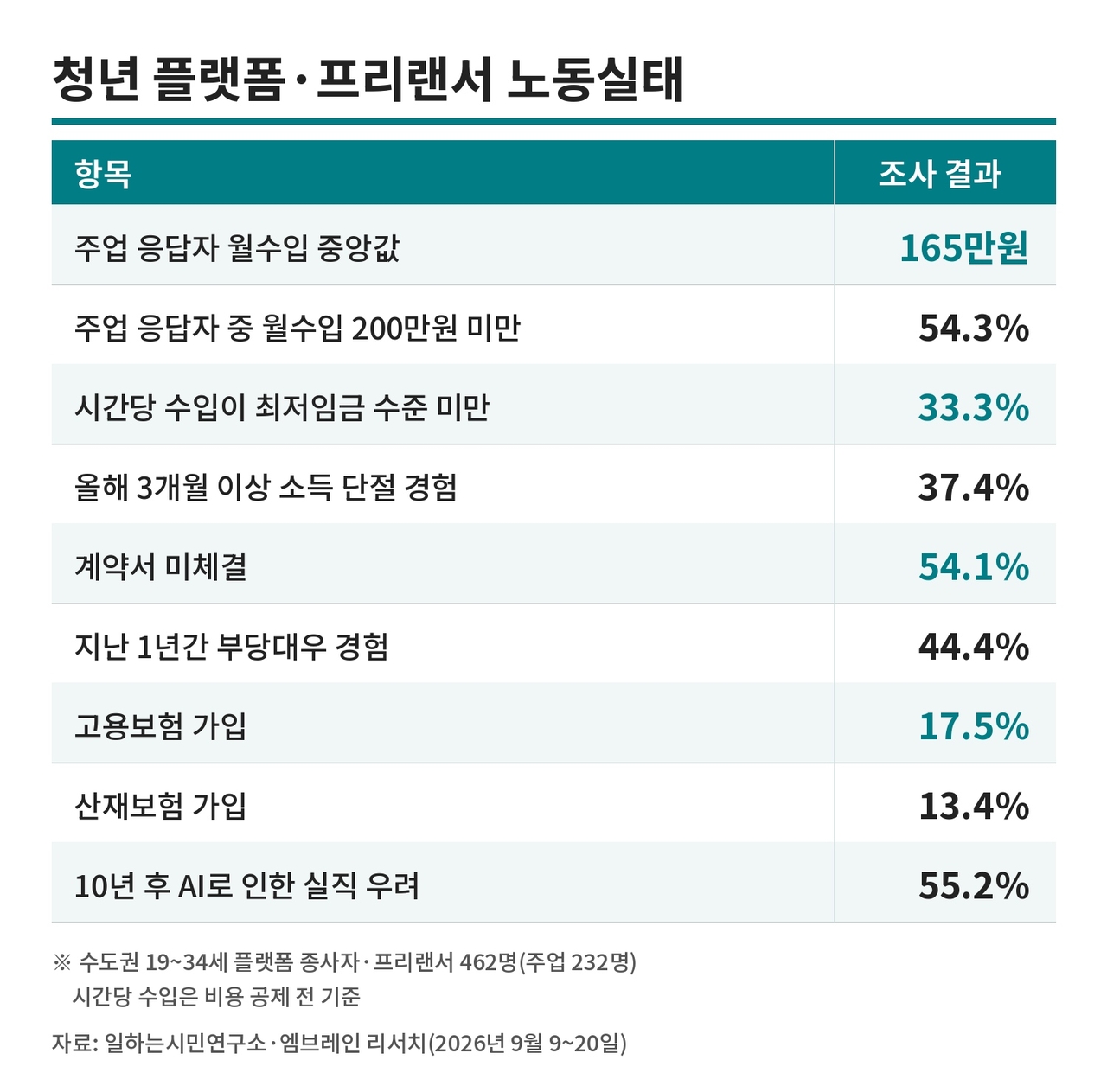
Among the 232 respondents who freelanced as their primary job, the median monthly income was 1.65 million won. Some 54.3 percent earned less than 2 million won a month. For the 230 respondents who freelanced as a side job, the median was 300,000 won, while the median across all young respondents was 800,000 won. More than a third — 37.4 percent — said their income had been cut off for three or more months this year. One in three, or 33.3 percent, earned less per hour than the minimum wage, and because that figure is calculated before deducting work-related expenses, actual take-home pay could be even lower.
Among primary-job respondents, 37.5 percent said they had taken up freelance work "to earn their main livelihood," while 26.3 percent cited the freedom to work on their own schedule. Across all young respondents, 35.8 percent had moved into freelance work from regular or non-regular salaried employment.
Yet protections for their earnings were scarce. Some 54.1 percent worked without a written contract, and 44.4 percent said they had experienced unfair treatment related to assignments, contracts or pay in the past year. A 32-year-old video editor who attended the forum said an event cancellation had left her unpaid for work she had already completed, having taken on the job without a contract.
Conditions did not improve with experience. The rate of unfair treatment was 40.2 percent among those with less than one year of experience, rising to 53.3 percent among those with three or more years. The share who had experienced non-payment, delayed payment or pay cuts also climbed — from 18.8 percent among newer workers to 35.5 percent among veterans. Among those with three or more years of experience, 31.4 percent had been paid late and 27.8 percent had been asked to perform work not specified in their contract. Even among respondents who had signed contracts, the rate of unfair treatment was 50.9 percent — higher than the 38.8 percent recorded among those without contracts.
The safety net for workers who lose income or are injured on the job was equally thin. Employment insurance enrollment stood at just 17.5 percent, and industrial accident insurance coverage was limited to 13.4 percent. Among respondents aged 19 to 24, 43.9 percent said they did not even know whether they were enrolled in employment insurance. Some 42.9 percent of all young respondents said they had worked night shifts.
The instability also showed up in mental health indicators. Some 30.3 percent of respondents scored in the range suggesting possible depression. That figure was 13.1 percent among those who faced none of the four key precarity factors — income disruption, unfair treatment, frequent night work and below-minimum-wage earnings — but jumped to 57.6 percent among those who faced three or more.
The spread of AI added to job insecurity. Among the 397 young respondents who use AI tools, 39.8 percent said AI was reducing their workload. Across all young respondents, 55.2 percent said they feared losing their jobs to AI within 10 years. Yet 48.1 percent said their clients had provided no training or education support.
Some 76.6 percent of young respondents said a basic labor protection law was needed, and 85.4 percent of those who had experienced unfair treatment called for a dispute-resolution system.
The Ministry of Employment and Labor said it would pursue enactment of a basic labor law before year's end that would protect the right to fair contracts, adequate pay and safe working conditions regardless of employment type. The ministry also plans to introduce income-based employment insurance, expand coverage under the Occupational Safety and Health Act, and establish the K-Labor Welfare Council to support the livelihoods and rights of independent workers.
"Even freelancers who enjoy relatively flexible working arrangements should not have to shoulder the difficulties they face on the job alone," Employment and Labor Minister Kim Young-hoon said. "By enacting the basic labor law before the end of the year, we will ensure that everyone who works can do so in conditions that meet basic standards."
fact0514@heraldcorp.com




