
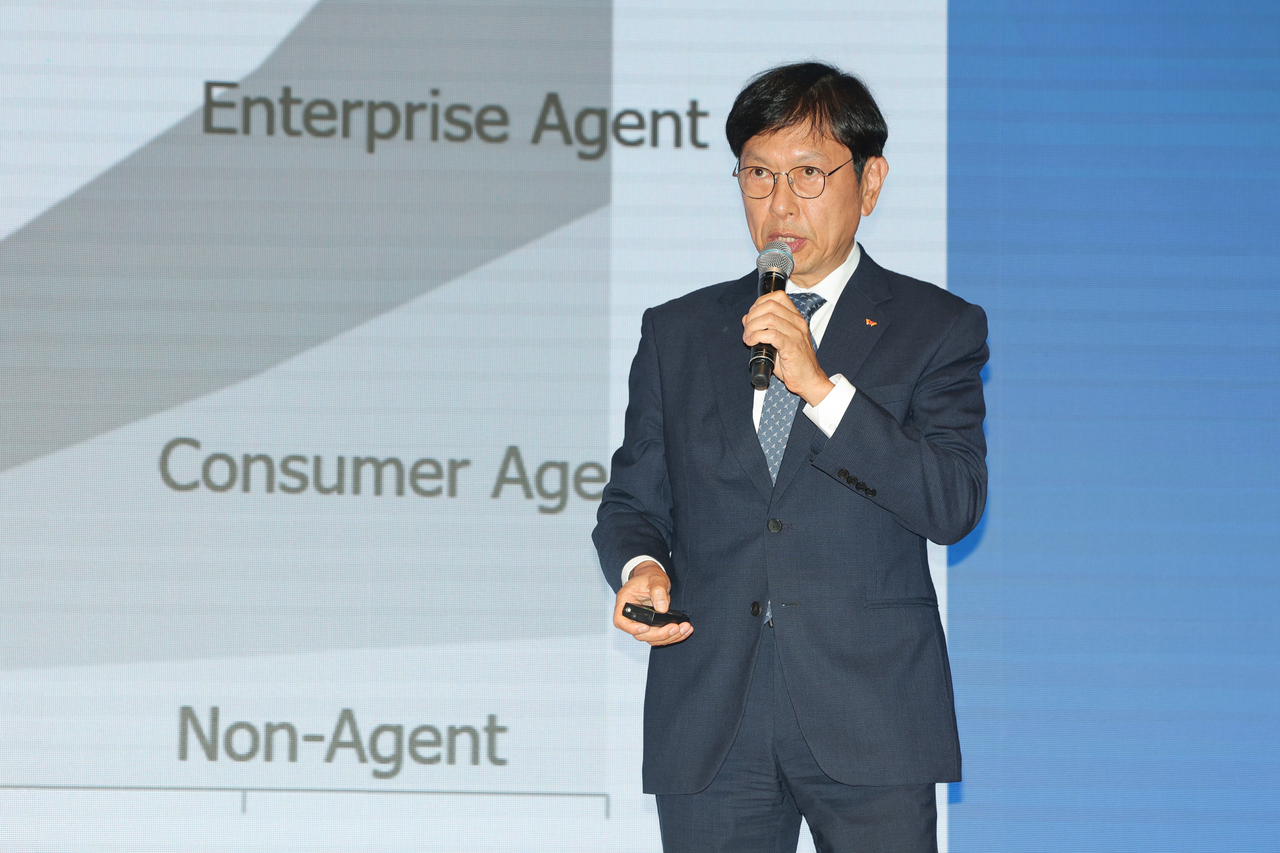
SK hynix President Ahn Hyun, who oversees the company's development operations, said Wednesday that the scale of AI infrastructure performance will grow roughly 20 times by 2030 compared with this year — a bold projection that drew attention at a major industry gathering.
Ahn made the remarks during a keynote address at the 28th Semiconductor Exhibition (SEDEX 2026), held at COEX in Gangnam-gu, Seoul, where he outlined the rapid expansion of the AI inference market.
He said the AI inference market is growing simultaneously across three dimensions: the complexity of tasks, the volume of information that can be processed at once — known as context length — and the volume of inference requests. These factors are feeding into one another, he said, driving a swift rise in demand for AI infrastructure.
As AI inference demand grows, the importance of memory chips capable of storing and moving large volumes of data is also coming into sharper focus. The capacity of so-called KV cache — which stores and reuses information previously processed by AI — is expanding, requiring data to be distributed across different types of memory, including HBM, DRAM and solid-state drives. Analysts note that the data movement occurring throughout this process is emerging as a new bottleneck for both performance and power consumption.
Ahn said the industry needs to move beyond improving the performance of individual memory chips and instead adopt an approach that optimizes the entire memory hierarchy.
To that end, SK hynix is working to enhance its existing HBM technology while also developing next-generation memory chip solutions, including 3D-stacked DRAM and high-bandwidth flash, or HBF.
The company aims to achieve HBF bandwidth at roughly half the level of same-generation HBM while increasing capacity by about 10 times. As part of that effort, SK hynix plans to pursue HBF standardization and collaboration with global partners, and will continue developing next-generation memory chip technologies such as Compute Express Link, or CXL.
Meritz Securities raises SK hynix target price to 3.2 million won
As SK hynix broadens its push across multiple fronts, Meritz Securities on Monday raised its forecast for the company's third-quarter operating profit to 80 trillion won ($59.7 billion), up 32 percent quarter-on-quarter. The brokerage also lifted its target price on SK hynix shares from 3.1 million won to 3.2 million won and maintained a buy recommendation.
Meritz Securities analyst Kim Seon-woo said in a report that DRAM and NAND shipment volumes and selling prices were expected to rise 13 percent and 22 percent, and 4 percent and 15 percent, respectively, in the third quarter, putting operating profit from each segment at 63 trillion won and 17 trillion won.
The forecast exceeded the market consensus range of 70 trillion won to 74 trillion won, which had been tempered in part by the recent strengthening of the won.
Kim also projected that the pace of earnings improvement would accelerate from the fourth quarter onward, lifting estimates and improving investor demand dynamics.
"Although the high share of HBM sales in our product mix has capped selling price growth, the start of HBM4 supply will mark the beginning of a full-scale profit contribution," Kim said. He added that existing contracts with key mobile customers are being revisited as part of broader industry-wide long-term supply agreement discussions, and that the terms are beginning to shift significantly in favor of suppliers.
yul@heraldcorp.com




