Seoul Assembly member Kim Ki-deok has led community heritage tours for 20 years
Group visits Cheongpung Cultural Heritage Complex, Cheongnyeongpo and Jangneung
Stops at traditional markets add regional exchange and mutual-growth dimension
Organization's 4,800-strong membership continues to expand cultural access for residents
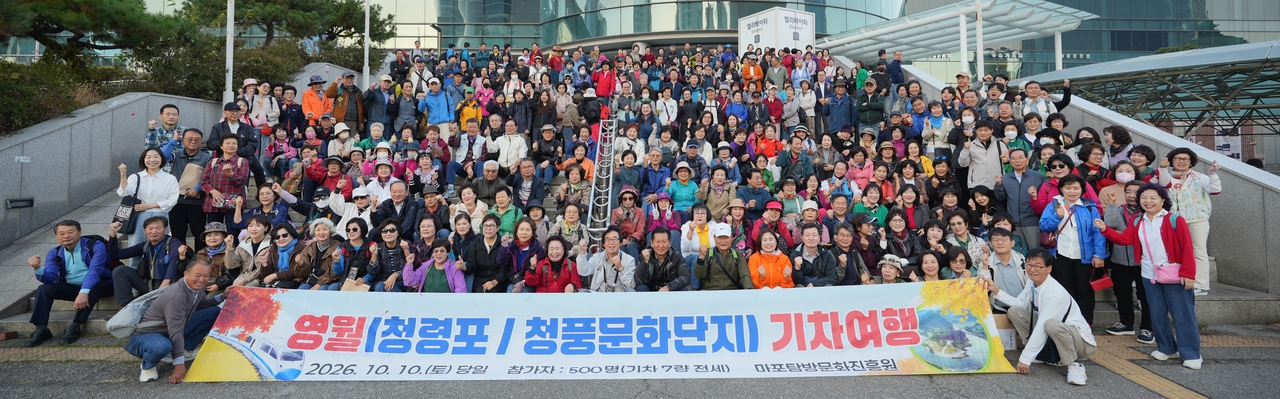
A special autumn journey into history unfolded by rail on Saturday, as 500 people — mostly residents of Seoul's Mapo-gu — traveled to Yeongwol in Gangwon Province and Jecheon in North Chungcheong Province to explore the regions' cultural heritage, retrace their historical footprints and soak in the atmosphere of traditional markets.
The Mapo Cultural Heritage Tour Promotion Institute, a nonprofit civic organization, announced that it held its 16th autumn historical and cultural tour on Saturday with 500 members in attendance.
The tour used seven carriages of a Saemaul-ho theme tourist train, departing from Seoul Station and stopping at major cultural heritage sites and traditional markets in Jecheon and Yeongwol. The itinerary wove together the romance of rail travel with history education and regional cultural experiences, offering residents an enriching way to engage with Korean heritage.
Assembly member Kim Ki-deok of the Democratic Party of Korea, who represents Mapo District 4 and has led community heritage tours for 20 years, joined all 500 participants for the entire day in his role as the institute's director.
A send-off ceremony held that morning at Seoul Station Plaza was attended by National Assembly member Jung Chung-rae, Mapo-gu District Mayor Yoo Dong-gyun and Mapo District Council Speaker Choi Eun-ha, who offered words of encouragement to the departing group.
Following in King Danjong's footsteps — living history at heritage sites
The group's first stop was the Cheongpung Cultural Heritage Complex in Jecheon, where participants explored historic structures and local cultural artifacts, gaining a window into the daily lives of their ancestors and the value of traditional culture.
The group then moved on to Yeongwol, where they had lunch at Seobu Market and spent free time browsing local specialties and shops, taking in the lively atmosphere of a traditional market.
The afternoon centered on Cheongnyeongpo and Jangneung, two sites steeped in the tragic history of Danjong, the sixth king of the Joseon Dynasty. To ensure smooth visits, the group split into two teams that alternated between the two sites.
Cheongnyeongpo is where the young king was sent into exile after being forced from the throne. Surrounded on three sides by a river and shaded by dense pine forests, the site evokes the solitude of Danjong's years in banishment.
Jangneung, Danjong's royal tomb and part of the UNESCO World Heritage-listed Joseon Royal Tombs, offers visitors a chance to reflect on the history of the Joseon royal court and the political upheaval of that era.
Walking the very ground where history unfolded, participants reflected on Danjong's life, the history of the Joseon period and the importance of preserving cultural heritage — bringing textbook knowledge to life.
Beyond sightseeing, the tour served as a community-centered cultural program that used historical sites as a setting for intergenerational exchange and open dialogue among local residents.
Heritage tour meets local economy — traditional market visits broaden community ties
Another notable aspect of the itinerary was its deliberate pairing of heritage visits with stops at local commercial districts.
After lunch and free time at Yeongwol's Seobu Market, the group visited the area around Jecheon's Yeokjeon Market before heading back to Seoul.
With hundreds of visitors sampling local food, regional specialties and everyday culture firsthand, the tour gave a boost to local businesses while fostering exchanges between residents from different regions.
By linking cultural heritage visits and traditional market stops into a single rail-based itinerary, the program pursued both the pleasures of travel and the goal of supporting regional economies.
After wrapping up in Yeongwol, the group returned to Jecheon, toured the Yeokjeon Market area and held a closing ceremony at Jecheon Station Plaza. Jecheon Mayor Lee Sang-cheon attended to welcome the group.
Participants boarded a Saemaul-ho train bound for Seoul at Jecheon Station at around 6 p.m. and arrived at Seoul Station at around 8:30 p.m., bringing the day's journey to a close.
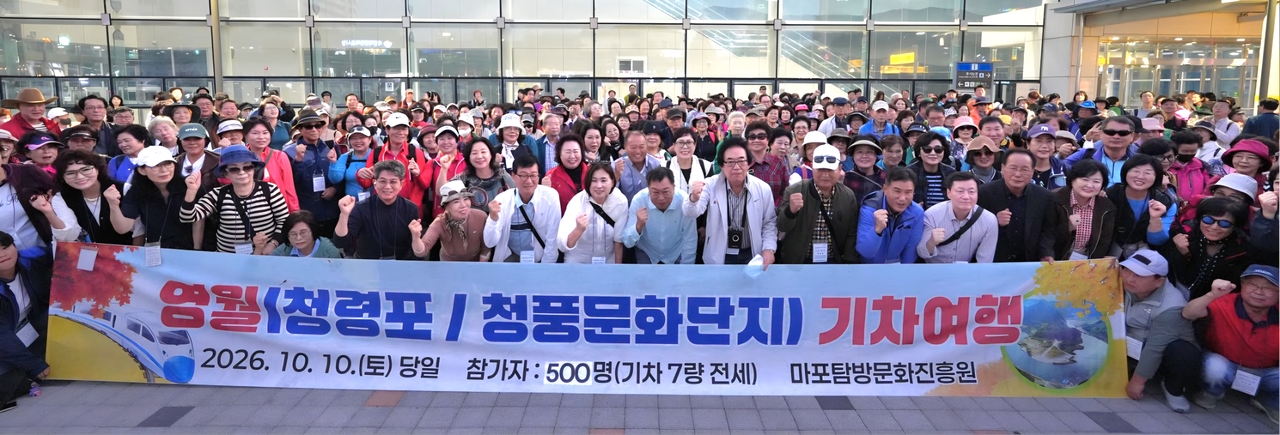
Twenty years of community-led heritage tours — a 4,800-member network built on shared experience
The event also drew attention as the latest chapter in the institute's long-running tradition of resident-driven cultural programming.
Registered with the Seoul Metropolitan Government as a nonprofit civic organization, the institute currently has about 4,800 active members.
Through a range of programs — including domestic and overseas heritage tours and themed train journeys — it has consistently created opportunities for residents to step outside their daily routines, discover new cultures and connect with their neighbors.
For 20 years, Assembly member Kim has led tours to historical and cultural sites across the country, working to channel shared cultural experiences into community cohesion and dialogue.
Large-group train journeys in particular have become a natural setting for residents who might otherwise rarely interact to mingle and build common memories.
The Yeongwol-Jecheon tour was designed not only to reaffirm the value of cultural heritage but also to deepen bonds among local residents and strengthen ties with the communities they visited.
The institute's heritage tours have grown into a fixture of everyday cultural life — a space where residents learn and connect together. Two decades of steady effort have helped broaden access to cultural welfare and put the principle of regional mutual growth into practice.
7toy7@heraldcorp.com