Survival strategies for reducing loan interest in a high-rate environment
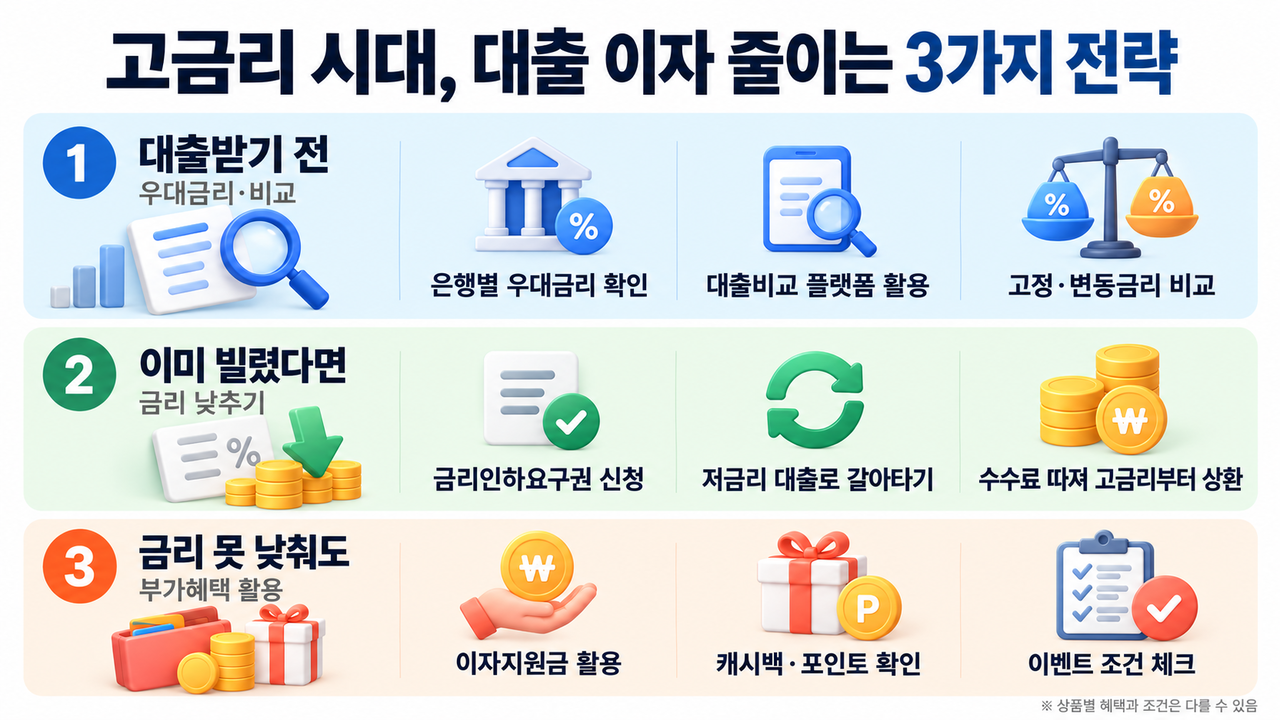
Check preferential rates before borrowing; use digital channels to maximize discounts
Fixed-rate loans offer debt service ratio advantages; use loan-comparison platforms
Rate-cut request service can automate interest savings
When rate cuts aren't possible, tap interest subsidies and cashback offers

A 27-year-old identified only as A once carried nearly 100 million won ($74,700) in loans but recently managed to cut his interest rate by 1.5 percentage points. His approach was methodical: he drew up a repayment schedule listing each loan's balance and interest rate, paid down the highest-rate debt first, and made extra payments whenever he had spare cash. He then filed a formal rate-cut request with his lender — and it worked.
In a high-interest-rate environment, borrowers who want to shave even a little off their loan costs need to scrutinize preferential rate conditions from the moment they take out a loan. For those who have already borrowed, exercising the right to request a rate reduction — or refinancing into a lower-rate product — can ease the burden. When a rate cut is out of reach, interest subsidies and cashback rewards offered through fintech platforms are worth pursuing.
Financial education, online applications: unconventional ways to unlock lower rates before you borrow
The first step to cutting loan interest is checking preferential rate conditions. Some products offer discounts for reasons beyond the usual salary transfers or credit card spending. KB Kookmin Bank's "KB New Hope Holssi II" product cuts the rate by 0.1 percentage point for customers who complete a financial education course, and by 0.5 percentage point for those who take part in a tailored low-income financial counseling session. Shinhan Bank's "Shinhan MY CAR New Car Loan" offers a 0.5-percentage-point reduction to borrowers who submit a local government certificate confirming their vehicle is a Grade 5 emissions-rated older polluting car registered in Seoul.
Preferential rates can also vary by application method or loan amount. NH NongHyup Bank's "New Hope Holssi Loan" gives a 0.3-percentage-point discount for in-branch applications and 0.5 percentage point for online applications. The "Didimtol Home Purchase Loan" offered by Hana Bank and others cuts the rate by 0.1 percentage point if the borrower takes out no more than 30 percent of the assessed loan limit. Policy-based loans such as the New Hope Holssi and Didimtol products, however, carry separate eligibility requirements based on income and other criteria.
Borrowers should also revisit preferential rate conditions when renewing a loan. Woori Bank's "Woori Youth Leap Loan" applies a 0.3-percentage-point preferential rate at renewal for customers supporting a parent aged 60 or older. A fixed rate applies for the first year, making the discount unavailable during that period, and since the rate is recalculated at renewal, borrowers should compare the new rate against their existing one.
Those planning to take out a mortgage should also weigh the difference between fixed and variable rates. Even if a variable rate looks lower upfront, fixed-rate and periodic-adjustment loans carry an advantage in the stress debt service ratio calculation, which can result in a higher borrowing limit. Paying down existing unsecured credit loans first to lower the debt service ratio is another option.
For borrowers who find it tedious to compare rates across banks one by one, loan-comparison platforms such as Toss, Kakao Pay, Naver Pay and Banksalad allow simultaneous comparisons of rates and limits across multiple lenders. Because each platform partners with a different set of financial institutions, checking two or three platforms together yields the best results.
Already borrowed? It's not too late to refinance and cut your rate
Even after taking out a loan, borrowers can exercise the right to request a rate reduction at any time and as many times as they like, as long as their income has risen or their credit score has improved. Applications can be submitted through a bank's website or mobile app, after which the lender reviews whether the borrower's credit standing has improved and decides whether to lower the rate. In one case provided by Banksalad, a male customer in his 30s exercised the rate-cut right on a 130 million won bank credit loan, securing a 7.21-percentage-point reduction and saving roughly 9.37 million won ($7,000) in annual interest.
A modest improvement in credit standing does not, however, guarantee a significant rate cut. A 29-year-old identified as Nam borrowed 5 million won from a bank at an annual rate of 15 percent to cover living expenses while preparing for the certified public accountant exam. After passing, he filed a rate-cut request — but his rate dropped only 0.3 percentage point, to 14.7 percent.
An official at a major commercial bank said the limited reduction likely reflected the fact that Nam had not yet formally joined an accounting firm, so the income increase had not been captured. "The rate-cut right works differently depending not just on obtaining a new qualification or getting a promotion, but on the actual degree of improvement in income and creditworthiness," the official said. "It is most effective to apply when your credit standing has clearly improved — when your income has risen or your credit score has gone up."
For borrowers worried about missing the right moment to apply, an "automatic rate-cut request service" that took effect Feb. 26 this year offers a convenient alternative. By giving one-time consent to a participating MyData operator — Toss, Naver Pay, Kakao Pay or Banksalad — borrowers authorize the platform to monitor their credit standing and file rate-cut requests with lenders on their behalf. Automatic filing does not, however, guarantee that a rate reduction will be granted.
Refinancing into a lower-rate loan is another option. In a case provided by Banksalad, a female customer in her 20s switched from a card loan at an annual rate of 17.9 percent to a bank credit loan at 3.9 percent, saving 1.15 million won in annual interest. Loan refinancing through comparison platforms such as Toss, Naver Pay and Banksalad involves looking up an existing loan in the app, selecting a lower-rate product and submitting an application. If the application is approved, repayment of the original loan is handled automatically. Eligibility varies, however, depending on the type of loan and the borrower's credit profile.
Borrowers carrying multiple loans are generally better off paying down the highest-rate debt first. For example, if someone holds one loan at 15 percent annually and another at 5 percent, repaying 10 million won on the higher-rate loan first saves an additional 1 million won in annual interest. Any early repayment fees should be factored in when calculating the actual savings.
Meanwhile, Naver Pay is offering 50,000 won in Naver Pay points to customers who take out a loan marked with a "50,000-won reward" tag through its credit loan comparison service, through Dec. 31 this year. The points are credited automatically by the afternoon of the next business day after the loan is confirmed, with no separate application required. The offer applies only to new loan customers and is not available to those refinancing an existing loan.
Banksalad runs a service called "Monthly Interest Subsidy," which randomly selects customers who have linked an existing loan to the app and made monthly interest payments, then reimburses a portion of their interest. Recipients can get back up to 100 percent of their monthly interest payment, with a support cap of 2 million won per loan. Card loans, cash advance services and revolving credit lines are excluded.
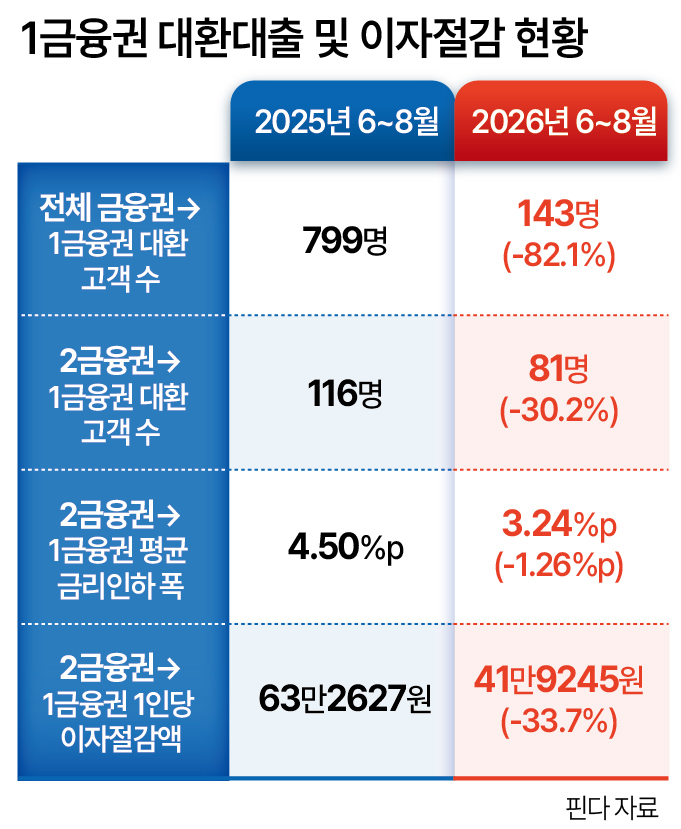
Even as loan rates approach 8 percent and the interest burden on borrowers grows, the path to refinancing into a lower rate is narrowing. The number of customers who refinanced into a first-tier bank fell more than 80 percent in a year, and even those who successfully switched found the interest savings shrinking as the rate gap between lenders closed. With long-term US Treasury yields surging to their highest levels in roughly two decades and adding upward pressure on domestic market rates, observers say refinancing conditions may remain difficult for now. According to loan-comparison platform Finda, 143 customers refinanced into a first-tier bank through Finda between June and August, down 82.1 percent from 799 during the same period last year.

snsd@heraldcorp.com
hyuk@heraldcorp.com