Why the current account matters in a volatile market
Annual $450 billion surplus target within reach
Stocks and won both falling — experts dismiss crisis talk
Prolonged high rates add to investment uncertainty
AI-focused stocks, bonds and regular saving plans draw attention
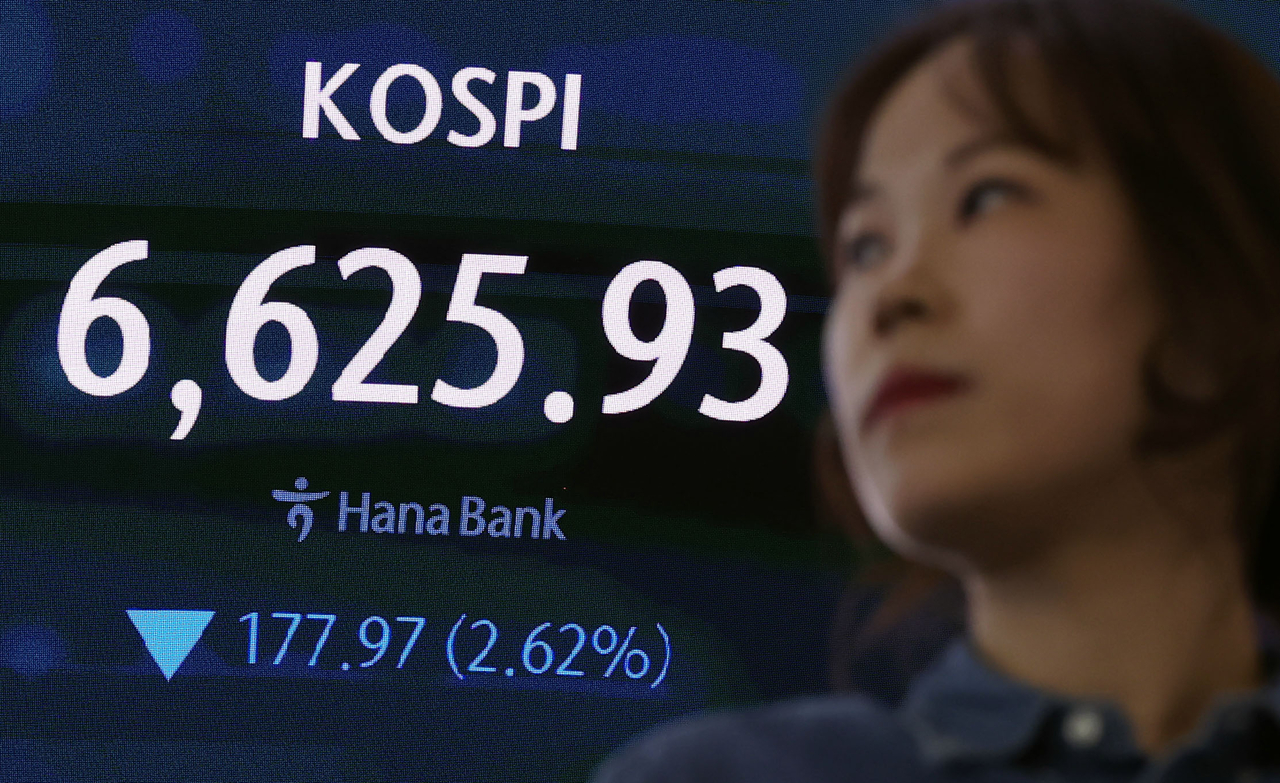
Investors are growing increasingly anxious as South Korea's stock market continues to struggle after a sharp recent selloff, with expectations of a prolonged global high-interest-rate environment adding to the difficulty of navigating markets.
Experts advise against judging whether a crisis is at hand by share prices alone, saying investors should also watch external economic indicators such as the exchange rate and the current-account balance.
Current-account surplus defies crisis talk, topping $40 billion for third straight month
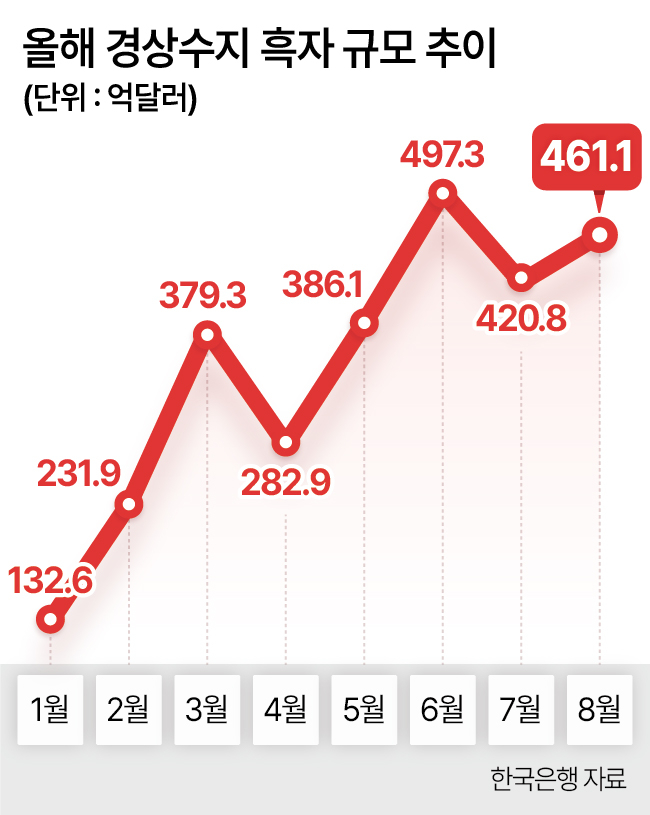
South Korea's current-account surplus reached $46.11 billion in August, the Bank of Korea said Saturday, making it the second-largest monthly surplus on record after June's $49.73 billion. The surplus has exceeded $40 billion for three consecutive months.
The current account measures the net difference in all routine economic transactions between a country and the rest of the world — goods, services and income. A surplus means the country is earning more from abroad than it is paying out.
This year's surplus has expanded sharply on the back of a surge in global semiconductor demand. The cumulative surplus for January through August reached $279.2 billion, more than double last year's full-year total of $123.1 billion. The annual current-account surplus first crossed $100 billion in 2015, then retreated, before rising for three consecutive years from 2023's $32.5 billion and setting a record last year.
Semiconductor exports jumped again in August as AI infrastructure demand held firm, driven by expanded capital spending from global hyperscalers such as Google and Amazon. According to the Ministry of Trade, Industry and Energy, semiconductors accounted for $46.65 billion — 47 percent — of total August exports of $98.25 billion. Chip exports have exceeded $40 billion for three straight months.
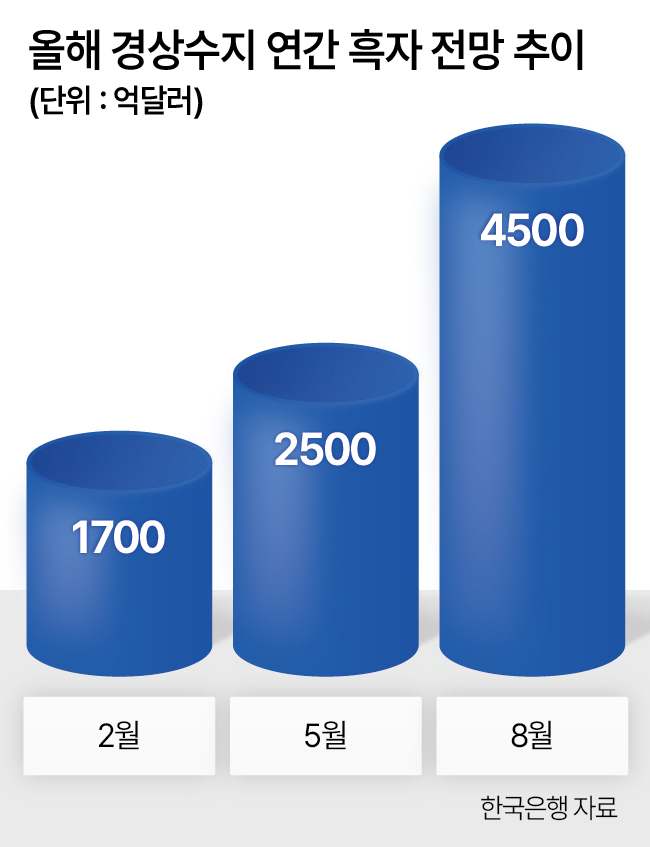
At the current pace, an annual surplus of $450 billion appears well within reach. The Bank of Korea raised its full-year surplus forecast to $450 billion in its revised August economic outlook, up $200 billion from its earlier projection of $250 billion. Yu Seong-uk, head of the bank's financial statistics department, said at a balance-of-payments briefing Thursday that the second-half target of $259 billion was broadly on track through August. "In September, the trade balance is running ahead of expectations, and export concentration tends to increase toward year-end, so we should be able to hit the forecast," he said.
The record surplus streak stands in sharp contrast to a sluggish stock market. The Kospi climbed to the 9,000 level in June before plunging to 5,593.6 on July 30. It has since recovered somewhat but remains locked in a tug-of-war around the 7,000 mark. The wild swings have prompted some to raise the specter of an AI bubble.
But experts say the scale of the recent current-account surpluses shows the South Korean economy is far from a crisis. The exchange rate tells the story most clearly. Even as the Kospi fell sharply and then drifted sideways, the won has been on a sustained strengthening trend against the dollar. According to the Bank of Korea, the monthly average won-dollar rate — based on weekly closing prices — fell steadily from 1,528 won in June to 1,488.9 won in July, 1,404.4 won in August and 1,358.8 won in September. This is the opposite of what typically happens in a genuine economic crisis, when a plunging stock market drives up demand for the safe-haven dollar and the won weakens. The stock decline, experts argue, cannot therefore be read as a crisis signal. If share prices have fallen without an underlying crisis, the most likely explanation is a reversal of sector-specific optimism — and in that case, recovery tends to come faster than it would from a fundamental economic breakdown.
Oh Geon-young, head of the Pathfinder unit at Shinhan Bank, said at the Herald Money Festa 2026 on Thursday that a falling stock market accompanied by a rising dollar reflects correlation, not causation. "When a crisis hits, stocks plunge and the dollar rises — but a falling stock market does not necessarily mean the dollar will rise," he said.
Oh added that a current-account surplus of $100 billion a year used to be considered an "A+" result, yet the cumulative surplus through July alone had already reached $230 billion this year. "That tells you semiconductor prices are rising far faster than oil prices," he said. In fact, when semiconductor export volumes rose 10 percent in August, chip prices roughly doubled.
Prolonged high rates cloud outlook, but experts say AI investment still holds
Expectations that major economies will keep interest rates elevated for longer are also unnerving investors, though experts say AI-related investment will remain viable. The US Federal Reserve raised its benchmark interest rate target range by 25 basis points last month — its first increase in three years and two months — while the Bank of Japan also lifted rates by 25 basis points to their highest level in 31 years. The Bank of Korea raised its benchmark rate in back-to-back moves in July and August. On Thursday, yields on 10-year and 30-year US Treasury bonds climbed to 5.36 percent and 5.73 percent, respectively, their highest levels since 2002.
High interest rates tend to increase investment uncertainty. As returns on safe assets rise, the incentive to take on risk diminishes and the appeal of equities fades. Oh said markets will grow tense "the moment investors become convinced that the rate-hiking cycle will last for quite some time," adding that investing in a rising-rate environment carries more uncertainty than doing so when rates are falling.

Even so, experts continued to back semiconductor-centered investment. Oh said "if the AI revolution collapses, the debt problems of countries around the world will go unsolved as well — state-level support for AI will keep coming," adding that "if you take a long view, your portfolio should be positioned toward AI."
Choi Chang-gyu, head of the ETF consulting division at Mirae Asset Global Investments, said hyperscalers' capital expenditure is forecast to reach $1.2 trillion next year, which should keep the market on solid footing. "You need to look not just at semiconductors but at every sector where AI is embedded," he said. He added that while high interest rates are a headwind, they will not derail the AI industry, and he expected the investment cycle to remain intact for some time.
Experts also cautioned against betting solely on AI and chips, urging investors to diversify their portfolios across individual stocks and bonds.
Lee Jae-man, head of global investment analysis at Hana Securities, said stock selection matters as much as sector choice in a 5 percent interest rate environment. Hana Securities forecast that Kospi net profit growth would slow from 271.5 percent this year to 30.6 percent next year. Lee said that in the early stages of a growth slowdown, operating margin improvement would be the key differentiator for share performance, and he pointed to operating margin trends adjusted for won strength and free cash flow growth as the main screening criteria.
Yuk Dong-hwi, head of ETF product marketing at KB Asset Management, said "this is a time to spread exposure across bottleneck industries — from HBM shortages to data center power and cybersecurity — and wait it out," adding that the key question now is not what to buy or when, but how long an investor can hold on.
Some experts also recommended raising bond allocations and adopting a regular savings approach to cushion against volatility. Choi noted that the 30-year US Treasury yield had surged to around 5.7 percent, a 22-year high, calling it "an exceptional market environment unusual enough to break the traditional 60-40 stocks-to-bonds formula." He suggested investors actively consider gradually increasing their bond allocation starting at year-end. He also forecast that fractional-share purchases and other forms of regular, incremental investing would become the dominant strategy, given the fatigue felt by those who entered the market near this year's peak.
Experts also stressed the importance of a long-term investment horizon. Kim Gyeong-pil, chief executive of Money Training Lab, warned that only money an investor genuinely will not need for the next five years — what he called "winning money" — stands a real chance of success, while funds earmarked for near-term needs such as a jeonse deposit or tuition fees, which he termed "losing money," will likely be wiped out when markets fall.
kimstar@heraldcorp.com