Hangul Day marks its 100th anniversary this year, tracing roots to 'Gagya Day' in 1926
Hanyang University and Seojeong University research teams surveyed 73 public institution websites
71 of 73 sites used foreign script without hangul equivalents
'ESG management' (225 times) and Q&A (127 times) were the most frequent offenders
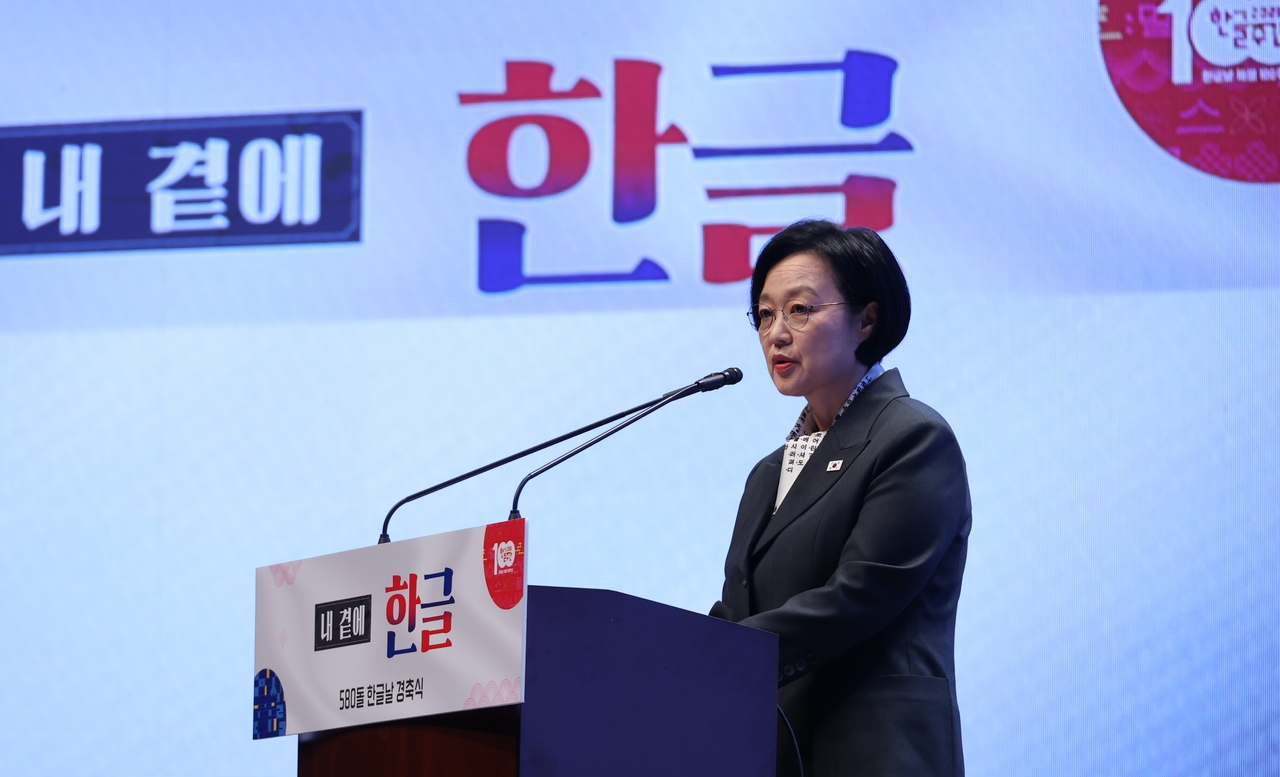
As South Korea marks the 100th anniversary of Hangul Day this year amid growing calls to reaffirm the value of the Korean script, researchers say the public institutions best positioned to lead that effort are still filling their websites with English.
Kim Tae-kyung, an associate professor at Hanyang University's Creative Convergence Education Institute, and Baek Kyung-mi, an assistant professor in the Korean language department at Seojeong University, published their findings on language use across public institution websites in the latest issue of "Hangul," an academic journal published by the Hangul Society, on Friday.
The research team conducted a comprehensive survey of language used on 73 websites — covering Gyeonggi Province, its cities and counties and affiliated agencies, subordinate public institutions, and the Korea Customs Service — between April and December last year.
The survey examined a total of 128,446 word units and 9,650 phrases and sentences appearing in site frameworks, main banners and pop-up notices, excluding posts that simply quoted external materials.
As a result, 71 of the 73 institutions surveyed — 97 percent — used foreign script such as hanja or English abbreviations without providing hangul equivalents. The total number of such instances reached 1,696.
The most frequently used term was "ESG management" (225 times). Other common examples included Q&A (127 times), SNS (94 times), CI (87 times) and FAQ (55 times), with English appearing most often in website navigation menus.
The research team said that because the items visitors check first when looking for information on a website are not written in hangul, people with lower levels of education may find them difficult to navigate.
Policy and project names also frequently contained English abbreviations that are not immediately recognizable, such as "ITS construction section" and "DRT project."
Many sites also used English expressions that the National Institute of Korean Language recommends replacing with Korean equivalents — including HOME (for main page), FAMILY SITE (for related sites) and GUIDE (for help or directions).
About half of the institutions surveyed — 34, or 47 percent — also used loanwords and foreign terms, including "co-working space," "food tech," "regulatory sandbox," "open innovation" and "webzine," for a total of 145 instances.
The research team noted that all of these expressions appear on the National Institute of Korean Language's list of loanwords subject to evaluation in official documents, published last year, and are recommended to be replaced with Korean alternatives.
In a separate survey of 7,975 Gyeonggi Province residents conducted from Oct. 1 to Oct. 10 last year, the research team found that more than 80 percent of respondents said certain terms used on public institution websites needed to be changed. Words such as "manifesto," "co-working space" and "objet" ranked among the top terms flagged for improvement.
Unfamiliar Sino-Korean terms also appeared frequently — expressions such as "gwanggeup jajae" (government-supplied materials) and "yeongjomul" (public facilities). Forty of the 73 institutions, or 55 percent, used Sino-Korean terms a combined 722 times.
"New foreign words are entering the language rapidly every year, and even where Korean alternatives already exist, they are often rarely used in practice because they do not fit the actual context," the research team said. "Even when substitute terms are already available, their usage and public acceptance need to be reviewed and refined."
Meanwhile, a 2025 survey on public language awareness by the National Institute of Korean Language found that 87.3 percent of respondents said they had experienced difficulty understanding words used in newspapers or on television. Of those, 52.4 percent said it happened occasionally and 34.9 percent said it happened frequently. When asked what kinds of words caused the most trouble, 60.0 percent cited terms requiring specialized knowledge, followed by slang and neologisms (47.7 percent), difficult Sino-Korean vocabulary (45.6 percent) and loanwords or foreign expressions (33.7 percent).
The share of respondents who said they had been confused by text written entirely in foreign script without hangul equivalents stood at 46.6 percent — an increase of more than 9 percentage points compared with a 2020 survey. Some 61.8 percent of all respondents said using foreign script alone was a problem.
The findings suggest that the language barrier facing a significant portion of the public stems not only from neologisms but from a broader linguistic environment dominated by technical jargon and foreign expressions.
killpass@heraldcorp.com