Property tax on housing in Gyeonggi Province over the past five years
Tax revenue rises 138.1 billion won, or 6.9 percent, from last year
Higher home prices and assessed values push up tax burden
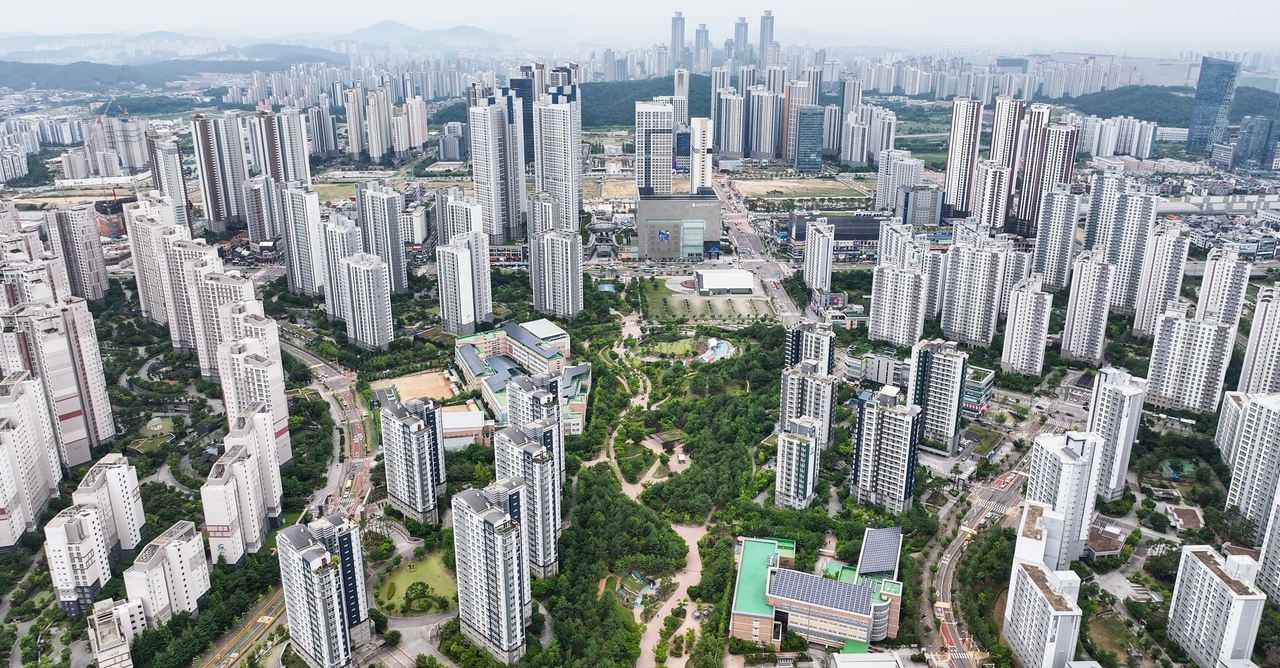
As home prices in Gyeonggi Province have risen faster than those in Seoul in recent months, the province's total housing property tax bill has grown by nearly 380 billion won ($284 million) over three years, reaching a record high this year. Analysts attribute the increase to rising home values concentrated in well-connected areas near Seoul and the semiconductor belt in southern Gyeonggi Province.
Gyeonggi housing property tax rises 138.1 billion won in a year
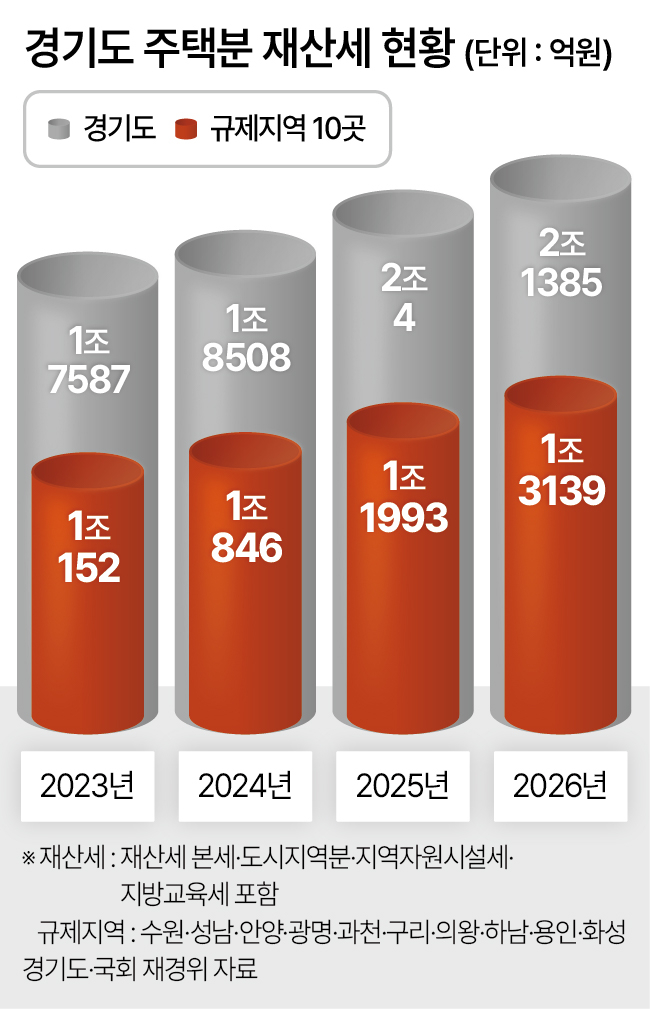
According to data on Gyeonggi Province's housing property tax from 2021 to 2025, obtained through the National Assembly's Finance and Economy Planning Committee, the province's total housing-related property tax this year reached 2.14 trillion won. That is up 138.1 billion won, or 6.9 percent, from last year's 2 trillion won. The figure combines the base property tax, the urban area levy, the local resource facility tax and the local education tax.
Property tax on housing is assessed annually based on ownership as of June 1. The tax base is calculated by applying the fair market value ratio to the publicly assessed home price, with tax rates then applied by bracket. This year, the fair market value ratio for general housing stands at 60 percent, while single-home owners pay between 43 and 45 percent depending on their assessed price.
Single-home owners also benefit from a separate preferential tax rate. Under current local tax law, homes with a publicly assessed price of 900 million won or less qualify for a rate that is 0.05 percentage points lower per bracket than the standard rate. Homes assessed above 900 million won are excluded from this preferential treatment.
Compared with three years ago, the province's total housing property tax has risen 379.9 billion won, or 21.6 percent, from 1.76 trillion won in 2023. The figure climbed to 1.85 trillion won in 2024, a 92.1 billion won increase of 5.2 percent from the prior year, before rising to 2 trillion won in 2025 — up 149.6 billion won, or 8 percent. This year's additional 138.1 billion won gain, a 6.9 percent rise, means tax revenue has grown sharply for two consecutive years.
Rising home prices are the primary driver. The publicly assessed price realization rate — which determines how closely assessed prices track actual transaction prices for apartments — has held steady at 69 percent for four straight years since 2023. With the realization rate largely unchanged, higher actual transaction prices have fed directly into assessed values and tax bases.
In 2023 and 2024, single-home owners were uniformly subject to a 45 percent fair market value ratio, but this year the rate varies between 43 and 45 percent based on assessed price. Given that neither the assessed price realization rate nor the fair market value ratio changed significantly, analysts say the recent run-up in Gyeonggi home prices has been the dominant factor behind the higher tax bills.
Seongnam, Hwaseong, Suwon, Yongin and Gwangmyeong account for 60% of the increase
Among Gyeonggi Province's 31 cities and counties, 10 designated as regulated zones — covering speculative overheating districts, adjustment target areas and land transaction permit zones — accounted for 61.4 percent of the province's total housing property tax this year. Those 10 municipalities are Suwon, Seongnam, Anyang, Gwangmyeong, Gwacheon, Guri, Uiwang, Hanam, Yongin and Hwaseong.
The 10 areas together paid 1.32 trillion won in housing property tax this year, up 124.6 billion won, or 9.6 percent, from 1.2 trillion won last year — outpacing the province-wide growth rate of 6.9 percent. Compared with 2023, their combined tax bill has risen 30.4 percent from 1.02 trillion won.
![Apartment buildings in Gwangmyeong [Herald DB]](https://wimg.heraldcorp.com/news/cms/2026/10/08/news-p.v1.20260811.fbcf437bf3bc4b30bbc62ac48189ed51_P1.jpg)
The tax increase was heavily concentrated in a handful of cities. Seongnam, home to the Bundang district, saw its housing property tax rise 80.2 billion won over three years, accounting for 21.1 percent of the province-wide increase. Hwaseong, where the Dongtan district is located, contributed 38.2 billion won, or 10.1 percent of the total gain.
Suwon, which includes the Gwanggyo area, followed with an increase of 36.6 billion won, while Yongin added 35.9 billion won and Gwangmyeong 33.5 billion won. Their respective shares of the province-wide increase were 9.6 percent for Suwon, 9.5 percent for Yongin and 8.8 percent for Gwangmyeong.
The top five cities — Seongnam, Hwaseong, Suwon, Yongin and Gwangmyeong — together accounted for 224.4 billion won of the increase, or 59.1 percent of the province-wide gain of 379.9 billion won. Roughly 60 percent of Gyeonggi Province's total property tax increase was concentrated in areas where home prices rose most sharply.
Flagship apartments in Bundang and Dongtan jump by hundreds of millions of won
Actual transaction prices for representative apartments in those areas have surged by hundreds of millions of won. A 124-square-meter unit at Parkview in Seongnam's Bundang-gu sold for 2.25 billion won on the 16th floor in October 2023, but fetched 2.94 billion won on the 32nd floor in July this year — a gain of about 700 million won in three years.
The upswing was equally pronounced in Hwaseong and Yongin, both part of the semiconductor belt. An 84-square-meter unit at Dongtan-yeok Lotte Castle in Hwaseong's Dongtan-gu traded at 1.5 billion won on the 41st floor in June 2023, then sold for 2.23 billion won on the 33rd floor in June this year, a gain of 725 million won over three years. A unit at Hillstate Giheung in Yongin's Giheung-gu climbed from 860 million won in October 2023 (7th floor) to 1.25 billion won in September this year (46th floor), a gain of about 385 million won.
Experts described the property tax increase as a result of broad-based upward price convergence, with home values in key Gyeonggi areas and on Seoul's outskirts rising toward a higher common level.
Ham Young-jin, head of Woori Bank's real estate research lab, said price gains had previously been confined to Gwacheon and Bundang in Seongnam, but the trend has broadened since last year. "Demand has flowed into Gwangmyeong, which faces reconstruction and redevelopment pressure, and into Yongin and Hwaseong — areas within shuttle-bus commuting range of semiconductor campuses — driving a broad upward convergence," he said. He added that a shortage of jeonse listings in Seoul has also pushed younger buyers to seek homeownership in outer Gyeonggi areas.
hss@heraldcorp.com