Interview with Alana Lorins, head of planning and regulation at the Basque Energy Agency
Private-sector leadership is the cornerstone of Basque energy policy
Government stake kept below 50% even in publicly backed projects
Citizen-participation wind complex experiment a resounding success
'Consistency in energy policy is crucial'
![Alana Lorins, head of energy planning and regulation at the Basque Government's Energy Agency, speaks with reporters at the offices of the Basque Trade and Investment Agency on Sept. 30. [Provided by the Korea Wind Energy Industry Association]](https://wimg.heraldcorp.com/news/cms/2026/10/08/news-p.v1.20261005.e0051eb4cd5749ac837037431cc226d1_P1.jpg)
"Even in government-led projects, the principle is that the private sector makes the decisions. Key decision-making authority is left to the companies."
Alana Lorins, head of planning and regulation at the Basque Government's Energy Agency, made the remarks in an interview with reporters at the Basque Trade and Investment Agency offices on Sept. 30.
Government stake capped at 25% in 65 billion won public project
The central tenet of the Basque Energy Agency's policy is voluntary private-sector participation. In public energy projects that involve private companies, the agency works to minimize the government's ownership stake and hand operational control to the private sector.
One recent example is a joint venture established to build a 10 MW water electrolysis facility for hydrogen production, funded with 44 million euros ($49.3 million) in combined public and private investment. The Energy Agency held just a 25 percent stake. The remainder went to Petronor, Spain's largest refinery based in the Basque Country, which took 50 percent, and Nortegas, a natural gas and LNG distributor, which took the remaining 25 percent.
"When we identify a project of strategic importance, we look for a private operator and propose a co-investment arrangement," Lorins said. "We keep the public stake below 50 percent."
She added that the agency's role is to support coordination with local governments and regional administrative bodies, and to secure various grants and subsidies for the projects.
Wind complex profits shared with citizens — slots filled on day one
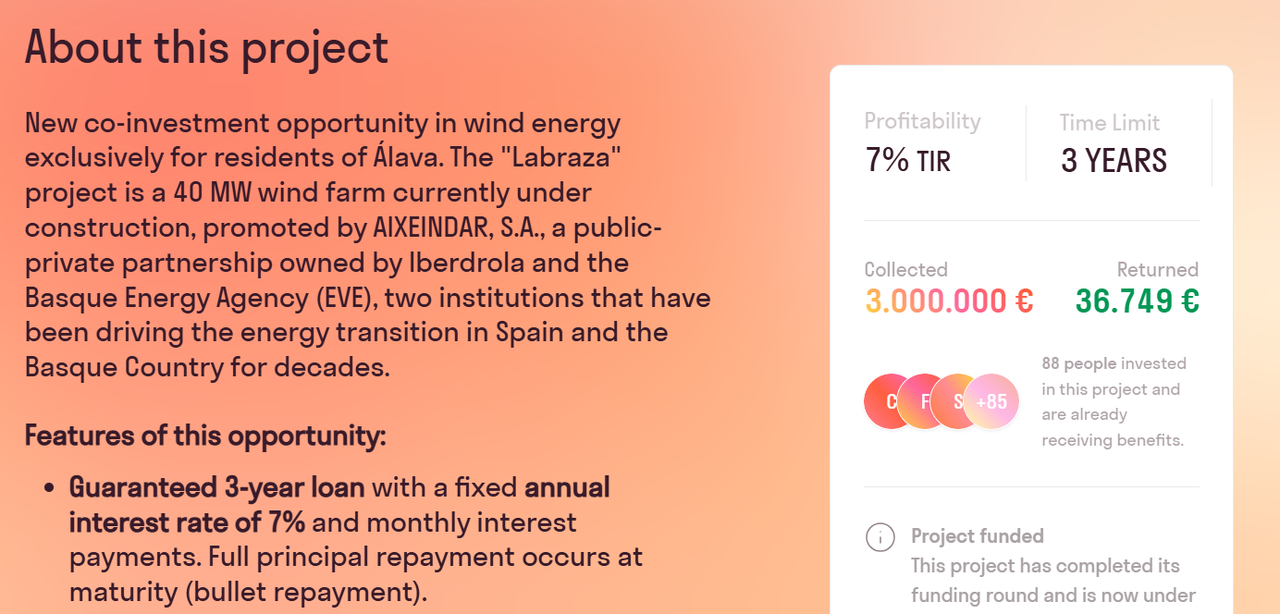
The agency has recently extended the scope of private participation to ordinary citizens, with the aim of letting them experience the tangible benefits of energy policy firsthand. Lorins cited the Labrasa wind complex, financed through a citizen participation funding model, as the agency's most successful recent initiative.
The project, a joint venture between Iberdrola and the Basque Energy Entity (EVE) to build a 40 MW onshore wind complex, marked the first time the Basque Government used citizen participation funding to raise capital. Citizens could invest a minimum of 1,000 euros and receive a fixed annual return of 7 percent, with the Basque Government guaranteeing the profit payments.
The result was a resounding success. "We opened 20 percent of the Labrasa project to citizen participation, and the entire citizen-allocated stake was filled on the very first day of recruitment," Lorins said. "When citizens invest directly in a renewable energy project and become a kind of project owner, social acceptance of that project inevitably rises."
The agency is also exploring electricity bill discounts for residents living near renewable energy facilities. Notably, the proposed benefit would extend beyond immediately adjacent communities to areas indirectly affected by the projects. "Not only residents in the area where the facility is actually located, but also residents along the routes where cables must be laid to connect the power plant to the grid could be included as beneficiaries," Lorins said.
Lorins also identified policy stability as the government's single most important role. "Consistency is crucial in energy policy. When the governing party changes, some policy directions may shift, but there is a kind of long-standing common consensus that has been maintained over many years," she said, "and that is to sustain the industry and support the energy sector in driving the energy transition."
klee@heraldcorp.com