Once the engine of Spain's economy, the Basque Country's industrial heartland saw unemployment hit 35% as factories collapsed in the 1980s. Decades later, a combination of corporate exports, small-business partnerships and government backing has transformed the region into a global offshore wind powerhouse — without a single wind farm of its own.
![An aerial view of the port of Bilbao in Spain's Basque Country. [Provided by the Korea Wind Energy Industry Association]](https://wimg.heraldcorp.com/news/cms/2026/10/08/news-p.v1.20261005.88fb29c0202f4e94bbe0f4b5e0d80178_P1.jpg)
In northern Spain, there is an autonomous region better known for its landmark than its name. That region is the Basque Country — home to the Bilbao Guggenheim Museum, whose transformative impact on a declining city gave rise to the term "the Bilbao Effect."
Public-private collaboration builds ecosystem despite absence of wind farms
The Basque Country, long defined by its heavy industry, was once a cornerstone of the Spanish economy. But in the 1980s, its factories lost competitiveness and began failing in rapid succession, pushing unemployment as high as 35%. The region's prolonged slump was so severe that it earned the dismissive nickname "black hole" in Spain.
Of late, however, the Basque economy has regained its footing. As the global offshore wind market expanded sharply, legacy shipbuilding and steel companies in the region — led by major corporations — successfully pivoted to offshore wind one after another.
What makes the story unusual is that the Basque Country has not a single offshore wind farm of its own. Even so, aggressive exports by large companies, partnerships with local small and medium-sized enterprises, and government support working in concert have produced a new industrial ecosystem — a rare model with few parallels elsewhere.
Since the offshore wind market opened in the 2000s, the Basque Country has undergone a near-complete transformation into an energy hub. According to the Basque Trade and Investment Agency, 150 Basque companies are now embedded in the offshore wind value chain, generating combined global sales of 15.7 billion euros ($17.6 billion) per year.
Companies invest 2.5 billion euros in Bilbao port over 30 years
![Jon Anagasti, head of development and transport at the Port of Bilbao, speaks with reporters on Friday. [Provided by the Korea Wind Energy Industry Association]](https://wimg.heraldcorp.com/news/cms/2026/10/08/news-p.v1.20261005.07029371f8884f2da680af7b2c19aca6_P1.jpg)
A visit to the Port of Bilbao on Oct. 2 — spanning 430 square meters of dedicated wind energy facilities — offered a vivid sense of the scale of the Basque offshore wind industry. The port is the largest in northern Spain and the only one in the country to handle offshore wind as its primary cargo.
Jon Anagasti, the port's head of development and transport, said the port was at capacity with energy companies and that expansion work begun last year was continuing this year.
On the quayside, large tower segments used to support offshore wind turbines sat wrapped in packaging bearing the name Siemens Gamesa, awaiting shipment. As global companies have aggressively scaled up turbine sizes to improve generation efficiency, the tower segments themselves have grown to reach up to 40 meters in height.
Dozens of other components were stacked across the port — among them offshore wind substructures with a horizontal diameter of up to 10 meters, and drums loaded with power cables. The companies gathered there assemble offshore wind equipment near the logistics hub to speed up exports.
Companies that invest in production facilities at the port receive the right to use the site for 50 years. Under that incentive, companies have invested a total of 2.5 billion euros in the Port of Bilbao over the past 30 years. The public sector has contributed an additional 1 billion euros. Anagasti said the port reinvests the fees it collects from companies back into port development.
Large firms and SMEs in symbiosis: 'Wind cargo a major contributor to jobs'
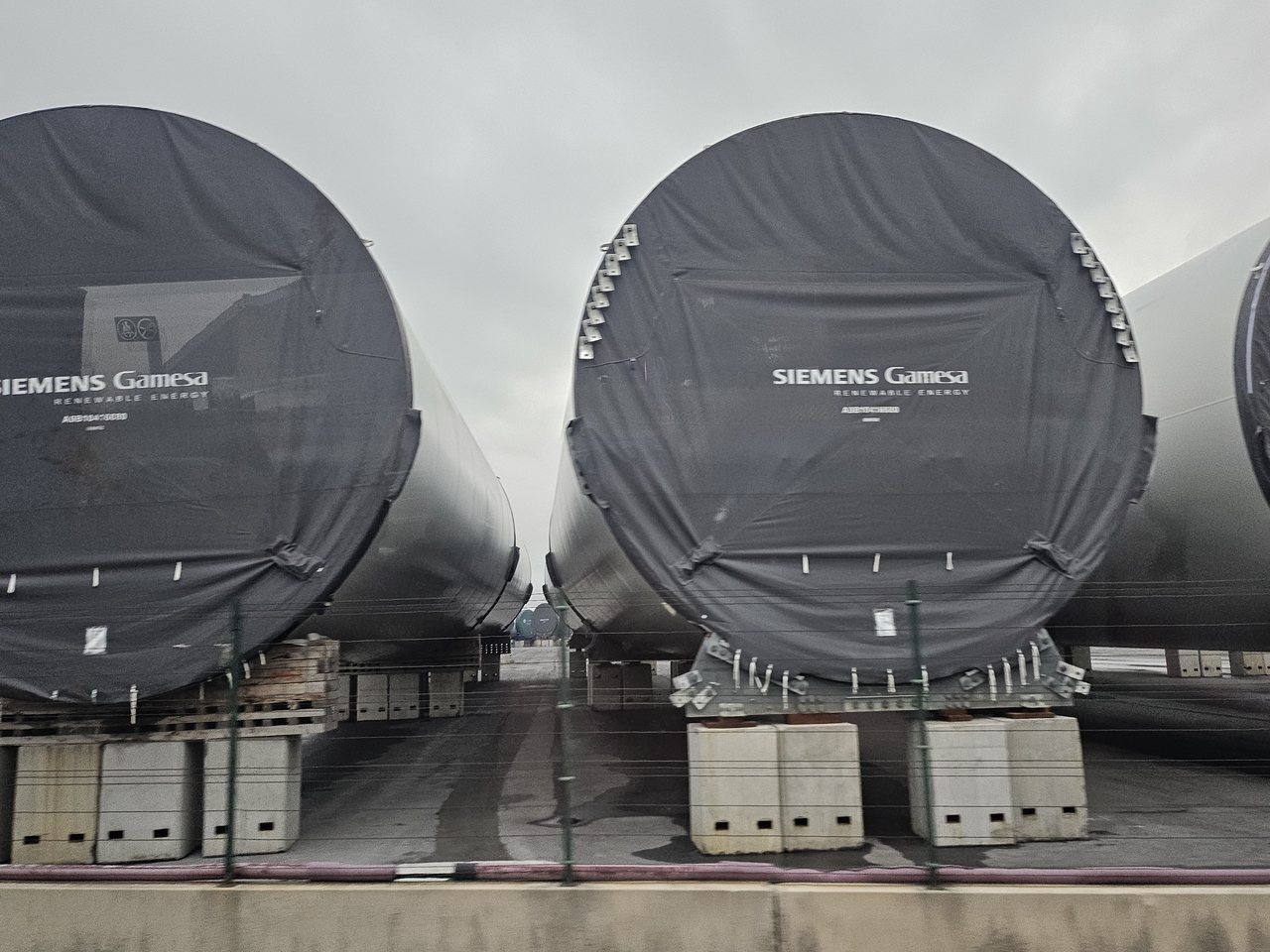
The defining feature of the Basque offshore wind ecosystem is a symbiotic relationship between large corporations and small and medium-sized enterprises in the region. Siemens Gamesa, for instance, is a global leader in wind turbines, but it cannot supply the market on its own — it depends on smaller companies that manufacture key components such as nacelles, cables and substructures, in addition to tower segments.
Anagasti said wind-related cargo makes a significant contribution to the region's and the country's industrial ecosystem, particularly in terms of jobs. He said providing sites for wind-related factories reflects a vision for the overall development of the Basque region.
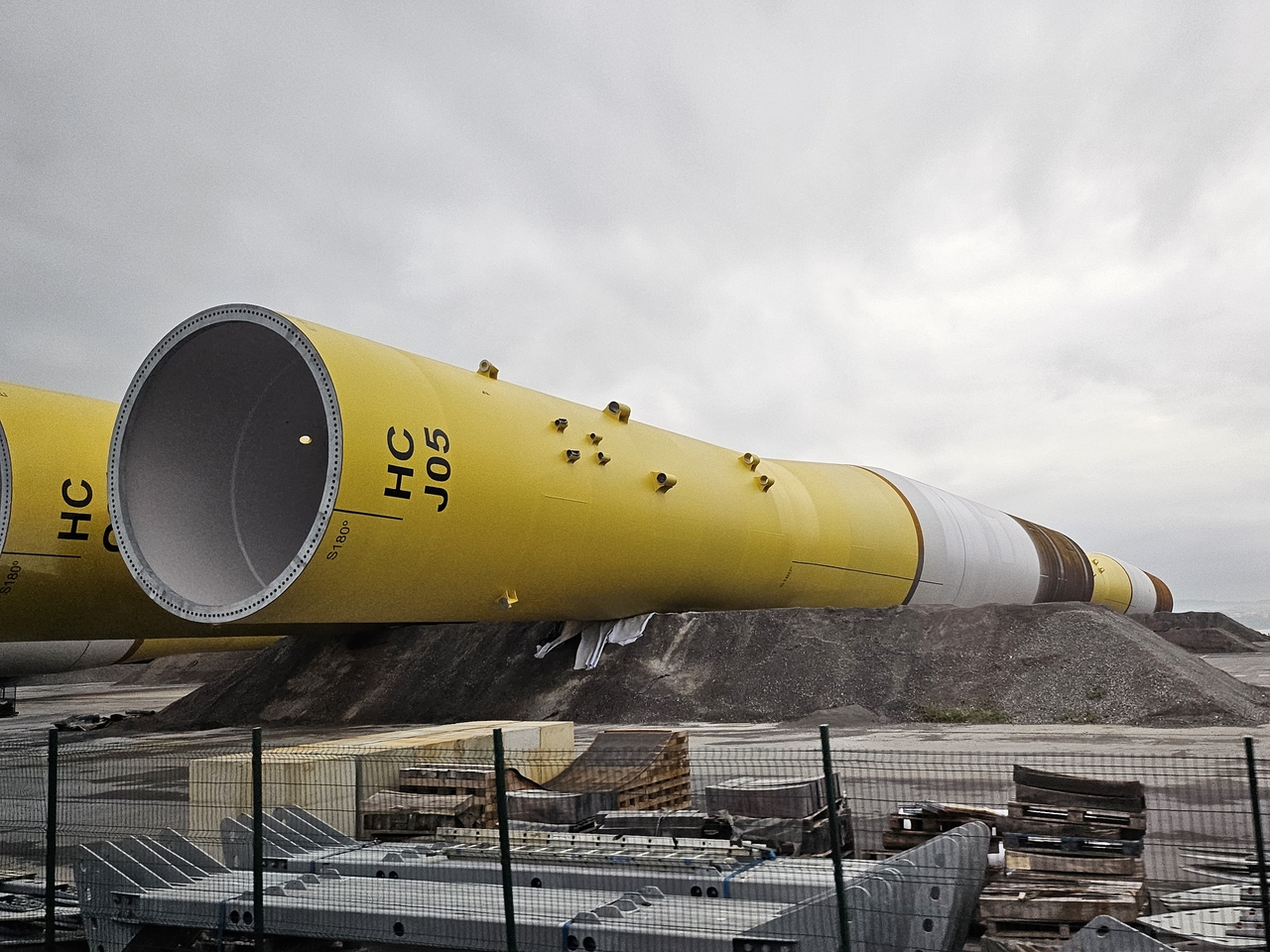
The two corporate giants that drove the Basque offshore wind industry are wind turbine maker Siemens Gamesa and energy producer Iberdrola. As offshore wind installations expanded in earnest in the 2000s, both companies grew active in global markets and began placing orders with local small and medium-sized enterprises, naturally driving the region's industrial transition.
As more companies entered the offshore wind supply chain, the Port of Bilbao has continued to invest year after year. Last year, the port put in 35.7 million euros to develop 31 square meters of new land and two new berths.
According to local reports, this year's port budget stands at 87.1 million euros, and 15 new concrete caissons serving as berths have already been installed. Most recently, offshore wind substructure company Haizea Wind secured a new site of 120,000 square meters.
From power utility to energy company, Iberdrola says offshore wind drives regional economy
![Begoña Díaz González, Iberdrola's head of overseas offshore wind projects for Asia-Pacific, speaks with reporters at the Basque Trade and Investment Agency office on Sept. 30. [Provided by the Korea Wind Energy Industry Association]](https://wimg.heraldcorp.com/news/cms/2026/10/08/news-p.v1.20261005.9667033e34d3491dbcedb446fcdcc4be_P1.jpg)
Iberdrola started as a power utility in 1992 and has since transformed into an energy company in line with the global shift toward clean energy. It is a case study in growing alongside local businesses from its earliest days.
Begoña Díaz González, Iberdrola's head of Asia-Pacific operations, said in an interview on Sept. 30 that the Basque Country had long been home to many local companies producing electrical components even before Iberdrola began operations in the 1970s. She said the company actively engaged and partnered with local suppliers as it expanded into renewable energy.
Having grown into a global energy company, Iberdrola has pointed to supply chain development as the key to revitalizing regional economies. González said large-scale industries such as offshore wind ultimately create a "pull effect" that draws the broader industrial base along with them. She added that large companies tend to attract the most attention, but they too rely on their own suppliers — which are often small and medium-sized enterprises — ultimately forming one interconnected supply chain.
klee@heraldcorp.com