Bumper unit next on the block after lamp sale; module and core parts margin at just 0.2%
Electronics sales up 12% in first half; automotive semiconductor localization gains pace
Robotics actuators added to growth roadmap
![Hyundai Mobis' holographic windshield display [Hyundai Mobis]](https://wimg.heraldcorp.com/news/cms/2026/10/08/news-p.v1.20260202.11fe152ce4ce4b69bb26bd6117001b05_P1.jpg)
Hyundai Mobis is accelerating a sweeping overhaul of its business portfolio. Using the sale of its lamp unit as a starting gun, the company plans to shed low-margin businesses with limited synergy with next-generation vehicles and redirect resources toward electrification, automotive electronics and global customer expansion.
According to industry sources Thursday, Hyundai Mobis laid out the strategy at an investor relations event Wednesday, calling the lamp divestiture "the first execution of our 'selection and concentration' strategy."
The company described its existing structure as a "department-store portfolio" — a sprawling collection of businesses accumulated over years of broadly supporting Hyundai Motor and Kia. "As we kept expanding products and businesses to support Hyundai Motor and Kia across a wide range, resources became dispersed across eight business areas," the company said. "Limited investment capital spread across multiple businesses has created a vicious cycle of eroding competitiveness."
![Hyundai Mobis President Lee Kyu-seok delivers a welcome address at the first Hyundai Mobis Automotive Semiconductor Forum "Auto Semicon Korea," held at the DoubleTree by Hilton Seoul Pangyo hotel in Seongnam, Gyeonggi Province, on Sept. 29, 2025. [Hyundai Mobis]](https://wimg.heraldcorp.com/news/cms/2026/10/08/news-p.v1.20261008.2b6dd972d76b442b8c84894501195aaf_P1.jpg)
The lamp and bumper units are first in line for divestiture. Hyundai Mobis signed a deal late last month to sell its lamp business to French firm OP Mobility. Talks to sell the bumper unit are also under way, with mid-sized parts makers already selected as preferred negotiating partners.
For legacy businesses such as modules and chassis safety systems, the focus will shift to improving profitability and operational efficiency rather than outright sale. Electrification and automotive electronics, by contrast, are classified as growth businesses, with plans to increase investment in market expansion and technology development.
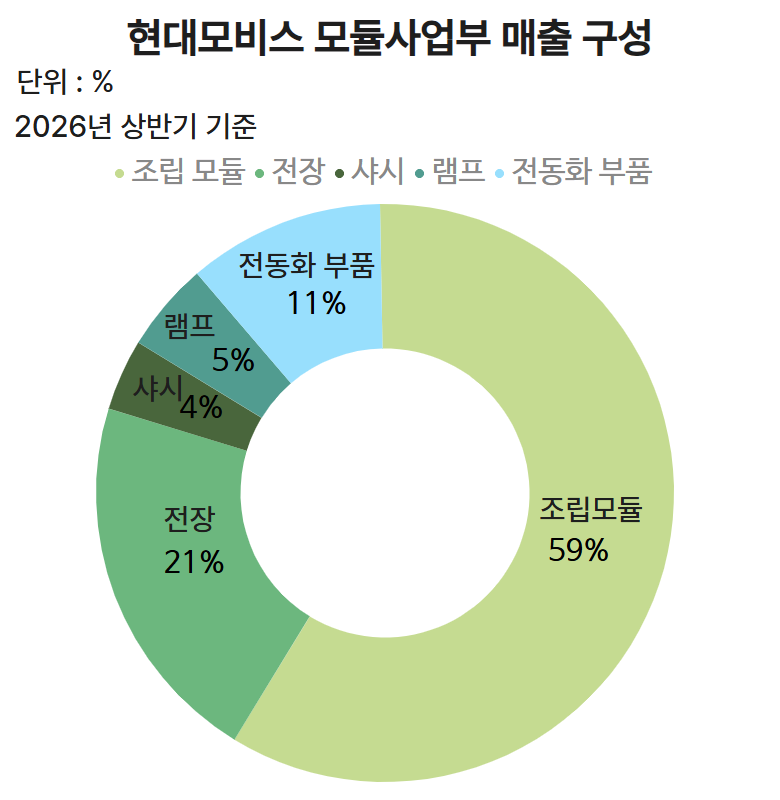
Module and core parts margin at 0.2% — profitability varies wildly by segment
Profitability is one of the key criteria for identifying businesses to nurture. Last year, the module and core parts segment posted sales of 47.8 trillion won ($35.7 billion), accounting for roughly 78 percent of total revenue, yet its operating profit margin was just 0.2 percent. The segment ran operating losses of 76 billion won in 2023 and 42.5 billion won in 2024.
Module assembly alone generated sales of 28.23 trillion won last year, representing about 59 percent of the module and core parts segment's total. Because the business involves assembling components and delivering them sequentially to Hyundai Motor and Kia production lines, it adds relatively little value relative to its revenue scale and is highly sensitive to fluctuations in finished-vehicle output. Module assembly's outsized revenue share is widely cited as one of the main factors dragging down the segment's overall profitability.
![An integrated driving and parking controller developed by Hyundai Mobis. The unit fuses long-range and short-range sensors to improve both safety and convenience. [Hyundai Mobis]](https://wimg.heraldcorp.com/news/cms/2026/10/08/news-p.v1.20260909.8b484c25418b4564ab052494af42f8d7_P1.jpg)
The lamp business, now in the process of being sold, is profitable, but its operating margin is only 3 to 4 percent. The unit requires large-scale production facilities, and its short product cycles demand repeated rounds of research and development and capital expenditure. With 85 percent of lamp sales concentrated in Hyundai Motor and Kia, the company concluded that achieving further growth would require winning global customers and volumes to secure economies of scale.
The after-sales service business, by contrast, is Hyundai Mobis' signature cash cow. Last year it generated sales of 13.32 trillion won — about 22 percent of the total — but delivered operating profit of 3.28 trillion won at a margin of 24.6 percent, accounting for roughly 98 percent of the company's overall operating profit. The automotive electronics segment, identified as another future growth engine, is also improving rapidly, with its operating margin climbing to the 7 to 9 percent range. Sales in the first half of this year rose 12 percent from the same period a year earlier.
![The high-performance actuator structure applied to the joints of Boston Dynamics' humanoid robot Atlas. The design features a modular architecture that uses identical components across all joints. [Boston Dynamics]](https://wimg.heraldcorp.com/news/cms/2026/10/08/news-p.v1.20260320.9463f92b4e404e0db90089b14a5f0d22_P1.png)
Investment shifts to electronics, semiconductors and robotics in future-vehicle pivot
The company is also weighing future investment requirements, market growth potential and technological linkages with its core future businesses. The decision to sell the lamp unit reflected a judgment that it offered limited synergy with the electrification and electronics businesses Hyundai Mobis intends to prioritize.
Investment is accordingly shifting toward electrification, automotive electronics and automotive semiconductors as the core technologies of future vehicles. Early results are emerging: electronics system sales in the first half of this year reached approximately 5.2 trillion won, up 12 percent from the same period a year earlier and roughly double the sales of electrification components.
On automotive semiconductors, Hyundai Mobis is pursuing in-house development of sensor and communications chips to reduce import dependence — a push accelerated by the global supply crunch. The company is also strengthening its fabless design capabilities alongside sensor fusion, smart cabin and software-defined vehicle integrated control technologies.
Over the medium to long term, Hyundai Mobis plans to extend technologies developed for automotive parts into robotics. Vehicle actuators, sensors, controllers and battery technology share strong technical overlap with core robot components, allowing the company to leverage its existing electronics and electrification capabilities in the robotics space. Once its US actuator factory begins full operation in 2028, the company projects annual sales of 500 billion won to 1.5 trillion won based on robot production of 10,000 to 30,000 units.
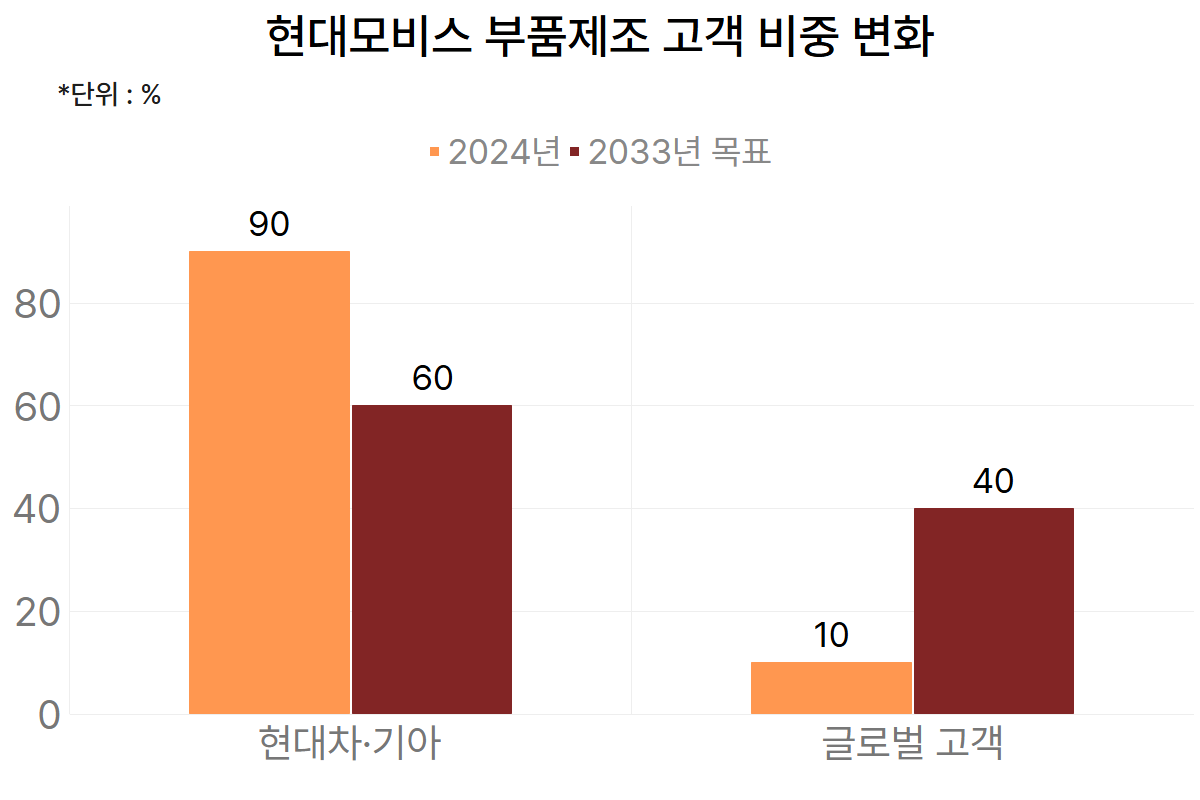
The company also intends to reshape its customer base. Hyundai Mobis plans to reduce the share of Hyundai Motor and Kia in its parts manufacturing sales from 90 percent in 2024 to 60 percent by 2033, while raising the share of global automakers from 10 percent to 40 percent. Rather than cutting sales to Hyundai Motor and Kia, the strategy is to grow overall global revenue by winning more orders for high-value parts such as electronics and electrification components from customers in North America, Europe and Japan.
![A concept rendering of the robot actuator Hyundai Mobis supplies to Boston Dynamics [Hyundai Mobis]](https://wimg.heraldcorp.com/news/cms/2026/10/08/news-p.v1.20260106.dde669d78b1d43649eb61f6ca7f5ca4b_P1.jpg)
'Fire-sale' debate over 600 billion won lamp deal — analysts call it fair
Challenges remain. Hyundai Mobis plans to put a physical spin-off of its domestic lamp business to a vote at an extraordinary shareholders' meeting on Nov. 24, with the full sale — including overseas subsidiaries — to be completed by the second half of next year. The deal has drawn pushback from the union and some shareholders over the sale price.
The lamp business is being sold for approximately 600 billion won, equivalent to about 0.24 times last year's sales of 2.5 trillion won. The union and some shareholders have raised the possibility of a fire sale, arguing that the transaction multiple is lower than those seen in past acquisitions of global lamp makers.
![Members of the Korean Metal Workers' Union's Gyeongju and Gumi chapters hold a press conference outside Hyundai Mobis' headquarters in Gangnam-gu, Seoul, in March to protest the planned sale of the lamp business. [Korean Metal Workers' Union]](https://wimg.heraldcorp.com/news/cms/2026/10/08/news-p.v1.20260519.2a743375d9f144898bd9e4ea1faa2f72_P1.jpg)
The market has pushed back. Samsung Securities said that given the lamp unit's operating margin of 3 to 4 percent, the roughly 600 billion won price tag is appropriate, equating to a price-to-book ratio of about 0.8 times based on 2025 earnings. The brokerage noted that the valuation is in line with that of SL Corp., a lamp maker whose operating margin is roughly double that of Hyundai Mobis' lamp unit, arguing that profitability and future capital expenditure requirements must be weighed alongside raw revenue scale.
"Hyundai Mobis is now transforming from a company that supplies parts to meet the needs of Hyundai Motor and Kia into one that allocates capital on its own terms and broadens its customer base," said Im Eun-young, an analyst at Samsung Securities. "As the shift to software-defined vehicles and the localization of automotive semiconductors progress, this transformation will only accelerate."

kwater@heraldcorp.com