Council Speaker Im Man-gyun hosts forum on staffing and fiscal support for district sanitation workers
Vacancy rate hits 13% amid fears of overwork and industrial accidents
Participants call for rational cost-sharing framework between Seoul and its districts
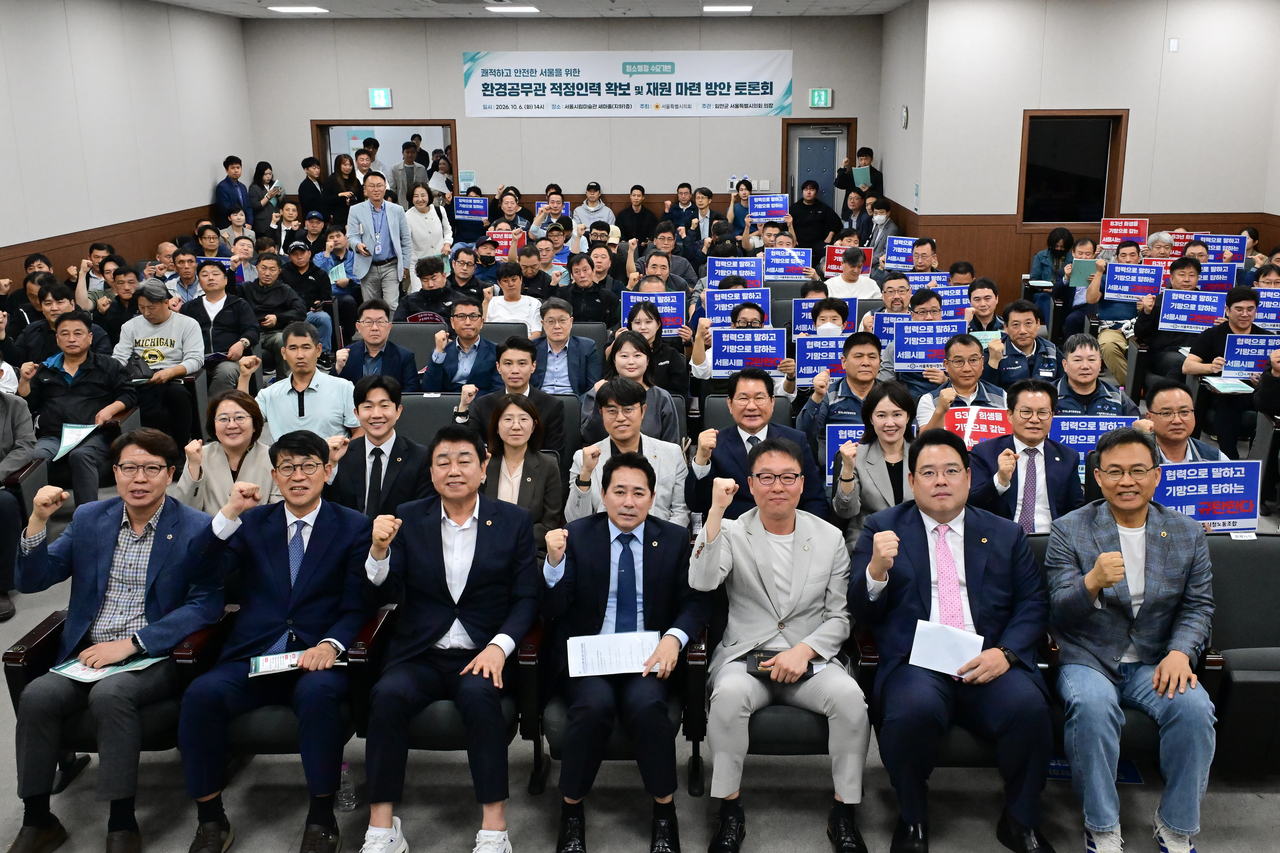
A persistent shortage of sanitation workers across Seoul's 25 autonomous districts has pushed adequate staffing and a fairer fiscal cost-sharing arrangement between the Seoul Metropolitan Government and the districts to the top of the policy agenda.
The Seoul Metropolitan Council said it held a forum Tuesday at SeMA Hall of the Seoul Museum of Art, organized by Council Speaker Im Man-gyun, to explore ways to secure adequate staffing for sanitation workers and improve the fiscal cost-sharing system between the city and its districts.
The forum was convened to establish staffing standards that reflect actual sanitation demand and to discuss ways to secure stable funding. It focused particularly on finding institutional solutions that could simultaneously address the deteriorating working conditions caused by staff shortages and the uneven fiscal burden borne by individual districts.
As of August, the authorized headcount for directly employed sanitation workers across Seoul's 25 districts stands at 2,867, but only 2,489 are on the job — a shortfall of 378 workers, or a vacancy rate of about 13.2 percent. Concerns have been raised that if the staffing gap persists as sanitation demand grows, existing workers will face mounting overtime and heavier workloads, raising the risk of industrial accidents.
Participants also noted that because each district differs in the size of its sanitation zones, road conditions, foot traffic and volume of household waste generated, objective staffing criteria that reflect local operational characteristics are needed rather than a uniform allocation formula.
Seoul Metropolitan Council member Song Yun-jeong, who presented at the forum, said a comprehensive investigation of authorized headcounts, actual staffing levels and real workloads should be conducted to establish district-specific staffing standards that reflect sanitation demand.
Song also proposed that staffing and fiscal cost-sharing issues be examined together, noting that Seoul, as the road management authority, bears responsibility for funding related costs even when national and city-level sanitation duties have been delegated to the districts.
The forum also raised a structural problem: while the districts are responsible for hiring sanitation workers and paying their wages, wage negotiations and related standards are set at the city level. Participants said this disconnect between policy-making authority and the actual cost burden could deepen the fiscal strain on individual districts.
Attorney Kim Gyu-dong proposed forming a joint task force between Seoul and the districts to reconcile unpaid wages and unify the calculation system for regular wages. Discussions also covered differentiated support based on each district's fiscal capacity and the need to establish medium- to long-term cost-sharing standards.
The forum drew 19 council members, including Deputy Speakers Seong Heum-je and Lee Seong-bae, Democratic Party of Korea floor leader Lee Sang-hun and Operations Committee Chair Lee Byeong-do, along with Seoul Metropolitan Government officials, who exchanged views on sanitation staffing and fiscal issues.
"We need to find a standard that ensures sanitation workers have adequate staffing so they can work safely and rest sufficiently, while allowing Seoul and the districts to share costs rationally in proportion to their responsibilities," Im said. "The Seoul Metropolitan Council will fulfill its role and responsibilities to build a stable and sustainable sanitation administration."
7toy7@heraldcorp.com