Seoul Metropolitan Theatre's 'Enemy' opens Oct. 26
Ibsen's 'An Enemy of the People' reimagined for the present day
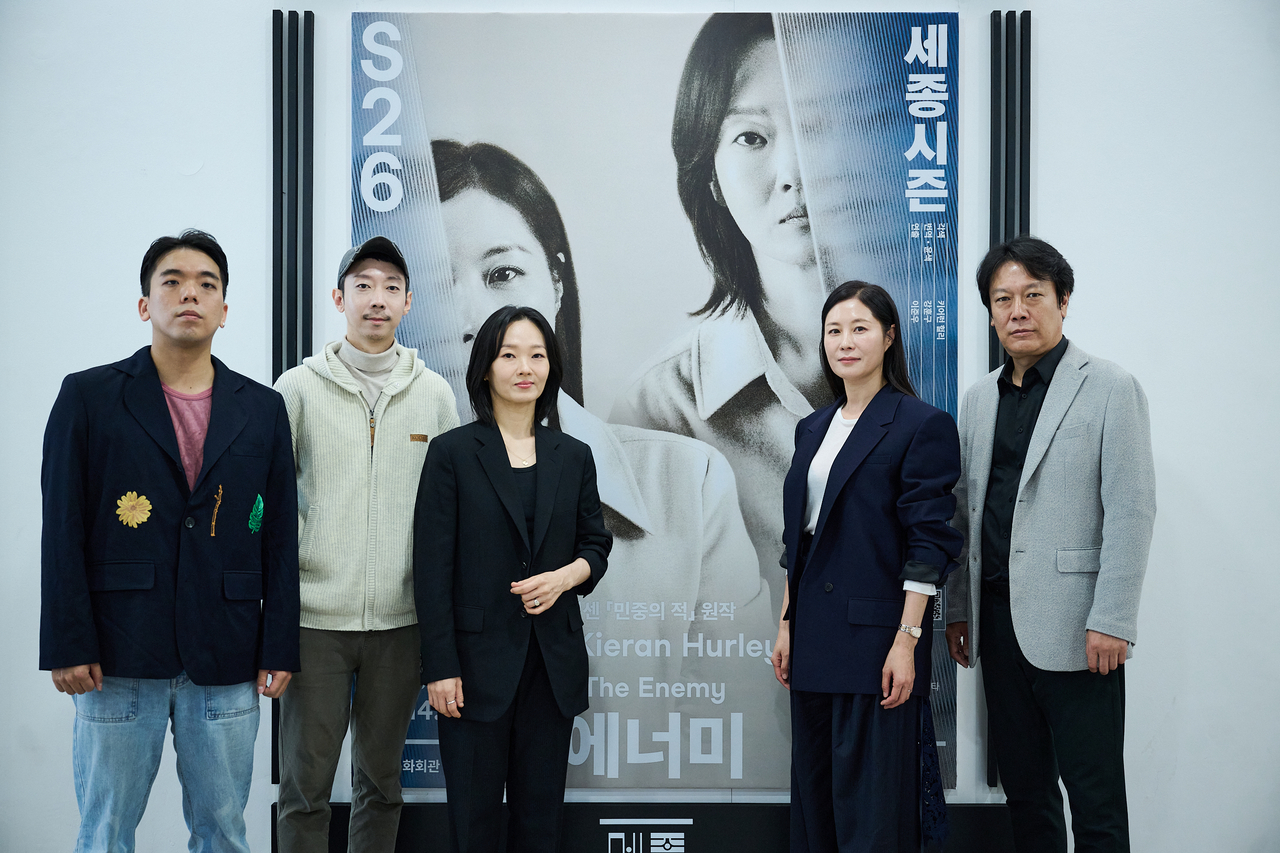
"I think a lot about whether the society we live in is the future we once dreamed of. Whether we've truly become more free — honestly, I'm not sure." — Playwright Kang Hun-gu
How long does it take for a person to become an "enemy of the people"? In the play "Enemy," a single day is more than enough.
"Enemy" brings Henrik Ibsen's 1882 classic "An Enemy of the People" to a 2026 stage, and the world it depicts is startlingly close to the present. Director Lee Jun-woo, artistic director of the Seoul Metropolitan Theatre, said that while SNS and media might seem to make truth more accessible and society more transparent, "this society has another face." He added that as personal interests, jealousy and hatred pile on top of one another, "it has become far harder to know the truth than it used to be."
The production is adapted by Scottish playwright Kieran Hurley and translated and reworked in Korean by Kang Hun-gu. The adaptation transplants Ibsen's era into the age of SNS: the brothers of the original become sisters, the spa becomes an eco-resort called "Big Splash," and the printer becomes a prominent local YouTuber.
The protagonist, Kirstin Stockmann, joins a project to build an eco-resort meant to revitalize the region, only to discover that the local water supply is contaminated. To Kirstin, it is a truth that must be made public for the sake of community safety — but to the residents, the resort represents a rare chance to rescue the local economy and is bound up with their livelihoods. As the interests of her sister Bonnie, the mayor, along with a journalist friend, a YouTuber, residents and investors all become entangled, public opinion turns against Kirstin in an instant. It takes less than a day for the person trying to tell the truth to become the target of a witch hunt. The audience watches in real time as one individual rises as a hero and then falls to become an "enemy of the people."
"It is probably all of us today who watch, with both fascination and a certain dread, the daily spectacle of someone becoming a hero in a single day only to be turned into an enemy of the people," Kang said. He added that he hopes the play will give audiences a chance to share in the questions: "Why does this society keep producing enemies of the people yet never change?" and "Who is the real enemy of the people?"
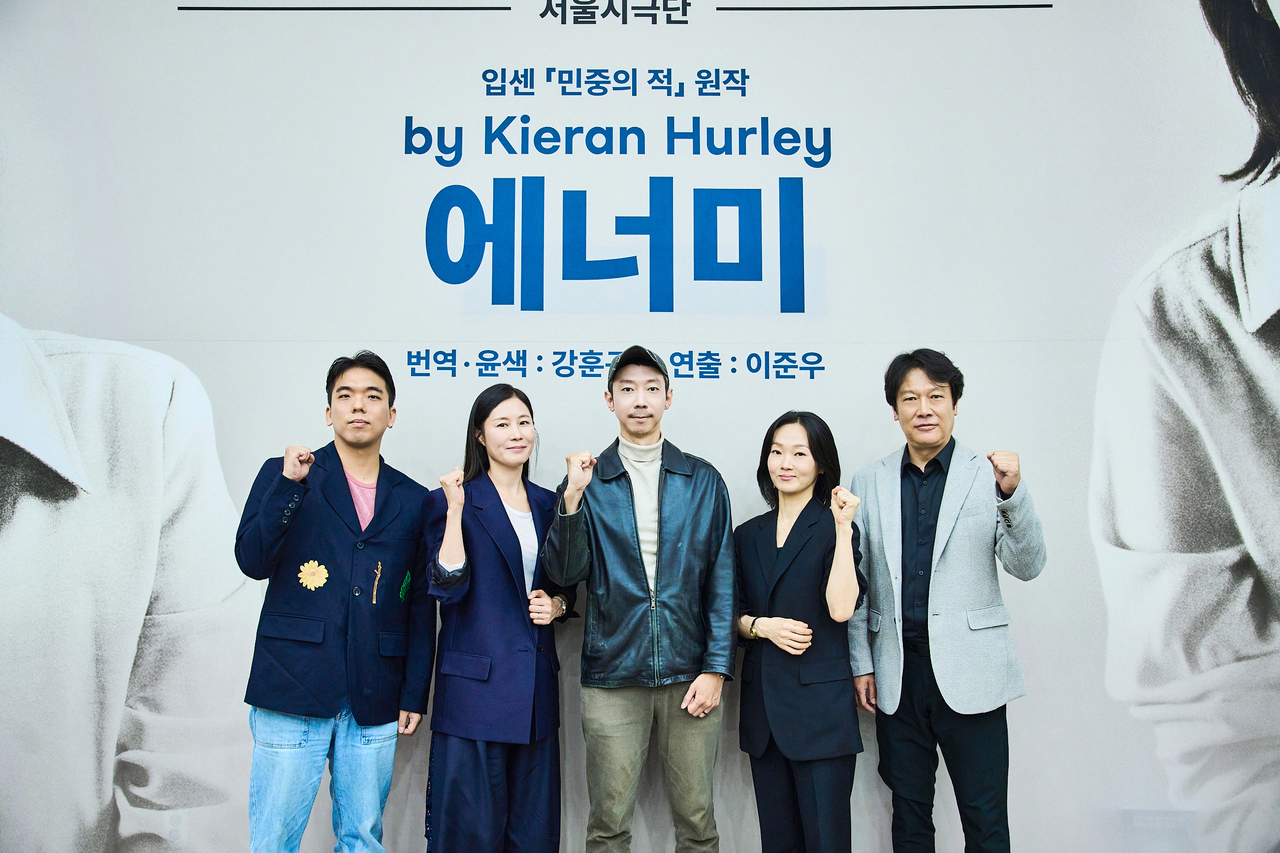
For Lee Jun-woo, who took the helm of the Seoul Metropolitan Theatre last November, "Enemy" is his second exploration of media, following his debut production "Big Mother." He said he has been struck lately by how differently he and those around him perceive the same world, and questioned whether the weight of words casually thrown out on SNS or in the media is disappearing.
What Lee wants to put on stage is the way public opinion moves. "Media picks a target, and when that target loses its novelty or interest fades, the frame shifts somewhere else," he said. He went on to ask whether those who attacked Kirstin were truly driven by a clear-eyed conviction about what is true and right in this society, or something else entirely.
The pathologies of the media environment are rendered through a range of theatrical devices. The production greatly expands the number of screens on stage, layering real-time comment feeds and a YouTuber's live broadcast over the actors' performances. Kang said he has been separately collecting online comments not found in the original or the adaptation, and predicted that audiences will have a chance to experience that fear firsthand.
"When the power to raise one's own voice is misused, it can become a blade that cuts others," Lee said, explaining his directorial intent. He said he wanted to capture "a scene from a fractured society in which everyone claims to be a victim while simultaneously becoming a perpetrator."
Moon So-ri and Lee Bong-ryeon, who alternate in the role of Kirstin, each bring a sharp focus to the "fragmentation of truth" that the character confronts.
Moon said she felt "a tremendous sense of speed and dread" when she first read the script. "In Ibsen's original, it was clear that the doctor held the truth and others were trying to conceal it," she said. "But the more we rehearse, the more I find myself wondering what truth actually is — whether each person's own position might be their truth."
She went on to say, "What the sister says makes sense from the sister's perspective; what the journalist says makes sense from the journalist's perspective; even the comments on SNS all seem right from each person's own standpoint. Everyone's truth is different, and when those truths collide and gather together, they gain power."
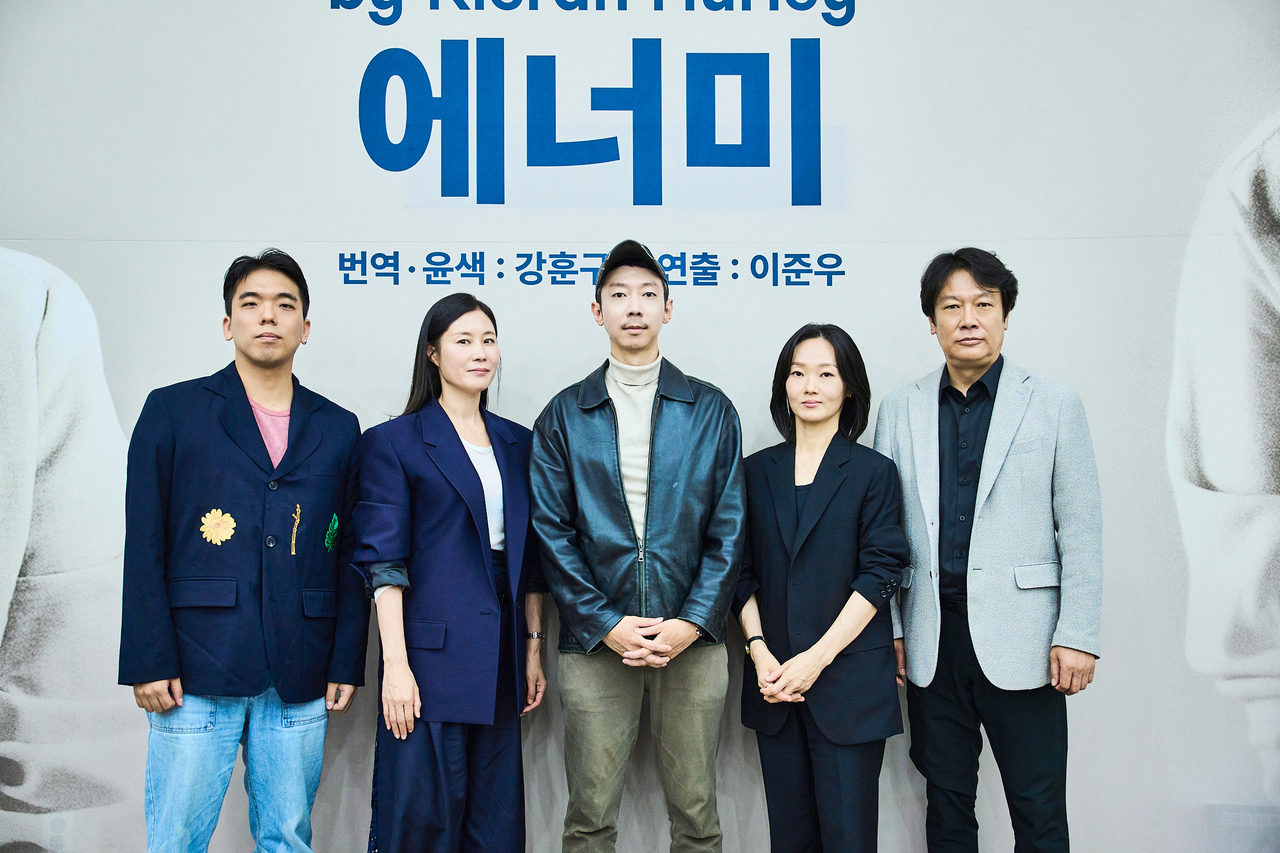
Lee Bong-ryeon, returning to the theater stage for the first time in two years, sees Kirstin as an ordinary person. "This isn't a play that invokes grand discourse to illuminate the inner self — it's about what an ordinary person goes through in a very short span of time," she said. "I was drawn to it because I thought I could understand her, even if she isn't exactly like me."
Kang Shin-gu, who played the journalist Billing in the Seoul Metropolitan Theatre's production of "An Enemy of the People" 28 years ago, returns this time as Derek, Kirstin's father-in-law and a businessman, adding a taut layer of tension. "Twenty-eight years ago, what stayed with me most powerfully was the proposition that the majority is never right," he said. "Looking at 2026, this is a work that fits today far better." He added that the choices a character makes to protect a cornered family can appear violent and selfish to others, and promised to portray that duplicity — love and family used as cover — with full honesty.
Living in an era where every move is exposed, the actors face Kirstin's dilemma offstage as well: whether to speak, and if so, when and how. On the question of making public statements, Moon said, "I haven't made up my mind. I'm always wrestling with it — how to say something, when to say it. Each time, I hope I don't get too hurt, and that my words don't hurt others either." Lee said, "I clearly think of the projects I choose, and the ones I've decided to be part of, as my own voice." She added that SNS has come to stand in for the public square, and expressed hope that the questions raised inside the theater would remain alive once audiences stepped back outside.
Kang named Kirstin's long speech — delivered after she has been branded an enemy — as the highlight of the production. In reality, individuals labeled "enemies of the people" are typically pushed to the margins by cancel culture and silenced, but the classic gives the accused the floor to argue their case in their own words until the very end. "People who get branded as enemies of the people usually just end up branded and that's it," Kang said. "But Ibsen gives Dr. Stockmann the right to speak. That speech is the crown jewel of this work." Have we truly become more free? The playwright's question passes to the audience, who must listen to that speech all the way through. The production runs Oct. 26 through Nov. 14 at the M Theater of the Sejong Center for the Performing Arts.
shee@heraldcorp.com