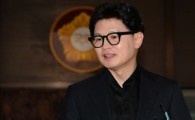
Appears as witness at National Assembly audit Wednesday
'I begged YG, SM and Hybe,' he says
JYP filed Fanomenon trademark first
Acknowledges 'abnormal' procedures
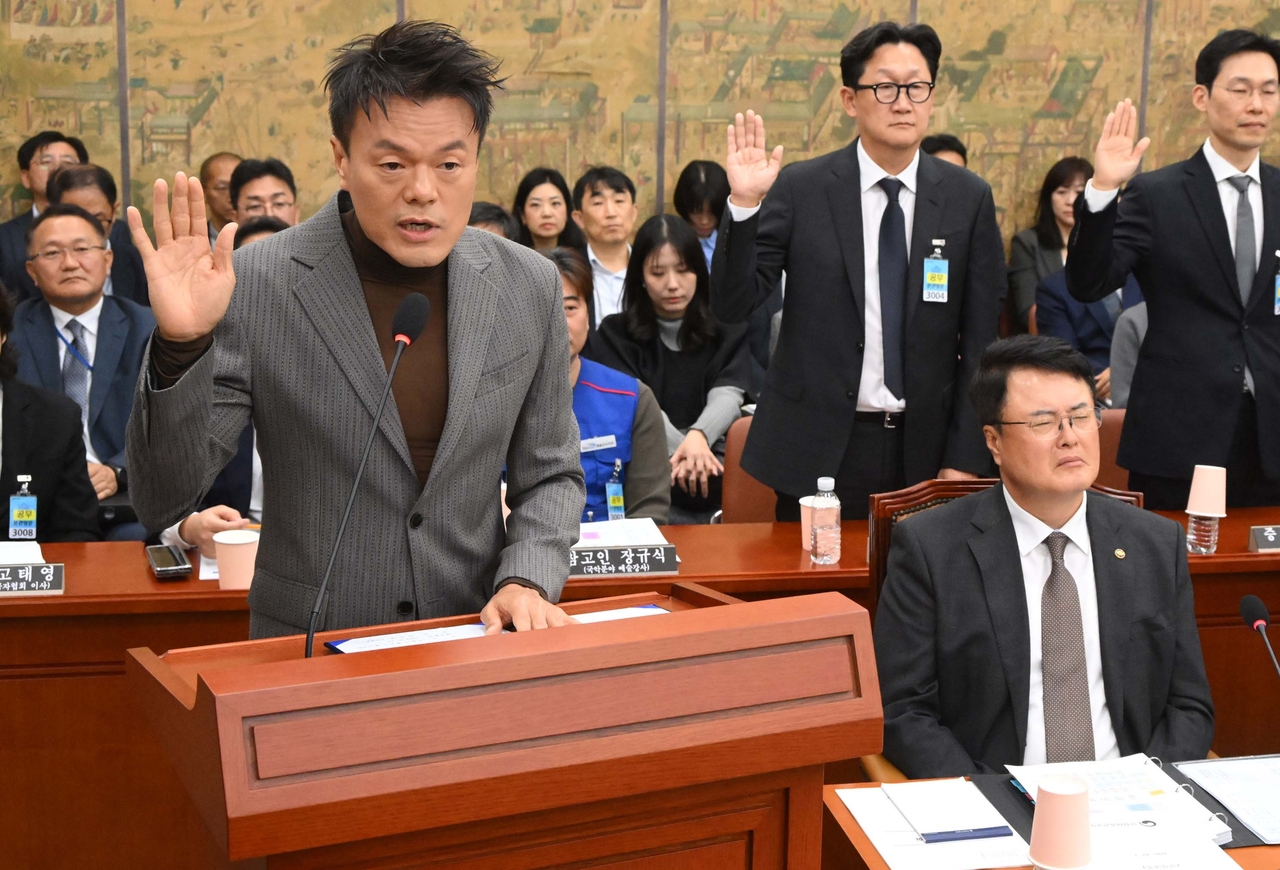
Park Jin-young, co-chair of the Presidential Committee on Popular Culture Exchange, pushed back Wednesday against allegations that the four major K-pop agencies received preferential treatment through the global K-pop festival Fanomenon, arguing that the headline acts of those companies would earn two to three times more revenue by holding separate concerts during the same period.
Appearing as a witness at the National Assembly's Culture, Sports and Tourism Committee audit of the Ministry of Culture, Sports and Tourism, Park said the artists involved were effectively forgoing far greater earnings. "If the top acts from the four companies didn't do this and held their own concerts instead, they would make two or three times the revenue," he said. "Getting every company to make that sacrifice was incredibly difficult."
Park said he personally appealed to each label to come on board. "I begged YG, I begged SM, I begged Hybe," he said, adding that the companies stood to lose hundreds of billions of won over the coming years. He said all of them ultimately made a major commitment based on a long-term vision — the spillover effects the festival could generate for South Korea and other industries. "If you skip this event and use that time for each artist's own concerts, you make far more money," he said.
The touring revenues of the flagship groups from the four major agencies are indeed substantial. According to the Billboard Boxscore published Tuesday (local time), BTS — signed to Hybe — surpassed $500 million in cumulative ticket sales on their Arirang world tour, becoming the first pop group to reach that milestone. In August alone, 12 shows generated $171.7 million, working out to roughly $14.3 million per show.
Stray Kids, signed to JYP Entertainment, grossed $185.7 million from 31 shows on their dominATE world tour in Billboard's 2025 annual tally — about $6 million per show. Blackpink, signed to YG Entertainment, recorded $148.3 million from 29 shows on their Born Pink world tour in the 2023 annual count.
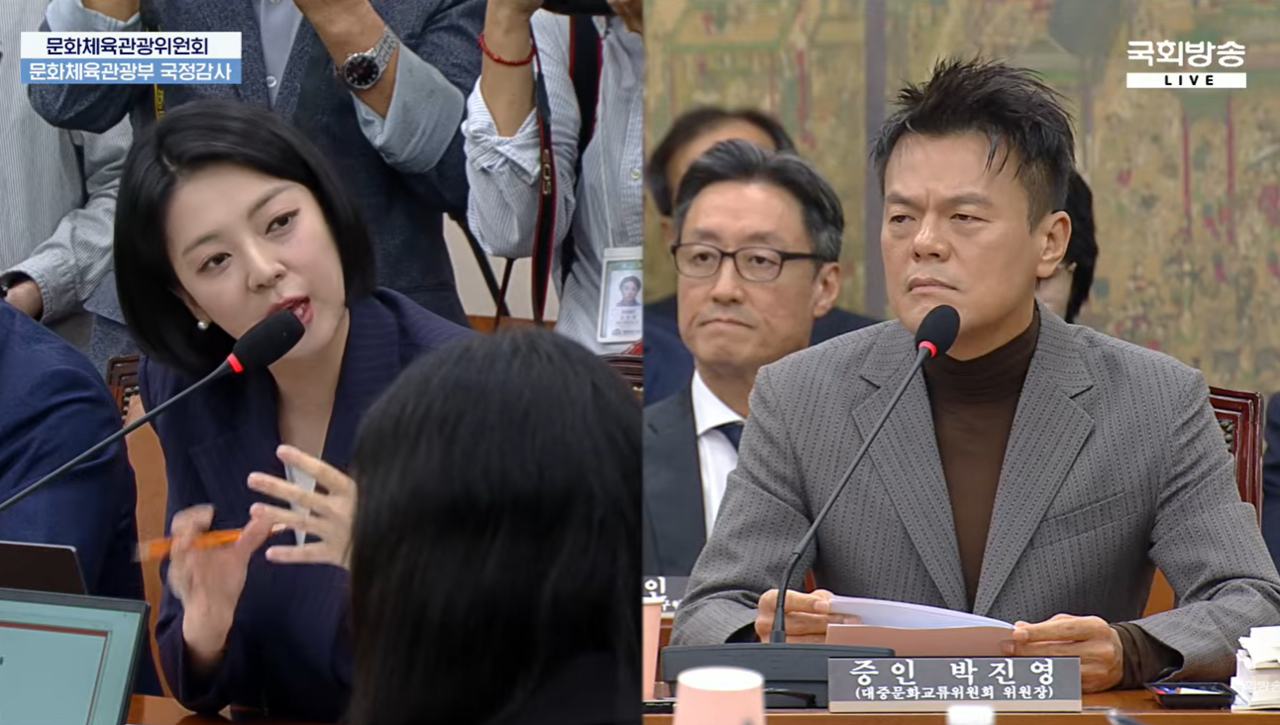
People Power Party lawmaker Bae Hyun-jin pressed Park extensively on how JYP Entertainment came to file the Fanomenon trademark. According to Bae, JYP filed for the domestic trademark on its own on Oct. 1 last year — the same day the Popular Culture Exchange Committee announced its launch. JYP subsequently filed for trademark protection in the United States in November of that year, and later in Japan and Mexico. Park acknowledged all of this.
Bae also took issue with a partial trademark rights transfer agreement JYP and the Ministry of Culture, Sports and Tourism signed on April 1, under which JYP transferred 50 percent of its domestic trademark stake to the government. "The contract specifies that the ministry holds only half the domestic rights while all overseas rights remain with JYP," Bae said, adding that the agreement contained no penalty clause for non-compliance.
The way the four agencies were brought into the project also drew scrutiny. "Normally, a government project puts out a public notice and selects capable companies through a competitive process," Bae said. "This project had insider companies entering a national initiative on their own from the very beginning." When Park responded that the project was "premised on years of sacrifice by the four companies," Bae shot back: "If it's the four companies' sacrifice, they can just do it themselves. There's no need for government support."
Bae noted that 3.7 billion won ($2.75 million) had been allocated to the Popular Culture Exchange Committee this year, with 15 billion won budgeted to plan Fanomenon next year.
Park conceded some of the criticism. Asked whether it was appropriate for JYP to retain overseas trademark rights, he said, "That shouldn't be the case." On the question of which side drafted the initial contract, he said, "I don't know. I wasn't briefed on that."
On the criticism that three public-interest conditions were absent from the contract, Park said, "Those three clauses are clearly laid out, but they cannot remain intangible. It's an extremely important issue, so I will verify it."
Park also acknowledged procedural shortcomings. Responding to a question from Democratic Party of Korea lawmaker Jeong Jun-ho, he said Bae's criticisms were "entirely valid points that are absolutely worth raising."
He went on to reflect on the rushed process. "Ideally, the organization would have been fully set up, all regulations confirmed, and we would have had about a year to prepare calmly," he said. "But from the perspective of someone working in the field, a year is an enormous amount of change. JYP had a dedicated team, so they filed the trademark in advance with the intention of transferring it to the government — that approach was clearly not normal."
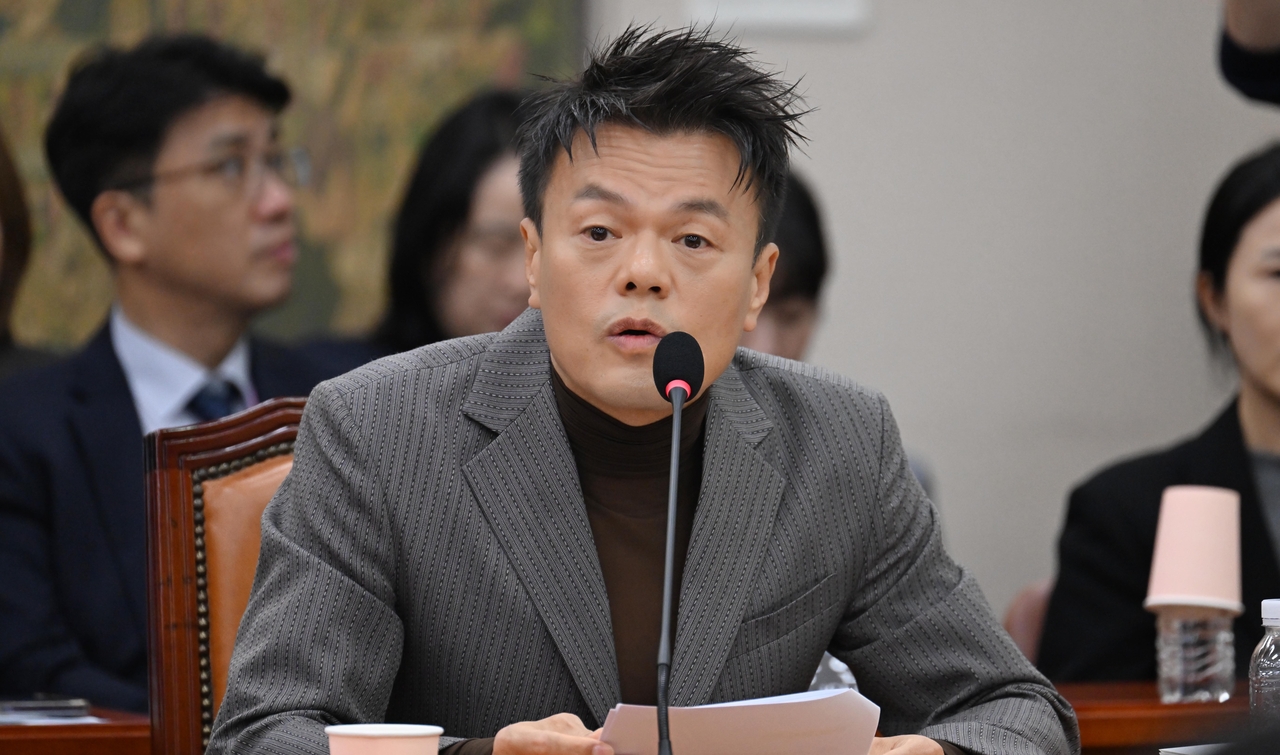
Park added that the unconventional methods stemmed from a fear of losing control of the project. "I think we ended up using various approaches out of a genuine desire to do this right and a worry that someone might take it away," he said. "I do think they were abnormal methods."
Jeong drew a parallel to cases in which local governments had struggled to secure trademarks after private individuals filed first — citing the "Buchang-i" mascot trademark dispute — and said that if a bad-faith individual had filed the Fanomenon trademark first, Wednesday's audit would have been about why the process was handled so clumsily.
Culture Minister Choi Hwi-young also pushed back against the favoritism allegations. "Fanomenon is not a case of the four major agencies muscling into a government event to seek some vested interest," Choi said. "It is a process of working together to further leverage the global achievements the four companies have already built." He added that the event could not go forward if any party stepped away, and asked for understanding of "the particular circumstances of how this work is unfolding."
Democratic Party of Korea lawmaker Choi Min-hee asked Park directly whether he had personally profited from filing the Fanomenon trademark first — whether he had actually made money from it — and suggested he had in fact spent more than he gained. Park replied, "I still find it rewarding. What is certain is that I will not hold the trademark myself," adding that personal funds had gone in.
Earlier in the session, Park told the committee in a briefing that the Fanomenon awards ceremony and festival should be privately led given the nature of the project. "The four K-pop companies have, for the first time, established a single joint company with equal capital contributions and equal voting rights," he said. He acknowledged, however, that "there is still an enormous amount of trial and error in figuring out how the public and private sectors should collaborate."
Fanomenon is a combined event featuring K-pop concerts, a fandom awards ceremony, and exhibition and experience programs by K-culture companies, scheduled for December next year.
shee@heraldcorp.com