Current purchase pace equals about 13 months of backlog on average; North Chungcheong at 27 months
Government targets 4,200 ha this year, but Korea Rural Community Corporation plans only 3,700 ha
Year-end backlog forecast at 3,220 ha, up 9.1% from last year
Agriculture minister acknowledges preparation was insufficient
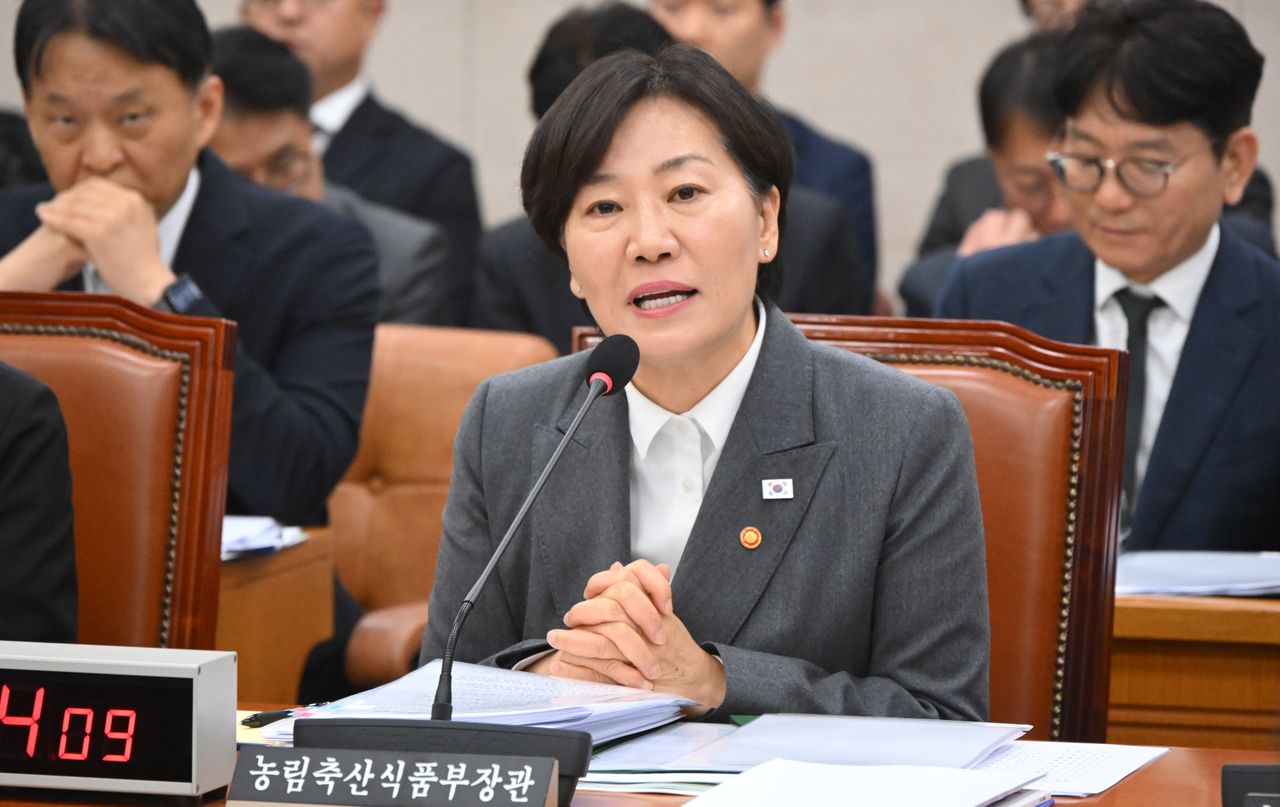
As a nationwide farmland survey gets underway, the backlog of farmland awaiting purchase by the farmland bank — which helps farmers sell or lease their land — has reached 3,320 hectares, according to data presented at a parliamentary audit Wednesday. At the current pace of acquisitions, that represents roughly 13 months' worth of purchases nationwide, with some regions facing waits of more than two years. Even if the government buys all the land it has planned for this year, the year-end backlog is forecast to be 9.1 percent larger than at the end of last year. Agriculture, Food and Rural Affairs Minister Song Mi-ryeong acknowledged responsibility after lawmakers said the government had failed to adequately prepare for the survey's knock-on effects on financial markets, including a drop in new farmland loans.
At Wednesday's national audit of the Ministry of Agriculture, Food and Rural Affairs by the National Assembly's Agriculture, Food, Rural Affairs, Oceans and Fisheries Committee, ruling and opposition lawmakers pressed the ministry on follow-up measures covering farmland bank demand, land prices, a slowdown in transactions, and financial issues arising from the comprehensive farmland survey.
Data submitted to Rebuilding Korea Party lawmaker Shin Jang-sik by the Korea Rural Community Corporation showed that as of the end of August, applications to sell farmland for public lease purposes totaled 5,345 ha. Of that, 2,025 ha had been purchased, leaving 3,320 ha in the queue. The purchase rate stood at 37.9 percent.
Based on the monthly average purchase volume from January through August, the backlog amounts to roughly 13 months' worth of purchases nationwide. North Chungcheong Province had 433 ha pending — about 27 months' worth — while Gangwon Province had 307 ha, equivalent to about 26 months. South Chungcheong Province had the largest absolute backlog at 740 ha, followed by North Jeolla Province at 619 ha and North Chungcheong Province at 433 ha. Those three provinces account for 54.0 percent of the total backlog.
A gap also emerged between the government's stated purchase target and the actual plan of the Korea Rural Community Corporation, which operates the farmland bank. The Ministry of Agriculture, Food and Rural Affairs said it had expanded this year's public-lease farmland purchase target from 2,500 ha last year to 4,200 ha, but the corporation's own annual purchase plan stands at 3,700 ha — 500 ha short.
The corporation estimated total farmland sell-off demand this year at 6,920 ha, combining 2,951 ha carried over from the end of last year with an expected 3,969 ha in new applications. Its 3,700 ha annual purchase plan covers only 53.5 percent of that projected demand.
Even if the full 3,700 ha is purchased as planned, the year-end backlog is expected to reach 3,220 ha — 269 ha, or 9.1 percent, more than the 2,951 ha carried over from the end of last year. By year-end, South Chungcheong Province is projected to have 764 ha waiting, North Jeolla Province 626 ha, and North Chungcheong Province 492 ha.
Shin said the problem was not a lack of publicity but flawed preparation and sequencing, arguing that the farmland bank cannot be presented as an exit route for the survey unless it first has the capacity to absorb actual demand. He also raised concerns that new farmland loans fell 33.1 percent during the survey period and that the collateral value of orchards and dry fields was declining.
"We did prepare to some extent, but not sufficiently," Song said. "I feel responsible for the parts where I fell short. I should have looked after things more carefully, and where I did not, I will do so going forward."
Anxiety in the field over the comprehensive farmland survey also ran through questions from both ruling and opposition lawmakers.
Democratic Party of Korea lawmaker Lee Jae-gwan said there had been insufficient advance explanation of the survey's purpose, procedures, and how its findings would be used. He noted that practices long accepted in rural communities — such as leasing inherited farmland, renting land by elderly farmers, or operating unregistered agricultural storage facilities — were being flagged as non-compliant under current law, leaving farmers worried about disposal orders and penalty fees.
Song acknowledged that the ministry "did not communicate carefully enough." She reaffirmed that even where practices are classified as illegal under current law, those that do not fit rural realities will be addressed through special legislation or other measures.
People Power Party lawmaker Lee Seong-gwon raised the issue of falling farmland prices and a slowdown in transactions. Presenting data showing a sharp decline in farmland deals since 2022 — including in areas facing population decline — he pressed the minister on the survey's impact on the farmland market.
Song said the declines in farmland prices and transaction volumes had been a continuing trend since 2021, predating the survey. She rebuffed the criticism by noting that farmland transactions from January through August this year were up 2.3 percent from the same period last year, and that farmland transaction prices rose about 19 percent in July, making it difficult to assess the overall market based on a single point in time or a single region.
People Power Party lawmaker Lee Yang-su also cited field conditions in which elderly farmers trying to sell land to pay off debts were finding transactions difficult, and called on the government to address falling farmland prices and the transaction slowdown.
Democratic Party lawmaker Song Ok-ju said the growing number of farmland owners living outside their registered areas, combined with a significant share of tenant farmers, meant the changed structure of farmland ownership and use needed to be reflected in policy.
Song said data were needed to reform farmland rules that no longer match reality, describing the comprehensive survey as a process of gathering the baseline information required for institutional reform.
People Power Party lawmaker Kim Seon-gyo called on the government to clarify the principles behind its farmland policy, given the tension between the comprehensive survey and policies to expand farmland use. The audit also touched on agri-solar power generation and the use of fallow land, with debate continuing over how to raise farm household income while preserving the agricultural production base.
The government plans to increase next year's budget for the farmland bank to expand its capacity. The Ministry of Agriculture, Food and Rural Affairs submitted a next-year budget of 2.26 trillion won ($1.68 billion) for tailored farmland support programs including farmland purchases — a record high, up 25.1 percent from this year.
"Taking into account the backlog and other factors, we have increased next year's farmland bank budget by 25 percent compared to this year and also raised the farmland pension to a record level," Song said. "It is still not enough, and I will work to secure additional funding at the National Assembly stage."
The Ministry of Agriculture, Food and Rural Affairs plans to wrap up field surveys this month. Routine violations identified during the process will be addressed through special measures legislation the government aims to enact by year-end, and the Farmland Act will also be revised to better reflect rural realities.
adastra@heraldcorp.com