City unveils three-pronged plan for Namsinhang Phase 2 project
1.08 trillion won investment to build 70,000-DWT berths
'Stable energy supply and global market connectivity' cited as goals
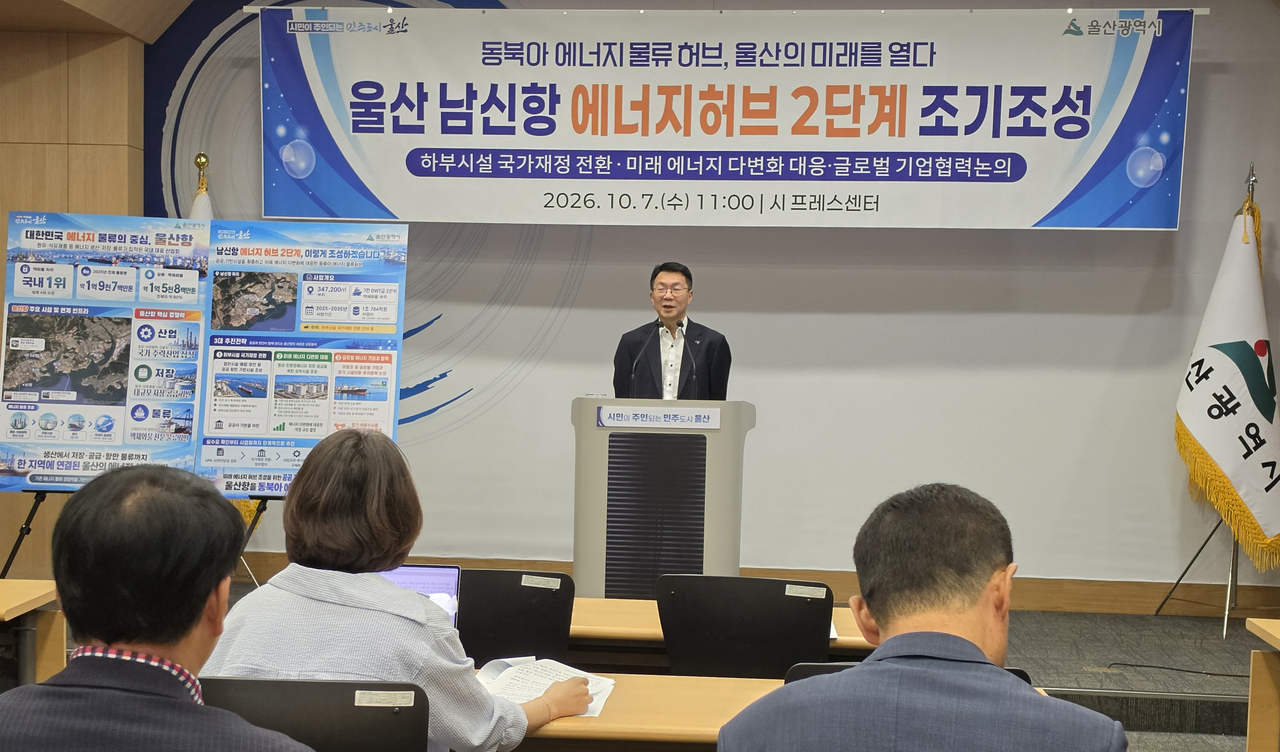
Ulsan port is set to evolve into a Northeast Asia energy logistics hub, expanding beyond its traditional role in crude oil and petroleum products to store and supply future energy sources including hydrogen, ammonia and methanol. Last year, the port handled 158 million tons of liquid cargo — including crude oil and petroleum products — in imports and exports, ranking first in South Korea and fourth in the world for liquid cargo throughput.
Ulsan city announced three key directions Wednesday for the Namsinhang Energy Hub Phase 2 project, a core infrastructure initiative tied to the city's campaign pledge to establish a Northeast Asia energy logistics hub under its ninth elected administration. The three directions are: a preliminary feasibility review and consultations with the central government on converting lower-infrastructure costs to national fiscal funding; planning upper-facility structures to accommodate diversified future energy needs; and pursuing long-term usage and investment cooperation with global energy companies.
The city plans to consult with the government on shifting the national fiscal burden for lower infrastructure — including berthing facilities, land reclamation and seawalls — while designing upper facilities to meet future demand for clean energy sources such as hydrogen, ammonia and methanol. It will also explore long-term usage and investment cooperation with global energy majors, including Saudi Arabian Oil Company (Aramco).
![A map showing the location of Namsinhang in Ulsan. [Ulsan city government]](https://wimg.heraldcorp.com/news/cms/2026/10/07/news-p.v1.20261007.f0c91e62d5484b2a99ba61aa4b92e35e_P1.png)
The Namsinhang Energy Hub Phase 2 project calls for the construction of two liquid cargo berths with a deadweight tonnage of 70,000 DWT on a 347,000-square-meter offshore site in Wonsan-ri, Onsan-eup, Ulju-gun, Ulsan. A Korea Development Institute preliminary feasibility study conducted in 2017 put the total investment cost at 1.08 trillion won ($803 million).
Ulsan city will work with the government to secure national fiscal funding for lower infrastructure, including berthing facilities, land reclamation and seawalls. Starting next month and running through October next year, the city will conduct a preliminary feasibility review through the Ulsan Port Authority covering project demand, appropriate facility scale, costs and economic viability, while consulting with relevant agencies on necessary adjustments to national plans.
The city will also review the appropriate scale of upper facilities to move beyond the existing crude oil-focused storage plan and better respond to shifting energy demand and future energy diversification.
Alongside this, the city will hold discussions with global energy companies, including Aramco, as well as domestic firms, on prospects for long-term facility use and investment cooperation. Ulsan Mayor Kim Sang-uk is set to visit Saudi Arabia and the UAE next month to pursue investment cooperation on the project.
"Recent geopolitical instability in the Middle East has reaffirmed the importance of supply chains capable of delivering stable energy supplies," said Shin Min-sik, Ulsan's deputy mayor for economic affairs. "We will advance this Namsinhang energy hub project at the national level."
cityblue@heraldcorp.com