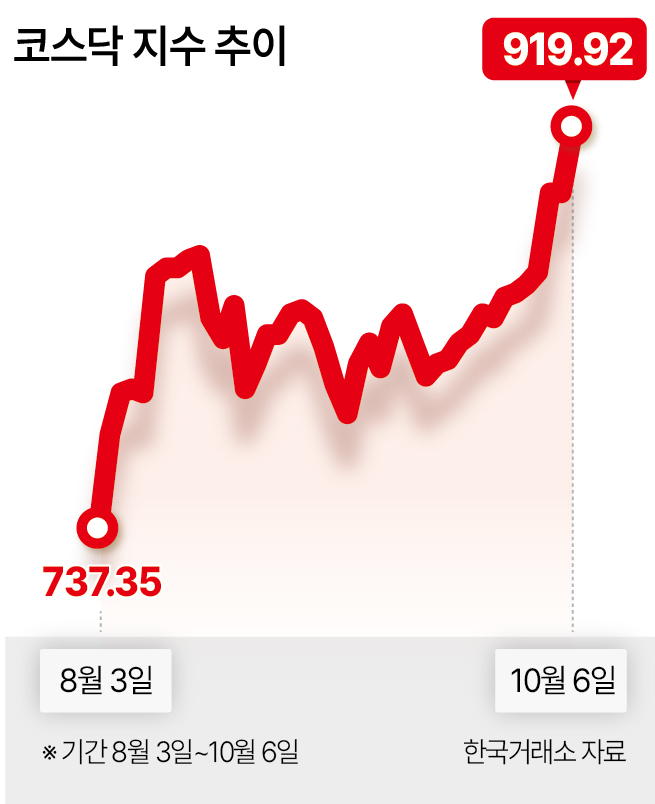
The Kosdaq has reclaimed the 900-point level for the first time in about three months, led by a rally in semiconductor materials, parts and equipment stocks whose gains have far outpaced those of Samsung Electronics and SK hynix. Analysts say investment funds have rotated into the Kosdaq semiconductor supply chain as capacity expansion expectations at home and abroad compound the supply-demand pressure weighing on large-cap chipmakers.
According to Korea Exchange, the Kosdaq opened Wednesday down 2.47 points, or 0.27 percent, at 917.45.
The index reclaimed the 900-point mark for the first time since July 1, roughly three months ago. After trading in a box range around the 800-point level since August, it accelerated its gains this month — crossing 890 on Thursday before breaking through 910 on Tuesday.
From Sept. 4 through Tuesday, the Kosdaq rose 16.41 percent, sharply outpacing the Kospi's 5.5 percent gain over the same period. Institutional investors net purchased 1.81 trillion won ($1.35 billion) on the Kosdaq during that stretch, underpinning the index's advance.
Semiconductor materials, parts and equipment stocks drove the rally. The Kosdaq 150 IT index surged 37.07 percent over the past month, the highest gain among Kosdaq-related indexes. The index is composed of major IT companies, including semiconductor materials, parts and equipment makers.
Gains in individual stocks also far exceeded those of the two Kospi semiconductor heavyweights. Over the past month, Jusung Engineering and Wonik IPS rose 65.77 percent and 70.00 percent, respectively. HPSP (37.05 percent), Leeno Industrial (35.15 percent), Simtec (48.94 percent), Hana Micron (52.16 percent) and SFA Semiconductor (108.72 percent) also posted sharp gains. By comparison, Samsung Electronics and SK hynix rose just 8.80 percent and 11.09 percent, respectively, over the same period.
The composition of top Kosdaq stocks by market capitalization has also shifted from biotech-dominated to semiconductor-led. Jusung Engineering climbed as high as second place by market cap during intraday trading on Tuesday. Wonik IPS, Simtec, EO Technics and Leeno Industrial also ranked among the top names. At the start of the year, Leeno Industrial — ranked ninth — was the only semiconductor-related stock among the top 10 Kosdaq companies by market cap.
Analysts say large-scale capacity expansion plans by major domestic and overseas chipmakers are lifting investor sentiment toward the materials, parts and equipment sector. "Given the sweeping capacity expansions by chipmakers, the 2027 equipment market outlook is likely to be revised upward further," said Kim Rok-ho, an analyst at Hana Securities. "Domestic memory chip makers are also set to begin investing in new factories in earnest. Both front-end and back-end process companies remain in a zone where investment ideas are valid."
Hwang San-hae, an analyst at LS Securities, said the Kosdaq rally was driven by the materials, parts and equipment sector's benefit from the large-scale capital expenditure commitments of major chipmakers becoming more visible. "Given that the Kosdaq and the materials, parts and equipment sector have structural tailwinds and limited exposure to the sustained foreign selling trend, their relative outperformance is expected to continue," he said.
Supply-demand pressure on Samsung Electronics and SK hynix shares is also cited as a factor behind the strength in Kosdaq semiconductor stocks. With the buybacks by Samsung Electronics and SK hynix expected to wrap up this month, profit-taking has emerged ahead of the anticipated supply vacuum. "Rotation centered on the downstream value chain is expected to continue until the supply-demand burden on large-cap memory stocks eases," said Lee Jun-young, an analyst at Eugene Investment & Securities.
Even as the Kosdaq has broken through 900, some analysts advise focusing on individual sectors rather than chasing the index. "The gains are concentrated in select IT sectors and themes — semiconductor materials, parts and equipment, substrates and telecom equipment — rather than a broad improvement in earnings estimates across the index," said Kim Se-bin, an analyst at Yuanta Securities Korea. "Rather than chasing the index, investors should narrow their focus to sectors where earnings and sales estimates are in fact rising."
moon@heraldcorp.com