IP agency to certify, consumers to verify, Interpol to pursue — a layered shield for K-brands abroad
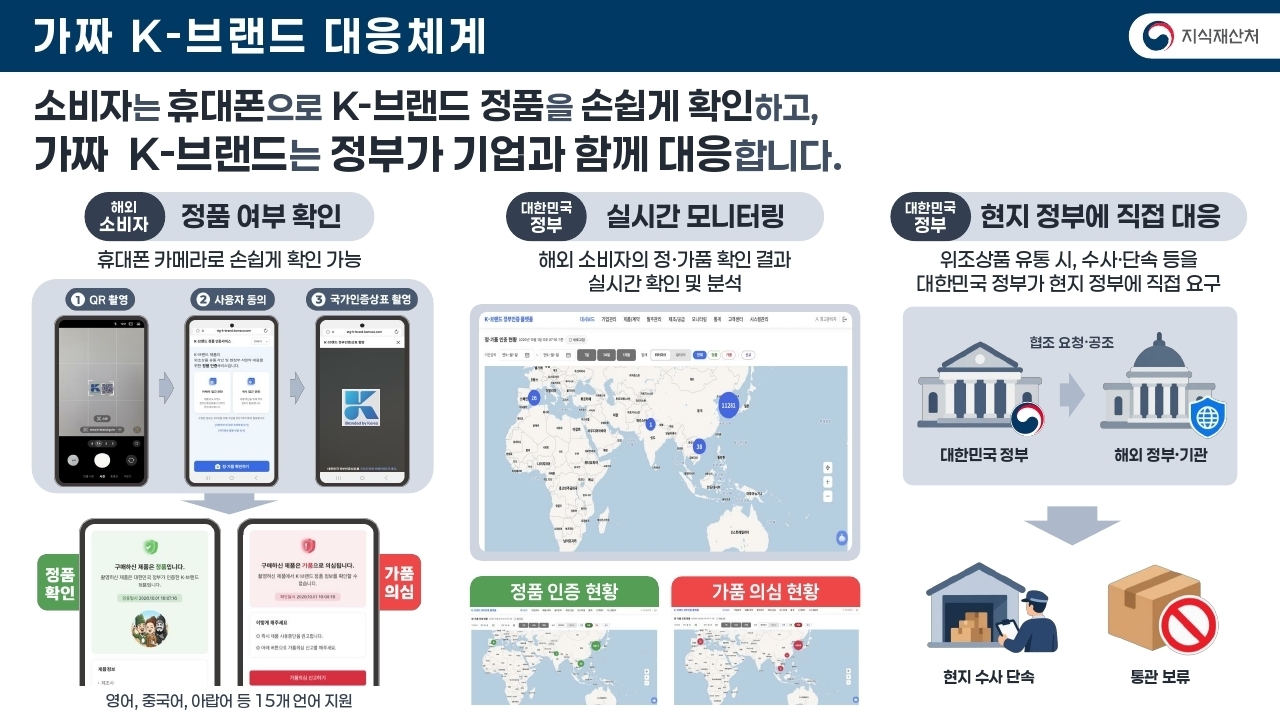
South Korea's government is stepping in as the direct rights holder of a national certification trademark to crack down on the proliferation of counterfeit K-brand goods overseas.
The Intellectual Property Agency announced Wednesday that it is formally launching the K-Brand Government Certification System.
According to an OECD report published in 2024, the global distribution of counterfeit K-brand goods is estimated at around 11 trillion won ($8.1 billion). The unauthorized pre-registration of K-brand trademarks and the spread of hallyu-riding products designed to be mistaken for those of Korean companies have made it increasingly difficult for individual businesses to respond on their own.
At the heart of the new system is the government's use of trademark rights — a form of intellectual property protected internationally through treaty — to stand alongside companies in fighting counterfeits, with the South Korean government itself as the rights holder of the national certification trademark. When the national certification trademark is counterfeited abroad, the South Korean government, as the aggrieved rights holder, will actively exercise its trademark rights to the extent protected under each country's laws.
Korean companies may voluntarily decide whether to use the national certification trademark and, if they choose to participate, may affix it to their products. The trademark will also incorporate the latest product-authentication technology developed by the Korea Minting and Security Printing Corporation, drawing on expertise accumulated through currency manufacturing, to make counterfeiting more difficult.
Overseas consumers will be able to scan the national certification trademark on K-brand products using their phone camera — no separate app required — to instantly verify authenticity. The government will analyze scan data to identify regions where counterfeit goods are circulating and share that information with local investigative and enforcement agencies for use in crackdowns.
So far, 31 companies have applied to participate, including Samyang Foods, Amorepacific, Korea Ginseng Corporation and a number of high-performing small and medium-sized enterprises. Their trademarks have already been filed domestically — completed in September — and are set to be filed in 73 major export markets by the end of the year.
Participating companies will receive access to a genuine-versus-counterfeit product monitoring system. Small and medium-sized enterprises and mid-sized companies will be eligible for up to 200 million won in support per company toward the cost of adopting the authentication technology. Additional benefits include discounts on export insurance premiums from Korea Trade Insurance Corporation (K-SURE), bonus points for participation in export trade fairs organized by KOTRA, and dedicated sales booths on the Korea International Trade Association's TradeKorea platform.
Promotional efforts targeting overseas consumers will also be stepped up. The agency plans to produce promotional videos featuring hallyu stars for concentrated distribution on global platforms such as YouTube and TikTok, with the goal of building a culture in which overseas consumers routinely scan the national certification trademark "K" to verify authenticity.
The agency will also strengthen its overseas investigation and enforcement capabilities. It plans to dispatch specialists to Interpol to actively pursue those who manufacture or distribute counterfeit K-brand goods on a habitual or large-scale basis. The agency will also continue pressing foreign governments, through bilateral networks, to step up investigations, enforcement actions and customs holds on counterfeit K-brand goods.
Together, these measures are intended to build a tight overseas protection framework for K-brands — running from government certification to consumer verification to the tracking and international investigation of counterfeit goods.
"K-brands are more than just an asset belonging to our companies — they are a precious national asset built through the passion and determination of the Korean people," Intellectual Property Agency Commissioner Kim Yong-seon said. "The South Korean government will provide solid backing so that our companies do not suffer unjust harm from counterfeit goods abroad, and so that K-brands can be trusted and chosen anywhere in the world."
Companies wishing to join the K-Brand Government Certification System may apply through the program's online application portal through Nov. 10. For further details, inquiries can be directed to the Korea Intellectual Property Protection Agency.
kwonhl@heraldcorp.com