Park Hyung-woo concentrates administrative efforts on laying groundwork for future growth at 100-day mark of elected 9th term
District strengthens community-level services while pushing Gyeyang Techno Valley and expanded transit network
Daejang–Hongdae line extension to Gyeyang and Cheongna planned alongside balanced development of new and old districts
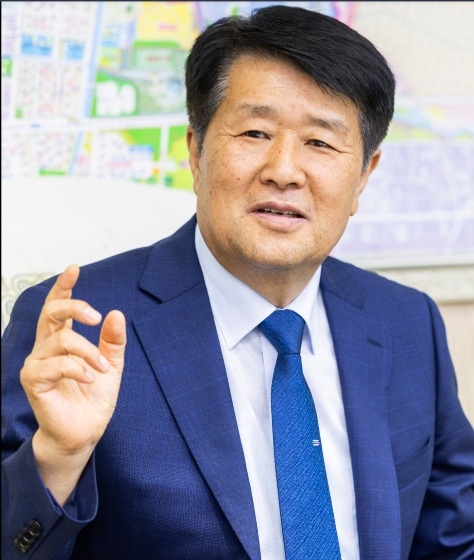
Incheon's Gyeyang-gu District Mayor Park Hyung-woo has marked 100 days in the elected 9th term by strengthening on-the-ground administration close to residents' daily lives while concentrating efforts on building a foundation for future growth through Gyeyang Techno Valley and an expanded regional transit network.
Since the start of the 9th elected term, the district has used the past 100 days not to push aggressively for new projects but to review existing campaign pledges and key pending issues and lay the groundwork for their implementation.
A central direction of the 9th-term administration is to allocate limited resources efficiently — cutting back on one-off projects and channeling the budget first into initiatives that residents can feel directly in their everyday lives.
Since taking office, Park has visited the administrative welfare centers in all 12 dong neighborhoods to meet residents and has listened firsthand to local concerns through community assemblies and town-hall meetings.
He has also visited major project sites to check on progress and shared residents' concerns with relevant departments, reinforcing a field-centered administrative system.
In education and childcare, the focus has been on making the district a better place to raise children.
In September, following deliberation by the Education Development Committee, the district provided a second round of supplementary education subsidies totaling 257.3 million won ($189,000) across 46 projects at 42 schools — 19 kindergartens, nine elementary schools, nine middle schools and five high schools.
The areas of support were also diversified to include school-specific educational programs, digital education, school environment improvements, fourth industrial revolution education, reading, debate and humanities education, and cultural, arts and physical education activities.
Childcare infrastructure is also being expanded. The district is working to open public nurseries in the A2 and A3 blocks of the Gyeyang 3rd-generation new town, targeting an opening in February next year, and aims to minimize childcare gaps as new residents — particularly young families and newlyweds — move in and demand is expected to rise.
In 2027, three additional public nurseries are planned to open in the Jakjeon Hyundai redevelopment zone and the Hyosung urban development zone.
Convenience for multi-child families is also being improved. To eliminate the need to prove the number of children each time they used a public parking lot, the district introduced an advance registration system for automatic parking fee discounts. Once registered, vehicles are identified by license plate recognition and receive the discount without any additional documentation. Families with three or more children receive a 100 percent discount; those with two children receive 50 percent off.
The district is also concentrating efforts on improving the living environment. Repair work is under way on aging and damaged sidewalks, curb stones and storm drains, with a focus on the everyday infrastructure residents use most.
Rather than waiting for resident complaints, the district has strengthened proactive field responses — with dong and tong leaders conducting patrols to identify road damage, illegal dumping and other daily inconveniences before reports are filed.
Parks are also being maintained, with post-monsoon inspections of benches, pergolas, exercise equipment, sunken walking paths, soil erosion and hazardous trees, followed by ongoing repairs as needed.
Alongside this community-level administration, the district is accelerating major development projects and transit expansion that will shape Gyeyang's future.
At the center is Gyeyang Techno Valley. In August, planning approval and public notice were completed for the entire urban advanced industrial complex, and in September a revised approval for the public housing district plan was secured. In December, the A2 and A3 blocks in the Gyeyang area are set to welcome their first move-in residents — the first among all third-generation new towns to do so.
The district envisions developing Gyeyang Techno Valley not as a simple residential new town but as an economically self-sustaining city that combines industry and employment.
To that end, the district plans to attract AI, robotics and other future-industry companies — including anchor firms — to the urban advanced industrial complex, and to build an advanced industrial ecosystem by linking it with the existing Seooun and Gyeyang industrial complexes.
Expanding the transit network is considered a key task directly tied to the success of Gyeyang Techno Valley.
The district is pursuing extensions of the Daejang–Hongdae line to Gyeyang and Cheongna, as well as a separate extension to Gyeyang Techno Valley.
A joint public-private petition drive held from Aug. 31 to Sept. 30 drew more than 285,000 signatures.
The proposed Daejang–Hongdae line extension would run from Bucheon's Daejang through Gyeyang, Seooun, Jakjeon and Hyosung before connecting to Gajung and Cheongna.
The Gyeyang Techno Valley extension proposal envisions a line connecting Bucheon's Daejang to Gyeyang Techno Valley and the urban advanced industrial complex.
The district plans to deliver the petition results to relevant agencies and continue negotiations to have the routes included in national and metropolitan railway network construction plans.
Coordination with political circles and related agencies to secure national and city government funding is also being strengthened. The district held policy consultations with National Assembly members and city council members, sharing details of 16 projects requiring national and city funding support.
Cooperation is also being pursued on a range of local issues, including inclusion in national and metropolitan railway network plans, a second phase of waterfront space development along the western main canal, and designation of priority sewer improvement zones.
Another pillar of the 9th-term district administration is balanced development between the new town and the existing urban core.
As Gyeyang Techno Valley and the third-generation new town development gain momentum, there are concerns that concentrating administrative resources on new-town growth could widen the gap with the existing urban core. The district therefore plans to pursue redevelopment, reconstruction, urban regeneration and residential environment improvements in tandem.
"It is important to listen directly to residents' voices in the field and reflect them in district administration," Park said. "Going forward, I will continue to communicate with residents, pay close attention to everything from small everyday inconveniences to major local issues, and fulfill our promises to residents one by one."
gilbert@heraldcorp.com