Korea Capital Market Institute report: 'Perpetual futures, institutional integration and changes in derivatives markets'
Perp market expands from crypto to stocks and ETFs
Cboe share price drops 9.8% among exchanges hit hardest
Samsung Electronics, SK hynix perps already trading offshore
![[Created using ChatGPT]](https://wimg.heraldcorp.com/news/cms/2026/10/06/news-p.v1.20261006.b14fe28326f6442a9b099d0b819d2193_P1.png)
Growing offshore trading of perpetual futures — known as perps — tied to Korean stocks such as Samsung Electronics and SK hynix has prompted calls for domestic investor protection measures, according to a new report. Analysts say South Korea's derivatives market must also move to strengthen its competitiveness by introducing longer-dated products and extending trading hours.
Nam Gil-nam, a senior research fellow at the Korea Capital Market Institute, said Tuesday that "measures to protect domestic investors are needed in response to the growth of offshore perpetual futures linked to Korean equities," adding that "strategies to maintain the competitiveness of the domestic derivatives market are required." The remarks came in a report titled "Perpetual Futures, Institutional Integration and Changes in Derivatives Markets."
Perps are derivatives with no expiration date, sparing investors the need to periodically roll over their positions into the next contract. Their ability to consolidate trading across multiple maturities into a single contract fueled rapid growth in the digital asset market. They typically operate through a funding-rate mechanism in which buyers and sellers exchange periodic payments to keep the contract price aligned with the spot price.
The underlying assets for perps have recently expanded beyond digital assets to include equities, ETFs and energy products. Binance, for example, launched a perp service covering traditional financial assets this year. An offshore perp market offering high leverage on Samsung Electronics, SK hynix and Korea-linked equity index ETFs is also growing rapidly.
Nam called for financial investment business regulations and investor protection rules to cover offshore digital asset trading. He noted that while unregistered foreign virtual asset service providers operating in Korea have been regulated under the Act on Reporting and Using Specified Financial Transaction Information, perps based on stocks or ETFs require a separate and tailored regulatory response.
Nam also raised concerns that a more active perp market could erode the price-discovery function of domestic markets. "If offshore perps on Korean stocks — which trade around the clock — become even more active, price discovery could become fragmented overseas, weakening the domestic market's contribution to price formation and reducing order concentration," he said.
The spread of perps could also reshape the revenue model of traditional derivatives exchanges, the report noted. In conventional futures markets, exchanges earn fees each time investors roll contracts over at expiration. Round-the-clock perp trading would inevitably force changes to existing trading hours, clearing and settlement systems as well.
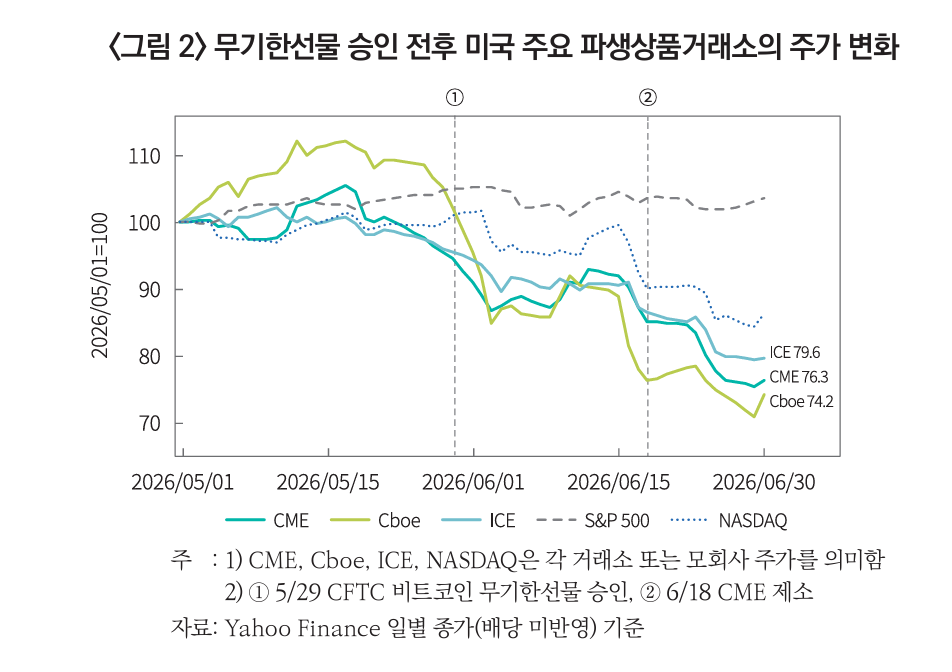
The market impact was already visible in practice. When the US Commodity Futures Trading Commission approved bitcoin perps as exchange-traded derivatives on May 29, shares of major US derivatives exchanges fell sharply on the next trading day, June 1 — the Chicago Mercantile Exchange dropped 5.8 percent, Cboe Global Markets fell 9.8 percent and Intercontinental Exchange declined 2 percent. Nam said the moves likely reflected "investor concerns about new competitive threats being priced into the shares."
Global exchanges have already begun responding. The CME last year introduced spot-quoted futures — contracts referenced to the spot price and holdable for up to five years without rolling over — while Cboe listed long-dated futures with a 10-year maturity.
Others have extended trading hours or forged overseas partnerships. Starting in May, the CME introduced around-the-clock trading for digital assets and some precious metals derivatives. ICE made a strategic investment in OKX and arranged for its own benchmarks to be used in crude oil perps. Singapore Exchange launched bitcoin and ether perps directly.
Nam said that "even without launching perps, strategies are needed to maintain the competitiveness of the domestic derivatives market — including listing longer-dated products permissible under current rules, extending trading hours and monetizing benchmark data."
kyoung@heraldcorp.com