![SpaceX's next-generation Starship rocket lifts off atop a Super Heavy V3 booster from Starbase in Boca Chica, Texas, on Sept. 28 (local time). The vehicle completed its first orbital flight and deployed Starlink V3 satellites in space for the first time. [SpaceX]](https://wimg.heraldcorp.com/news/cms/2026/10/06/rcv.YNA.20261003.PUP20261003004701009_P1.jpg)
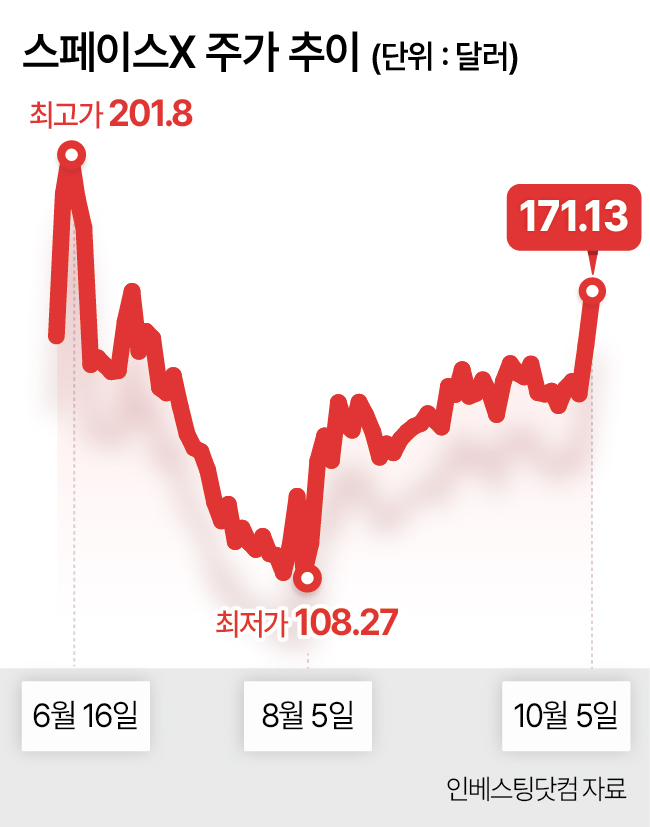
"Cheap and getting cheaper." That is how Morgan Stanley described SpaceX shares after the stock surged more than 7 percent on Monday (local time), breaking above the $170 mark. The investment bank reaffirmed its $300 price target, citing the growth potential and profitability of SpaceX's AI computing business. Since Starship's 14th test flight on Sept. 28 (local time), the stock has climbed more than 17 percent over five trading sessions.
SpaceX closed at $171.13 on Monday, up 7.66 percent from the previous session — the first time the stock has crossed the $170 threshold since its June listing, roughly three months ago. The gain far outpaced the broader technology sector. The NASDAQ hit a new all-time high, rising 1.05 percent, while major tech stocks including Nvidia and Microsoft also advanced, though most posted gains of around 2 percent.
The sharp rally was driven in large part by Morgan Stanley putting specific numbers behind its bullish case on SpaceX's AI business. The bank maintained its "overweight" rating and $300 price target — about 75 percent above the current share price. While the target itself was not raised, the bank offered concrete justification for its longstanding view that the stock is undervalued given the growth trajectory of its AI operations.
Morgan Stanley argued that the AI business is not yet adequately reflected in the share price. At around $160 per share, the bank estimated that the AI segment accounts for just $32 per share — roughly 20 percent of the total. If the enterprise AI business matures fully, however, Morgan Stanley valued that segment alone at $165 per share, more than five times what the current price implies.
Underpinning that valuation is the expectation that SpaceX can convert its large-scale AI computing infrastructure into a genuine revenue business. The company is expected to deploy 4.1 gigawatts of data center power for AI computing — roughly equivalent to three large nuclear power plants of 1.4 gigawatts each. The plan envisions building out that capacity and then selling AI computing services to corporate clients, with the pace of facility ramp-up and customer acquisition seen as the key determinants of business value.
Profitability hinges on the price SpaceX can charge for those services. Morgan Stanley estimated the company could sell AI computing capacity at up to 2.8 times the market consensus, projecting revenue of $30 to $50 per watt through its neocloud business — well above the market estimate of $17.60 per watt.
Progress in securing the semiconductor supply chain needed to expand AI computing infrastructure has also supported the recent rally. Elon Musk said Monday that SpaceX is in early discussions with TSMC regarding its Terafab project. No agreement has been reached, but the talks raise the possibility that SpaceX could draw on TSMC's technology and manufacturing expertise as it builds its own chip production base. Terafab is SpaceX's planned large-scale facility that would handle chip design, fabrication, packaging and testing under one roof.
The potential for additional institutional buying has also come back into focus. Morgan Stanley said it surveyed 40 major clients on whether they held SpaceX shares and "not a single hand went up," underscoring that large institutional investors have yet to build meaningful positions in the stock.
Beyond the AI business, progress on Starship — SpaceX's core launch vehicle — remains a key share price catalyst. The 15th test flight is expected to feature a "ship catch," in which the returning Starship is grabbed directly by the launch tower's recovery mechanism. Because the technology enables rockets to be recovered and reused, a successful catch would lower launch costs, shorten turnaround times and increase launch frequency. Adam Jonas, a Morgan Stanley analyst, said a successful ship catch could be "the strongest share price catalyst since the IPO."
The fuel supply chain needed to support an expanded launch schedule has also moved into the active investment phase. A SpaceX subsidiary is pursuing construction of a 32.4-mile natural gas pipeline at its Cape Canaveral launch facility in Florida. The site currently receives liquefied natural gas by truck — Florida authorities say a single launch requires hundreds of trucks — and the existing gas infrastructure cannot meet the volume and reliability SpaceX requires, prompting the push for a dedicated pipeline.
South Korean investors already hold close to 3.7 trillion won worth of SpaceX shares. According to the Korea Securities Depository's SEIBRO system, as of Monday domestic investors held $2.736 billion in SpaceX stock, ranking it 18th among all foreign equities by custody value. From Sept. 28 through Monday — the period surrounding the 14th test flight — Korean investors net purchased nearly 50 billion won in additional shares, reflecting renewed buying interest around the launch.
The next major share price catalyst is Starship's 15th test flight, currently scheduled for late October to early November.

kacew@heraldcorp.com