First ruling to void delisting rule on illegality grounds
Next year's tighter market-cap threshold now in question
Kosdaq quality-improvement drive faces its biggest test
![Korea Exchange's Yeouido office in Yeongdeungpo-gu, Seoul [Korea Exchange]](https://wimg.heraldcorp.com/news/cms/2026/10/06/news-p.v1.20260427.c2e3e5354ac244c985382abeaecddb47_P1.png)
A court has ruled that Korea Exchange's market-capitalization-based delisting rule is illegal and void, throwing the government's campaign to purge weak companies from the market into disarray. The decision raises the prospect of delays in removing companies already in delisting proceedings and is expected to complicate a planned tightening of the market-cap threshold scheduled for next July. Analysts say the government's broader drive to improve the quality of the Kosdaq market will now need to be reconsidered.
Seoul Southern District Court's Civil Division 51 granted injunctions Friday sought by Jooyontech, a Kospi-listed company, and Kmpharmaceutical, a Kosdaq-listed company, suspending Korea Exchange's delisting decisions against each firm, according to the financial investment industry and legal circles Tuesday. It marks the first time a court has ruled on the government and the exchange's tightened delisting requirements.
The court found that the rule allowing a company to be delisted solely for failing to meet the market-cap threshold — with no separate opportunity to make its case — clearly violated the principle of proportionality and was therefore illegal and void. The ruling took issue with three aspects of the regulation: companies were given no right to appeal or present their case; the requirement to maintain the market-cap threshold was tightened to 45 consecutive trading days; and the timeline for raising the market-cap standard was brought forward by six months.
The panel said market capitalization, unlike an outright default or complete capital impairment, is subject to external factors beyond a company's control — such as economic shocks and shifts in investment flows. It therefore held that companies falling short of the market-cap threshold must be given an opportunity to demonstrate their viability through an appeal or a review by a listing examination committee.
The court also said the decision to accelerate the tightening of the market-cap maintenance threshold ahead of the original schedule lacked concrete justification. It found that companies were not given sufficient time to prepare, undermining the principle of proportionality and reasonable predictability.
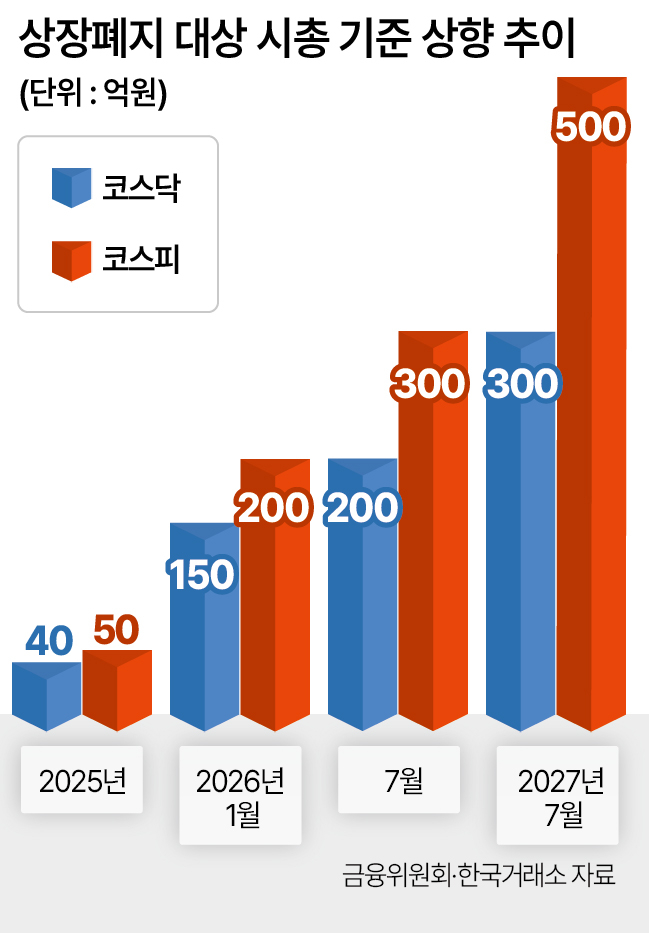
The Financial Services Commission and Korea Exchange had originally planned to raise the thresholds in annual steps — to 30 billion won ($22.1 million) for Kospi and 20 billion won for Kosdaq in 2027, then to 50 billion won for Kospi and 30 billion won for Kosdaq in 2028. The schedule was later accelerated to a semi-annual cycle, with the 30 billion won threshold for Kospi and 20 billion won for Kosdaq taking effect in July.
The validity of the 45-consecutive-trading-day requirement also came under scrutiny. Under current rules, a company placed on the watchlist for falling below the market-cap threshold must maintain that threshold for 45 consecutive trading days within a 90-trading-day window to avoid delisting. Previously, a company could avoid delisting by staying above the threshold for 10 consecutive trading days or a cumulative 30 trading days within the same 90-day window. The court said the exchange had failed to provide sufficient empirical evidence to justify the five-trading-day change.
With the court now questioning the market-cap delisting rule itself, there are concerns that a wave of lawsuits could follow from other companies facing removal on the same grounds.
Legal challenges are already mounting. Following Eutilex and Daejin Advanced Materials in July, Kmpharmaceutical, Gold&S, Jeil M&S, Samyung ENC and Jooyontech all filed injunction requests in September to suspend their delisting decisions. Medicox and Pintel joined them Thursday.
Delisting proceedings are also expected to slow. Financial authorities last month deferred the next planned increase in market-cap thresholds — originally set for January — to next July, citing sluggish market conditions. They also introduced a pathway allowing companies that meet certain financial requirements to transfer to the Konex market without going through a liquidation trading period. However, the court's decision to grant the injunctions is expected to lead more companies to stay listed and await a final legal ruling rather than transfer to Konex.
The government's Kosdaq quality-improvement initiative is now seen as facing a serious test. As of Friday, 72 Kosdaq-listed companies — excluding SPACs and preferred shares — had market caps below 20 billion won. Another 44 trade below 1,000 won per share, so-called penny stocks. "The court's brake on market-cap-based delistings means the removal of penny stocks also needs to be revisited," a securities industry official said. "Since the court has raised questions about the delisting rule itself, remedial measures will be needed."
Financial authorities held a meeting Friday to discuss their response, according to sources. The government's reaction has been one of embarrassment. When the FSC announced its delisting reform plan in February — aimed at swiftly and strictly removing insolvent companies — it said injunctions against Korea Exchange delisting decisions were rarely granted. According to the FSC, only two of 85 injunction applications related to delistings over the past five years (2021–2025) had been granted.
Korea Exchange amended the enforcement rules for both the Kospi and Kosdaq listing regulations on the same day. For the Kospi market, it added a new Article 46, Paragraph 3, allowing the watchlist designation to be deferred or suspended in response to a court order. Equivalent provisions — Article 58, Paragraph 3 and Article 59, Paragraph 5 — were added to the Kosdaq rules for the same purpose. As a result, delisting and liquidation trading procedures for Jooyontech and Kmpharmaceutical are suspended pending a final ruling on the merits.
moon@heraldcorp.com