Preliminary Q3 earnings due Thursday; record results expected
Memory chip boom offsets won-dollar exchange rate headwind
Memory division alone seen nearing 110 trillion won in operating profit
HBM4 mass production ramps up; enterprise SSD demand holds firm
![Samsung Electronics Chairman Lee Jae-yong delivers a welcome address at the gala dinner for the Lee Kun-hee Collection world tour, held at the British Museum on Wednesday (local time). [Samsung Electronics]](https://wimg.heraldcorp.com/news/cms/2026/10/06/news-p.v1.20261001.c1c4c34957444870871dbc8a4ad0c0a2_P1.jpg)
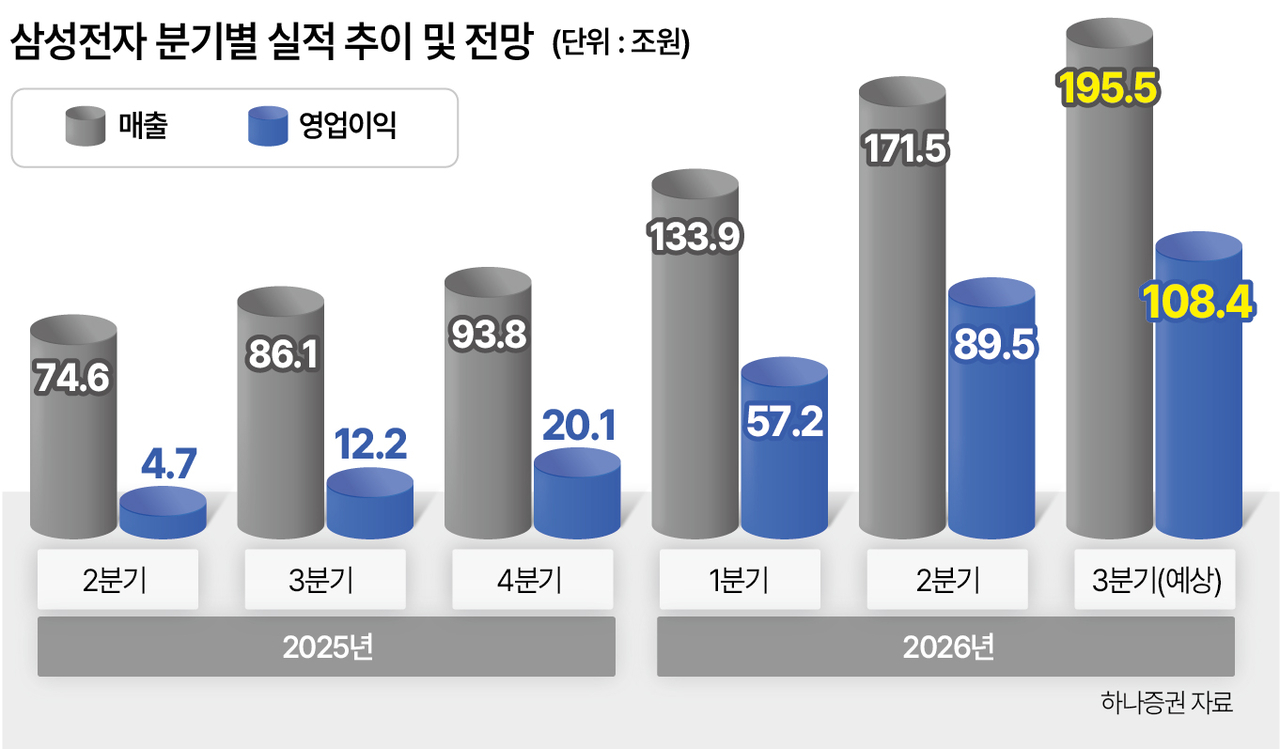
Samsung Electronics is expected to become the first South Korean company to post quarterly operating profit exceeding 100 trillion won ($73.6 billion), even as a sharp decline in the won-dollar exchange rate weighed on third-quarter results. Its memory chip division alone is estimated to have generated close to 110 trillion won in operating profit, more than enough to offset weakness in its finished-product businesses.
Samsung Electronics will release its preliminary third-quarter earnings Thursday morning, according to industry sources. Attention has turned to the industry leader's results after Micron, the world's third-largest memory chip maker, reported earnings that far exceeded market expectations.
Despite the AI-driven memory chip boom, securities firms recently trimmed their third-quarter earnings forecasts for Samsung Electronics, citing the steep drop in the won-dollar exchange rate. After surging past 1,500 won to the dollar in the second quarter, the rate fell sharply into the 1,300-won range in September.
Because domestic semiconductor companies receive export payments in dollars, a weaker dollar reduces their won-denominated revenue, making an earnings impact unavoidable. Kiwoom Securities cut its forecast from 122 trillion won to 107 trillion won, Hana Securities lowered its estimate from 119 trillion won to 108 trillion won, and Samsung Securities revised its projection down from 113 trillion won to 105 trillion won.
Even so, analysts believe Samsung Electronics has set another record, as rising memory chip prices combined with the full-scale mass production ramp-up of HBM4 — its sixth-generation high-bandwidth memory — beginning in the third quarter. With operating profit reaching about 147 trillion won in the first half, the company is widely expected to surpass 360 trillion won for the full year if growth continues in the second half — a figure that would represent a 726 percent increase from the previous year.
Samsung Electronics raised its share of the HBM market by revenue to 33 percent in the second quarter, narrowing the gap with SK hynix, which held a 50 percent share, according to market research firm Counterpoint Research. At its July conference call, Samsung said HBM4 revenue in the third quarter would more than triple from the second quarter, and that HBM4 would account for more than 60 percent of total HBM revenue in the second half of the year.
NAND flash is also contributing to earnings growth, driven by strong demand for enterprise solid-state drives benefiting from the AI boom. The foundry division is expected to have narrowed its losses compared with the second quarter, as utilization rates rose at its 4-nanometer process lines producing HBM4 base dies and Nvidia's AI inference chip, the Grok 3.
The consumer electronics and smartphone businesses, which have struggled with rising component costs, are estimated to have posted losses exceeding 2 trillion won again in the third quarter. Analysts say the memory chip division's strength has continued to absorb those losses and support overall results.
Debate over the pace of AI model development has fueled uncertainty about the sustainability of memory chip demand. Market watchers are also focused on the demand outlook and any new long-term supply agreements Samsung Electronics may announce at its third-quarter earnings conference call, scheduled for later this month.
Some voices in the industry have grown more cautious, noting that recent comments from major technology companies about moderating their AI spending make it harder to expect explosive growth in memory chip demand to continue.
Micron helped ease those concerns on Wednesday (local time), delivering results that beat market expectations at its fiscal fourth-quarter earnings call for the June-to-August period, demonstrating that AI memory demand remains robust.
Long-term supply agreements, which have become the new normal in the memory chip industry, are also generating optimism. Micron said the number of strategic customer agreements — long-term supply contracts with customers — rose from 16 to 26 in the latest quarter. It added that some existing contracts had been extended and that terms were becoming more favorable.
Micron has been expanding these agreements by committing to supply memory chips to customers over periods of five years or more in exchange for upfront payments, a structure seen as a key factor in improving the company's medium- to long-term earnings stability.
joze@heraldcorp.com