Inheritance planning lets you pass assets on your own terms
Inheritance disputes have topped 56,000 cases over the past decade
Trillions of won sit frozen over 'final will' disputes
Living-trust assets surge from 4.5 trillion to 7.7 trillion won
Hana Bank WM head Lee Eun-jung speaks at Herald Money Festa 2026
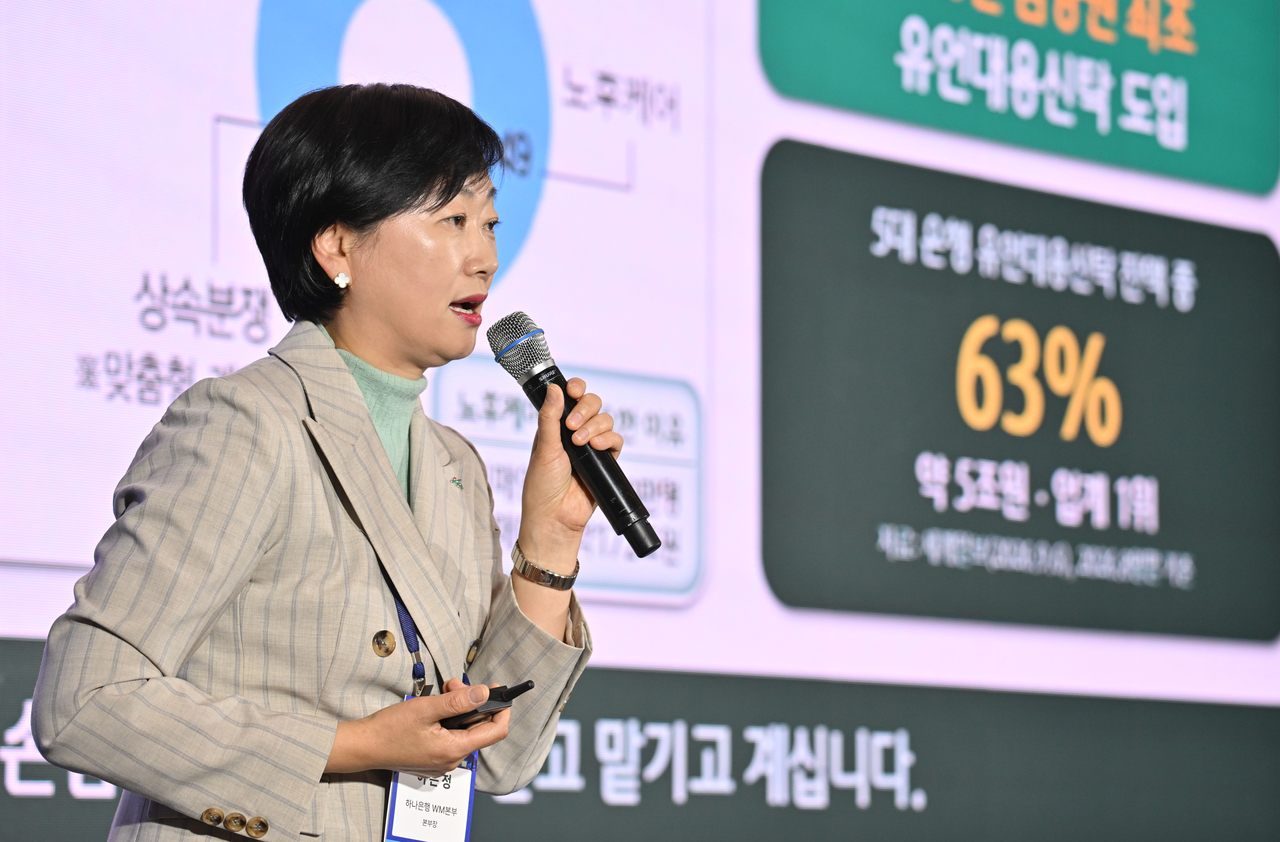
"Some people say, 'I don't need to prepare for any of this,' and skip inheritance planning altogether. But everyone thinks differently. When there's no agreement, dividing assets becomes nearly impossible."
Lee Eun-jung, head of Hana Bank's wealth management division and a trust specialist in the financial industry, named trusts as the essential tool for smart asset inheritance at Herald Money Festa 2026.
Speaking Friday on the first day of Herald Money Festa 2026, Lee delivered a lecture titled "Asset Planning to Connect Your Future and Your Family's." She said that without advance planning, an estate is distributed according to the legal order of priority and statutory shares — but with preparation, a person can ensure their wishes are carried out.
Lee shared the case of a male customer who came to the bank asking whether he could claim 70 percent of his late parents' estate, as they had promised. He ultimately received nothing. "Only the most recent will is valid," she said, "but from the bank's perspective, there is no way to confirm that a given will truly is the last one."
She added that the only recourse is to obtain a court ruling, a process that inevitably takes a long time. "Trillions of won have piled up this way," she said.
According to the Supreme Court's judicial yearbook, inheritance dispute cases over the past decade through 2025 totaled about 56,000. As of 2025, cases involving a claim value of 100 million won ($73,600) or less accounted for 84.5 percent of the total.
Lee said trusts are the best tool to prevent such disputes in a super-aged society. "A trust is a contract, so your wishes take effect immediately," she said. "You can specify who receives what, when, how much, and under what conditions."
The importance of trusts is growing as South Korea enters a super-aged society. According to the government, as of the end of last year, about 1.01 million people aged 65 or older had been diagnosed with dementia, and their combined assets were estimated at 172 trillion won.
Hana Bank introduced "Hana Living Trust" in 2010, becoming the first in the financial industry to offer a will-substitute trust product. The product allows customers to manage and invest their assets as they wish during their lifetime, and upon death, transfers the trust assets to a designated beneficiary — such as a spouse or child.
The total value of will-substitute trust assets held by banks grew from 3.51 trillion won in 2024 to 4.5 trillion won in 2025 and 7.67 trillion won in 2026.
"A will only takes effect after death, but a living trust becomes effective the moment you sign up," Lee said. "If you fall ill or find yourself in need, you can instruct the financial institution to use the funds however you wish."
Will-substitute trusts are already widespread in the United States. According to RBC, 84 percent of individuals with assets of $5 million or more hold a living trust.
"You need to ask yourself: who is this money for, when and for what purpose will it be needed, and what do you want to leave your family and how," Lee said.

hyuk@heraldcorp.com