Sales forecast at 33.25 trillion won this year, seen topping 40 trillion won by 2028
Operating profit to near 3 trillion won next year
2030 target may be reached 2-3 years early
Chinese cargo surges 93%; non-affiliate revenue tops half of car-carrier business
![A Hyundai Glovis pure car and truck carrier alongside vehicles awaiting shipment. [Hyundai Glovis]](https://wimg.heraldcorp.com/news/cms/2026/10/02/news-p.v1.20260211.aabcb7fb19ea4c15ae8edfac6d4a379f_P1.jpg)
Hyundai Glovis is posting a clear upward earnings trajectory, putting its 2030 sales target of 40 trillion won ($29.4 billion) — set two years ago — well within reach ahead of schedule. Surging demand for pure car and truck carriers, or PCTCs, has pushed the company into a boom where it is in effect turning away cargo because no ships are available. To keep pace with rapidly growing Chinese shipping demand, its car-carrier fleet has crossed the 100-vessel mark.
According to a three-month average broker consensus compiled by financial data provider FnGuide on Sunday, Hyundai Glovis is expected to post consolidated sales of 33.25 trillion won this year, up about 12.5 percent from a year earlier. Sales are projected to rise to 34.78 trillion won next year and reach 36.19 trillion won by 2028.
At the current pace, the company is widely expected to meet the medium- to long-term sales target it set two years ago with room to spare. Hyundai Glovis unveiled its goal of surpassing 40 trillion won in annual sales by 2030 at its 2024 CEO Investor Day.
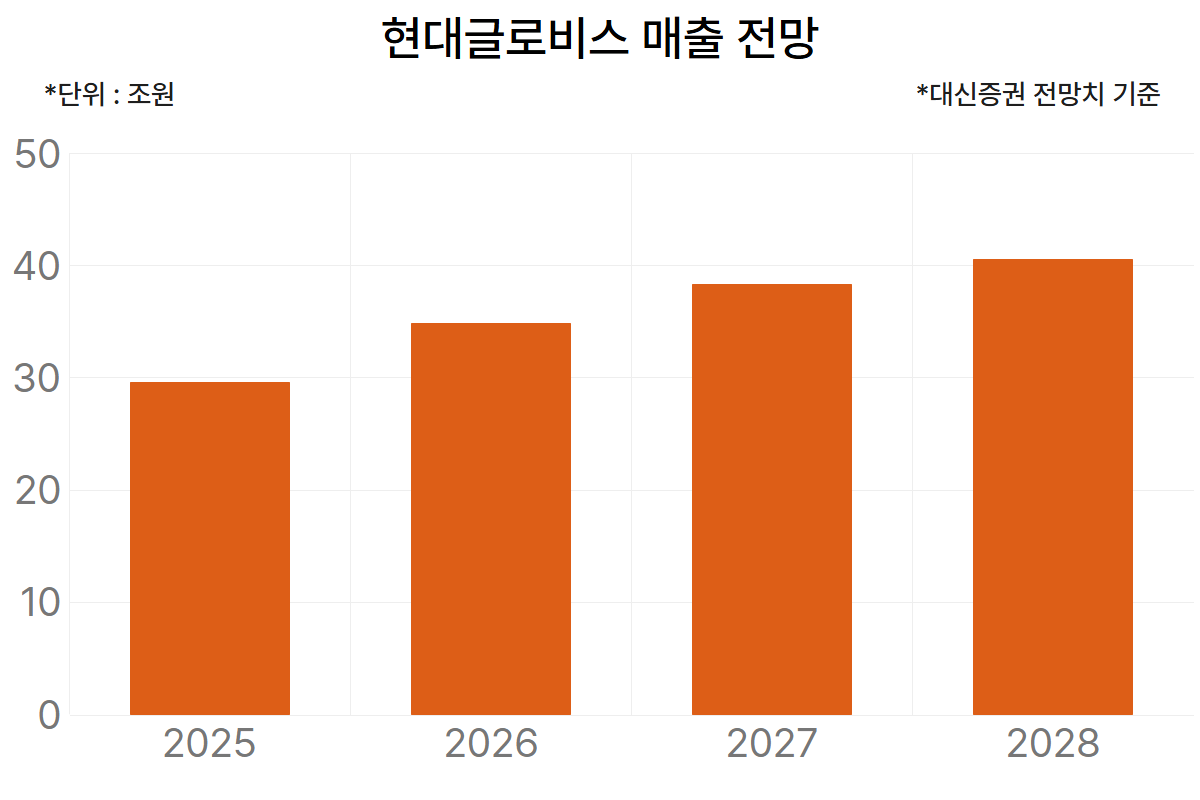
With the car-carrier business boom proving stronger than anticipated, some analysts now see the target being hit as much as two years earlier than planned. Daishin Securities projects Hyundai Glovis sales will climb to 38.27 trillion won next year before reaching 40.45 trillion won in 2028 — more than 4 trillion won above the market consensus.
Profitability is improving even faster. Daishin Securities forecasts operating profit will rise from 2.23 trillion won this year to 2.96 trillion won next year. Based on its projected sales of 38.27 trillion won for next year, that implies an operating profit margin of about 7.7 percent — roughly three years ahead of the company's own 2030 target of a margin above 7 percent.
![A Hyundai Glovis 7,000-CEU pure car and truck carrier. [Hyundai Glovis]](https://wimg.heraldcorp.com/news/cms/2026/10/02/news-p.v1.20260608.366d374caa1945d39b96709544e0f7bb_P1.jpg)
Chinese auto exports double; long-haul routes and heavy cargo drive vessel demand
The car-carrier business is the main engine of earnings growth. Since 2022, rising global vehicle volumes and port congestion have deepened a shortage of available car-carrier capacity.
This year, China has become a major demand driver. Chinese finished-vehicle exports more than doubled from about 3.11 million units in 2022 to 7.06 million units last year. In the first half of this year alone, China exported 5.1 million vehicles, up 65 percent from the same period a year earlier.
The shift toward longer-haul routes is also amplifying vessel demand. In the first half of this year, Chinese finished-vehicle exports to Europe and Latin America each reached about 1.1 million units. Longer voyages mean more time per round trip and lower vessel utilization, so more ships are needed to move the same volume. Instability in the Middle East has added to the pressure by forcing ships to reroute around the Cape of Good Hope, tightening available capacity on Asia-Europe lanes further.
Hyundai Glovis's car-carrier business, which grew primarily on Hyundai Motor and Kia volumes, has been rapidly expanding its Chinese customer base. After signing an MOU with BYD in 2024, the company has been growing cargo from Chinese automakers and global brands shipping out of China. The number of finished vehicles it transported by PCTC from China rose 93 percent in two years, from about 260,000 units in 2023 to 510,000 units last year.
Construction machinery and commercial vehicles from customers such as Caterpillar, Sany and Sinotruk have emerged as another growth pillar. Known in the industry as H&H — heavy and high — cargo, these oversized loads such as excavators and trucks occupy the equivalent of about seven passenger-car spaces each and command freight rates roughly 30 percent higher than those for passenger cars. Hyundai Glovis's contracted H&H volume has grown about 50 percent recently compared with 2024.
Non-affiliate revenue tops half; car-carrier fleet to reach 120 vessels next year
The growing external customer base has raised the profile of non-affiliate revenue. The share of non-affiliate sales in the PCTC business climbed from about 46 percent in the first quarter of 2024 to more than 50 percent in the first quarter of last year, and reached about 53 percent in the second quarter of this year — meaning revenue from customers outside Hyundai Motor and Kia now accounts for more than half of the car-carrier business. Hyundai Glovis ranked first in the Chinese maritime vehicle-shipping market last year with a 12 percent share and is expected to hold that lead this year.
![Vehicles waiting to be exported sit at Pyeongtaek Port in Pyeongtaek, Gyeonggi Province, on the afternoon of Jan. 27. [Lee Sang-sub]](https://wimg.heraldcorp.com/news/cms/2026/10/02/9/news-p.v1.20260127.4fd70a811c8444aaa777941b145a9936_P1.jpg)
Fleet expansion to absorb the growing volume is also accelerating. In April, the company took delivery of the Glovis Leader, one of the world's largest PCTCs, capable of carrying 10,800 small cars in a single voyage. Hyundai Glovis has now secured contracts for 37 new car carriers, which are scheduled for delivery in stages through 2028. The company plans to grow its fleet from 98 vessels at the end of the second quarter to 110 by year-end and 120 by next year.
The broader market backdrop of persistent vessel undersupply also works in Hyundai Glovis's favor. Chinese cargo is growing so quickly that immediately available car carriers are scarce, and newly ordered vessels take years to deliver. The one-year charter rate for a 6,500-CEU PCTC doubled from $42,500 a day in September last year to $85,000 in August of this year. New vessels ordered through August this year add only about 7 percent to current total fleet capacity, and a large share of recent orders are not scheduled for delivery until 2029 or later, meaning the car-carrier shortage is expected to persist for now.
"The rise in Chinese finished-vehicle volumes is translating into an expansion of non-affiliate cargo," an analyst said. "As the full effect of higher PCTC freight rates and charter rates feeds through, the medium- to long-term freight improvement trend will broaden through next year."

kwater@heraldcorp.com