SP Samhwa develops heat-dissipating coating, eyes commercialization
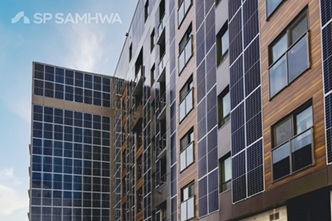
A newly developed heat-dissipating coating designed to improve the generation efficiency of building-integrated photovoltaic modules is drawing attention in the industry.
Building-integrated photovoltaic, or BIPV, modules combine solar power generation with exterior building materials, making them more prone to heat buildup than ground-mounted solar modules — a problem that undermines generation efficiency. Glass-to-steel, or G2S, module structures offer greater structural stability than conventional glass-backsheet designs, but they have a key drawback: heat trapped behind the steel panel causes module temperatures to rise easily.
Solar modules lose roughly 3 percent of their generation efficiency for every 10-degree Celsius rise in surface temperature, resulting in noticeable output losses in high-heat summer conditions. SP Samhwa recently developed a heat-dissipating coating composition technology and obtained a patent for it.
The coating works through three stages to expel heat that accumulates in BIPV modules, the company said. It conducts heat transferred from the steel panel rapidly across the entire coating film, radiates heat from the film's surface as infrared energy, and exchanges heat with the surrounding air through convection.
SP Samhwa has completed laboratory performance verification alongside the patent filing and plans to pursue commercialization following field demonstration tests. "If commercialized, the coating will improve the generation efficiency of G2S-structure BIPV modules," the company said Friday. "It is also expected to slow the degradation rate of the modules, contributing to longer product lifespans."
freiheit@heraldcorp.com