
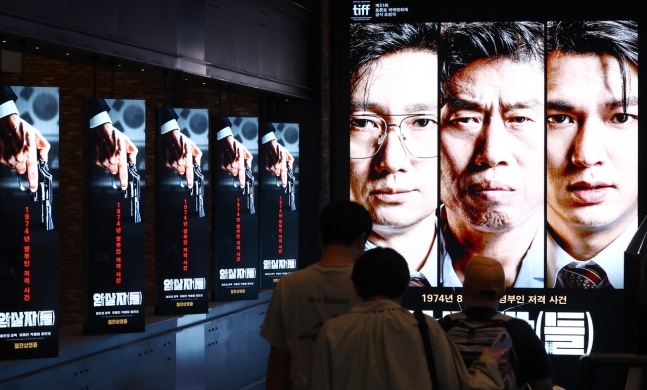
The controversy over "The Assassin," a film depicting the 1974 shooting of first lady Yuk Young-soo, has spilled into the real world, directly affecting the film's promotional activities. A public preview has been canceled, cast appearances at screenings have been scaled back, and film critics have come under attack.
According to the film industry on Thursday, the Busan Film Commission canceled a free public preview of "The Assassin" that had been scheduled for Monday at CGV Centum City in Busan at 3:50 p.m.
The commission announced the decision on its official SNS account, saying it had reached the conclusion "after comprehensively reviewing the recent situation surrounding the film and the wide range of opinions expressed by citizens." It added that "this decision does not represent support for or a judgment on the content of the film or any particular position," and asked for understanding over any confusion caused.
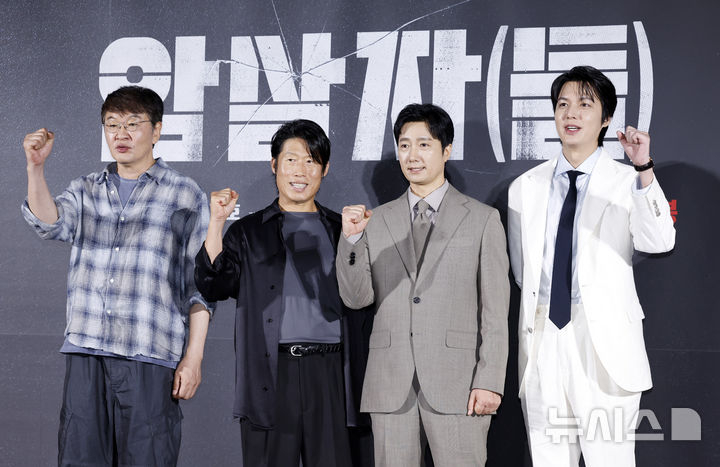
Planned cast appearances at weekend screenings have also been reduced in scale. Distributor Hive Media Corp announced that supporting actors Ryu Hye-young, Jang Ryul and Choi Yu-ri would not attend the second-weekend stage greetings scheduled for Saturday and Sunday in Seoul and Gyeonggi Province. As a result, only director Heo Jin-ho and lead actors Yoo Hae-jin, Park Hae-il and Lee Min-ho will appear on stage.
A representative said the change was "simply a restructuring to keep attendance numbers tight, and not because of the recent controversy." The explanation has been met with skepticism inside and outside the industry, however, coming as it did immediately after the comments section on a commercial advertisement featuring Yoo Hae-jin was shut down and a wave of criticism flooded the actors' personal SNS accounts.
Critics have also found themselves in the crossfire. Film critic Lee Dong-jin drew a line Wednesday on his personal blog after a review of "The Assassin" he had posted to his YouTube channel "B tv Lee Dong-jin's Pyaakia" was made private at the channel's discretion, saying he had "no intention of withdrawing my assessment or apologizing."
Lee addressed his much-debated remark that the film's questions "cannot be dismissed as mere conspiracy theory," clarifying that he had been "describing the way the film handles unresolved questions — such as the trajectory of the bullets fired — that were not settled by official accounts, and the comment had nothing to do with the theory that former President Park Chung-hee was behind the shooting."
He went on to say that his words "did not mean that every hypothesis the film raises is true," and said the remark "had nothing to do with the claim that President Park Chung-hee was behind the shooting of first lady Yuk Young-soo."
Lee also stated his position clearly on the interpretation that the film portrays former President Park as the mastermind behind the assassination. "Such an absurd and horrifying claim is not contained in this film — not in a single line of dialogue or scene," he said, adding that it was his judgment that "it would be difficult for audiences watching the film to arrive at the interpretation that President Park Chung-hee was behind the assassination of first lady Yuk Young-soo."
Above all, Lee said he hoped the debate surrounding the film would take place "after watching the film in its entirety," and that criticism of his review would likewise come "after looking at the overall context in which I spoke."
He acknowledged, however, that the question of how far to allow the line between fact and fiction in a dramatic film based on historical events was a legitimate subject for criticism and discussion. Lee said his "cinematic judgment on 'The Assassin' remains the same," and that he had "no intention of withdrawing the assessment made in the review or apologizing for the assessment itself."
As the controversy continued to grow after the film's opening, the film industry issued its first official statement. The Korea Film Producers Association said Thursday it was "concerned about the situation in which excessive criticism continues to be directed at individual creators — including the production company, director, actors and crew — simply for having participated in the work."
The association said it hoped "criticism and evaluation of the work will be grounded in facts, and that the creative activities of all those involved in making the film — the production company, director, actors and crew — will also be respected." It added that "when a work is based on historical events or real figures, differing opinions may arise depending on the audience's perspective and interpretation, and such diverse voices should be respected."
The association said it believed "it is desirable for assessments of a work's expression and interpretation to center on the work itself," and that "it is not conducive to a healthy production environment for Korean cinema for the discussion surrounding a work to go beyond evaluating the work and lead to attacks on individuals involved in its production — the production company, director, actors and crew — or to the spread of unverified information."
"The Assassin" follows detectives and journalists tracing the forces behind the death of first lady Yuk Young-soo. In the course of their investigation, characters in the film raise the possibility that there was a shooter other than Moon Se-gwang. The possible involvement of powerful institutions, including the Korean Central Intelligence Agency, also emerges as one of the hypotheses explored.
The current controversy over "The Assassin" stems from this premise. The People Power Party and some conservative groups have accused the film of distorting history, with calls to halt its screening and legal complaints already filed.
According to the Korean Box Office Information System, "The Assassin" drew 76,385 admissions on Wednesday alone, holding the top spot among domestic releases, and has accumulated a total of about 1.77 million admissions.
shee@heraldcorp.com




