Suburban bakery cafes: 10 years of operations not enough
All three sets of requirements — business, parent, heir — must be met
Coffee shops excluded; only licensed bakeries qualify
Nominal ownership not enough; 30-plus years of real management required
Heirs must also prepare early, including two years working in the business before inheritance
Housing costs, food bills, transportation — money seems to drain away just by breathing. But there is one more expense quietly embedded in everyday life: taxes. Drawing on consultations with tax-planning specialists, this column — "Your Everyday Tax Clinic" — breaks down the tax dilemmas ordinary people face.
![[Created using ChatGPT]](https://wimg.heraldcorp.com/news/cms/2026/10/01/news-p.v1.20261001.e1f311054959471cab807a2f067cfed5_P1.png)
Na Se-sang (pseudonym, 30) recently began weighing whether to quit his job when a piece of land his mother owns in Yongin, Gyeonggi Province, came to mind. The land is valued at around 10 billion won ($7.38 million), and he wondered whether starting a business on it might be the answer. "Mom, couldn't you transfer that land to me now?" he asked carefully — only for his mother to push back: "I heard the gift tax would be enormous. Wouldn't it be better to just inherit it later?"
As Na mulled over what seemed like an equally daunting inheritance tax bill, an intriguing tip reached him. "If you open a bakery on that land and pass it on through the family business inheritance deduction, you might pay zero inheritance tax." The sprawling suburban bakery cafes he had long admired suddenly came to mind. He began to imagine a scenario where his mother served as the registered representative while he ran the bakery — a move that could create a new livelihood and ease the inheritance tax burden at the same time. This column examines the easy-to-miss pitfalls under this year's proposed tax reform, with input from tax accountant Kim Hye-ri, known as "National Tax Sister."
Q. If my mother opens a bakery on her land and runs it for 30-plus years, can I inherit it tax-free?
A. If all the requirements for the family business inheritance deduction are met, the inheritance tax could indeed be zero. The deduction is designed to support the smooth succession of small and medium-sized enterprises by excluding a portion of the inherited business assets from the inheritance tax calculation — easing the tax burden so that a company's accumulated technology and know-how can pass to the next generation while employment is maintained.
Under the current rules, the deduction applies when a small or medium-sized enterprise that the deceased managed for at least 10 years — or a mid-sized company with annual sales below 500 billion won that meets certain conditions — is passed on to an heir. Depending on the length of management, up to 60 billion won can be deducted.
However, concerns have grown that large bakery cafes and parking lots are being used as vehicles for improper inheritance, and the government's proposed tax reform this year would raise the bar. The management-period requirement for the deceased would in principle be extended from the current 10 years to 30 years.
In return, businesses that have been run for a long time would receive expanded benefits. The deduction ceiling would be calculated as the number of years managed multiplied by 2 billion won, with a maximum cap of 100 billion won. For example, 45 years of management would allow a deduction of up to 90 billion won.
Given the size of the benefit, the list of conditions to satisfy is long. Requirements covering the business itself, the parent transferring it, and the heir receiving it must all be met — including the eligible business category, company size, actual management, and the heir's succession preparations.
All of this is contingent on the reform bill passing the National Assembly at year-end. The key amended provisions related to the family business inheritance deduction are set to apply to inheritances that begin after July next year.
Q. They look like the same kind of café from the outside — so why does opening a bakery reduce inheritance tax when a coffee shop does not?
A. The law specifies which business categories qualify for the family business inheritance deduction. Beverage shops — the category that covers coffee specialists — are excluded, while the confectionery and bakery business category, which is what bakery cafes actually operate under, is included. That is precisely why large suburban bakery cafes have attracted attention as a tool for reducing inheritance tax.
A bakery takes raw ingredients such as flour and butter through mixing, fermentation, and baking to produce and sell bread. A coffee shop, by contrast, centers on extracting processed coffee beans to serve drinks.
That said, not every shop that bakes bread is automatically classified as a "manufacturing" business under tax law. What matters is whether the actual operations fall under the confectionery and bakery category that qualifies for the deduction.
Q. Doesn't any bakery qualify? I assumed that having 'confectionery shop' on the business registration certificate would be enough.
A. Tax authorities do not judge by a sign or a business registration certificate alone. Tax law applies the "substance-over-form" principle, which looks at what a business actually does rather than its name or formal classification. Even if a business is registered as a confectionery shop, it cannot claim the family business inheritance deduction if its actual operations amount to running a coffee shop.
In practice, the National Tax Service examines the revenue and purchasing structure, along with confectionery equipment, to determine the true business category.
For instance, if a shop has no bread-making facilities and merely resells a small quantity of finished cakes, while its purchasing costs are dominated by coffee beans, milk, and syrups rather than flour and butter, authorities will scrutinize whether it is in effect operating as a coffee shop. Selling a little cake is not enough on its own to be recognized as a qualifying confectionery business.
The National Tax Service examined the appropriateness of registered business categories in a survey conducted earlier this year, looking at whether operators were disguising non-qualifying businesses as confectionery shops. The agency's position is that extending the deduction to bakery cafes whose assets consist mostly of real estate — set up and run in a perfunctory way solely to reduce inheritance tax — contradicts the original intent of the regime and the principle of tax fairness.
Q. Can't I just list my mother as the representative and run the bakery myself?
A. Simply putting your mother's name on the registration as representative is not enough.
To claim the family business inheritance deduction, the mother must in principle have actually managed the business for 30 or more years. For example, if an 80-year-old mother with no employment or business history is registered as co-chief executive alongside her child while the child actually runs the bakery cafe — with the arrangement dressed up to look as though the mother managed it — the deduction will not be recognized. The transfer could be treated as a gift rather than a business succession.
In practice, the National Tax Service looks beyond the registered name to the actual operating record. Purchase and sales data, national insurance enrollment history, satellite and aerial photographs, and family income and career records can all be used to determine who actually ran the bakery and how the land was genuinely used.
The length of time the representative held that position also matters. The mother must have served as representative for at least 50 percent of the total period the business was operated, or for at least five of the 10 years before her death. If the mother served as representative for 10 or more years before handing the role to Na, Na can still satisfy this requirement by continuing to serve as representative from the date of succession until the mother's death.
If the business is incorporated, shareholding requirements must also be checked. The mother must qualify as the largest shareholder, and she and related parties must have held a combined stake of at least 40 percent in an unlisted corporation — or at least 20 percent in a listed one — continuously for 10 or more years.
Q. Does that mean I also have to work at the bakery before I inherit it?
A. Yes. Na must also prepare in advance to take over the family business. He must be at least 18 years old as of the date the inheritance begins, and in principle must have worked directly in the business for at least two years before his mother's death.
An exception to the two-year requirement applies if the mother dies before the age of 65, or in unavoidable circumstances such as a natural disaster or accident. Since Na's mother is already in her 80s, the "death before 65" exception does not apply.
The succession timeline must also be observed. Na must take up an executive position by the inheritance tax filing deadline, and must assume the role of chief executive or equivalent within two years of that deadline. Simply receiving the assets is not enough — actually continuing to run the business is what counts.
Q. If a large bakery is built on my mother's land, can the entire site — including the garden, parking lot, and front yard — qualify for the family business inheritance deduction?
A. The fact that land is part of a bakery site does not mean the entire plot qualifies for the deduction. Each portion must be assessed to determine whether it is a business-use asset directly employed in the family business — including not just the building and facilities, but also whether the garden and parking lot are genuinely used in running the bakery.
For example, if a country house where the family lives sits within the site, or if part of the land is used as the family's private yard, that house and the land attached to it are excluded from the deduction. This does not mean the entire bakery site is disqualified — the business-use portion and the family's residential portion are simply separated.
Nor does a land classification of "residential site" automatically mean the land is recognized as business-use property; actual purpose of use is the standard. On top of this, the 2026 tax reform proposal includes provisions to narrow the range of land eligible for the deduction and to introduce a new cap on the land deduction. If the reform takes effect, even land used for business purposes will require an additional check on the applicable scope and ceiling.
Q. When inheriting a bakery site worth 10 billion won, how much does the inheritance tax differ depending on whether the family business inheritance deduction applies?
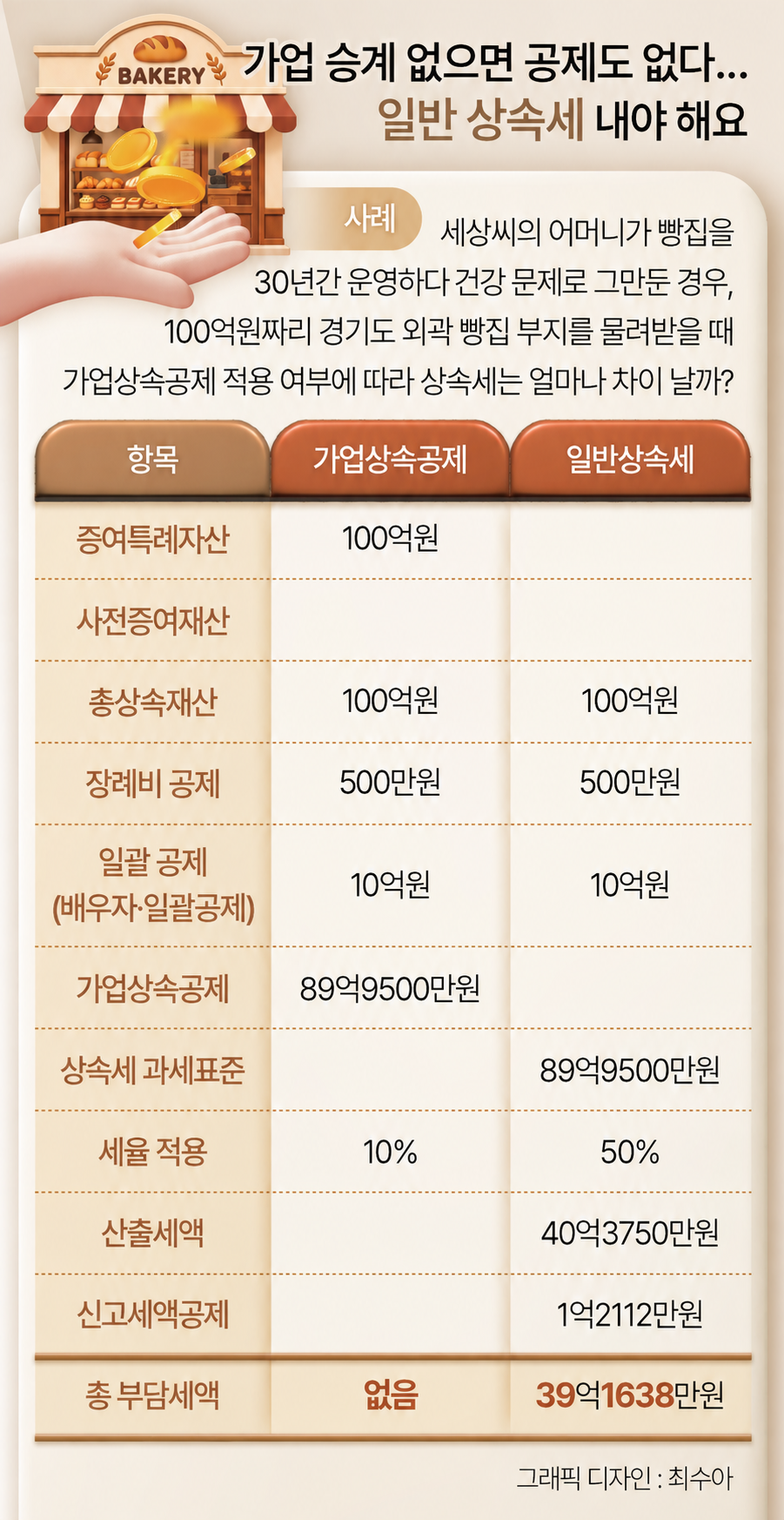
A. If the entire site qualifies for the deduction and all other requirements are met, bringing the taxable base to zero, there would be no inheritance tax at all.
If Na does not continue the family business and fails to meet the requirements, however, he would owe standard inheritance tax. Assume the inherited estate is worth 10 billion won, with a combined spousal and lump-sum deduction of 1 billion won and funeral expenses of 5 million won deducted. This assumes the spousal deduction is available and that there are no other assets, debts, or pre-inheritance gifts.
Subtracting the deductions from 10 billion won leaves a taxable base of 8.995 billion won. Applying the top rate of 50 percent and subtracting the progressive deduction of 460 million won yields a calculated tax of 4.0375 billion won. Filing on time and claiming the 3 percent filing deduction brings the actual tax payable to approximately 3.916 billion won — close to 4 billion won.
The lesson is clear: a bakery in name only will not suffice. The parent must have genuinely managed the business for 30 or more years, and the heir must have made proper succession preparations — both conditions must be in place.
[Reporter Yoo Hye-rim / Tax accountant Kim Hye-ri, deputy head of Tax Corporation HKL]
forest@heraldcorp.com