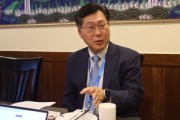
![Actor Yoon Kye-sang. [Netflix]](https://wimg.heraldcorp.com/news/cms/2026/10/01/news-p.v1.20261001.977e33022afe4edfae56bb848600c537_P1.png)
As controversy over the film "The Assassin" and allegations of historical distortion continue to mount, a 17-year-old interview remark by actor Yoon Kye-sang has resurfaced online, threatening to widen the dispute into a broader ideological debate.
Online communities and social media platforms were flooded Thursday with reposts of old news articles under titles such as "Yoon Kye-sang's candid past remarks" and "Yoon Kye-sang's interview about the left in the film industry."
The renewed attention to his past comments comes as conservative criticism of the Korean film industry has intensified in the wake of the historical distortion allegations surrounding "The Assassin."
The remark in question dates to the November 2009 issue of men's magazine GQ, where Yoon gave an interview ahead of the release of his film "The Executor." While discussing the prejudice he faced as an actor with an idol background, he said, "It's not that they look down on me as an idol-turned-actor — the fundamental nature of the Korean film industry is leftist. It is very unfriendly toward me."
When the interviewing editor pressed him on the nuance of the word "leftist," Yoon said, "It means closed off. I say this because I experienced it firsthand."
He explained that he had intended the remark to describe the insular culture of the film industry, where it was difficult for him to be recognized as a genuine actor because of his idol background.
After the comment sparked backlash, Yoon posted an apology on his fan cafe on Nov. 2 of that year, titled "A shameful day." He wrote, "It was entirely my mistake — I had a wrong understanding of the broader meaning of the word 'leftist.' It was not meant to convey any political view, nor did I mean that the film industry treated me with prejudice. I am deeply ashamed of my ignorance and will work hard to educate myself going forward."
Directed by Heo Jin-ho and starring Yoo Hae-jin and Park Hae-il, "The Assassin" is a mystery thriller that examines the circumstances and allegations surrounding the shooting of first lady Yuk Young-soo at a Liberation Day ceremony on Aug. 15, 1974.
The film reconstructs various theories surrounding the incident through cinematic imagination, but controversy erupted over the blurring of historical fact and fiction as it explores the possibility of an accomplice and potential government involvement in the shooting.
The People Power Party and the Park Chung-hee Presidential Memorial Foundation strongly condemned the film, calling it "a clear distortion of history and defamation of the deceased." Some political figures went further, demanding the film be pulled from cinemas and calling for the production team to appear before a national audit.
The production company, Hive MEDIAcorp, pushed back, saying the film "is simply a dramatic work that adds imagination to historical records and does not identify any specific individual as the mastermind or present the film's settings as historical fact," adding that it had "no intention of distorting established facts or reaching any definitive conclusion." The controversy, however, has shown no signs of dying down.
Meanwhile, the special investigative unit that handled the shooting at the time concluded that Moon Se-gwang, acting on orders from North Korea and the General Association of Korean Residents in Japan, attempted to assassinate then-President Park Chung-hee during his Liberation Day address but failed, with the bullet instead striking first lady Yuk Young-soo, who was seated beside him, killing her.
Moon was executed at Seoul Detention Center on Dec. 20 of that year.
yeonjoo7@heraldcorp.com