Orders hit 250 billion won — 1.8x last year's sales
Micron deal worth 93.6 billion won is largest single project ever
Overseas orders rise to 41% of total; US, Singapore, Taiwan in focus
Expanding from environmental equipment into HBM materials
Recurring 'operational revenue' targeted at 55% of sales by 2030
![Ecopro HN's headquarters in Cheongju, North Chungcheong Province [Ecopro HN]](https://wimg.heraldcorp.com/news/cms/2026/10/01/news-p.v1.20260824.9f93cc9b3fd243aba107b002dd2c02d3_P1.jpg)
Ecopro HN, the eco-friendly solutions affiliate of Ecopro, has secured US memory chipmaker Micron as a new customer, pushing its cumulative order backlog this year to 250 billion won ($184 million) — nearly 1.8 times the company's total sales last year. The milestone marks a significant broadening of its semiconductor environmental equipment customer base beyond Samsung Electronics, and the company is now targeting mass production of advanced packaging materials for high-bandwidth memory chips in the second quarter of next year.
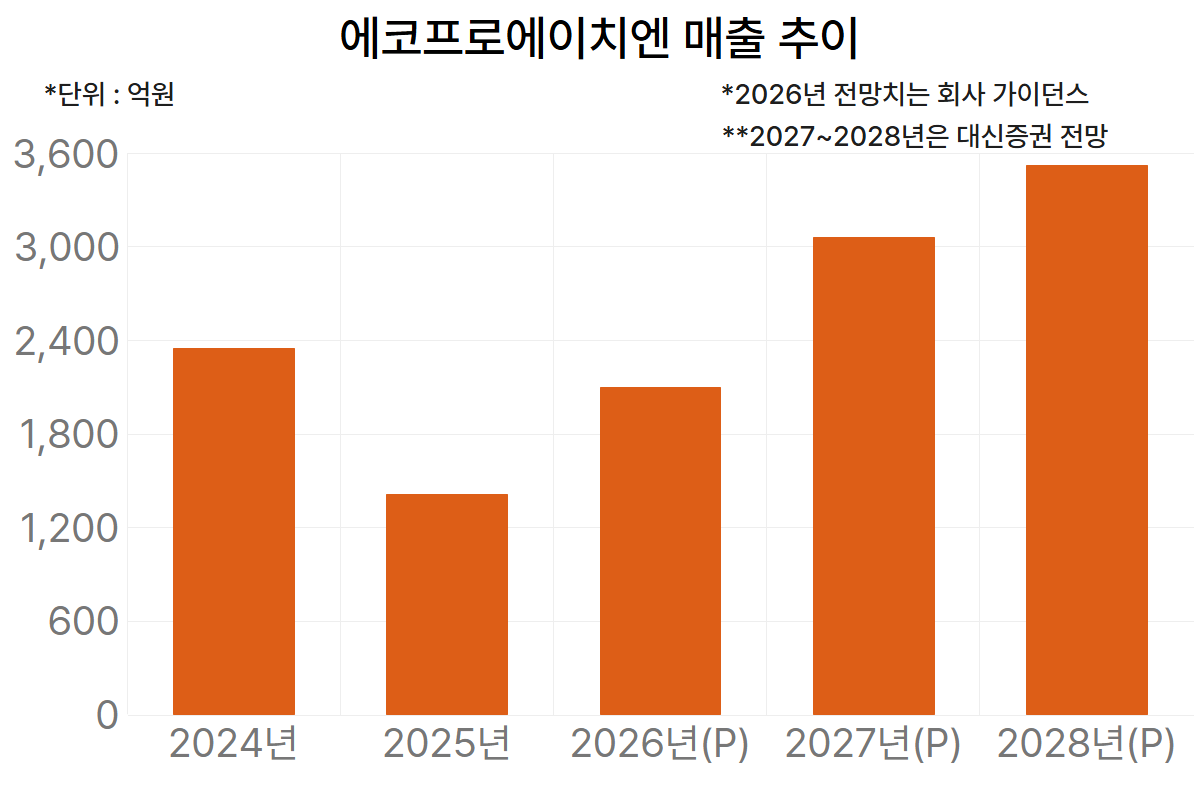
According to industry sources, Ecopro HN disclosed at an investor relations session Wednesday that its cumulative orders for the year had reached approximately 250 billion won. That figure is about 1.8 times its full-year sales of 141.1 billion won last year.
The order surge has raised expectations for improved earnings this year. The company maintained the guidance it set at the start of the year, projecting sales of around 210 billion won — an increase of roughly 50 percent from last year. It expects growth in its high-margin greenhouse gas reduction solutions to be the primary driver of the earnings improvement.
However, the orders secured this year will not be recognized as revenue immediately. Plant projects typically take between one and one and a half years from contract signing to revenue recognition. The orders accumulated this year are expected to be reflected in earnings on a rolling basis starting next year.
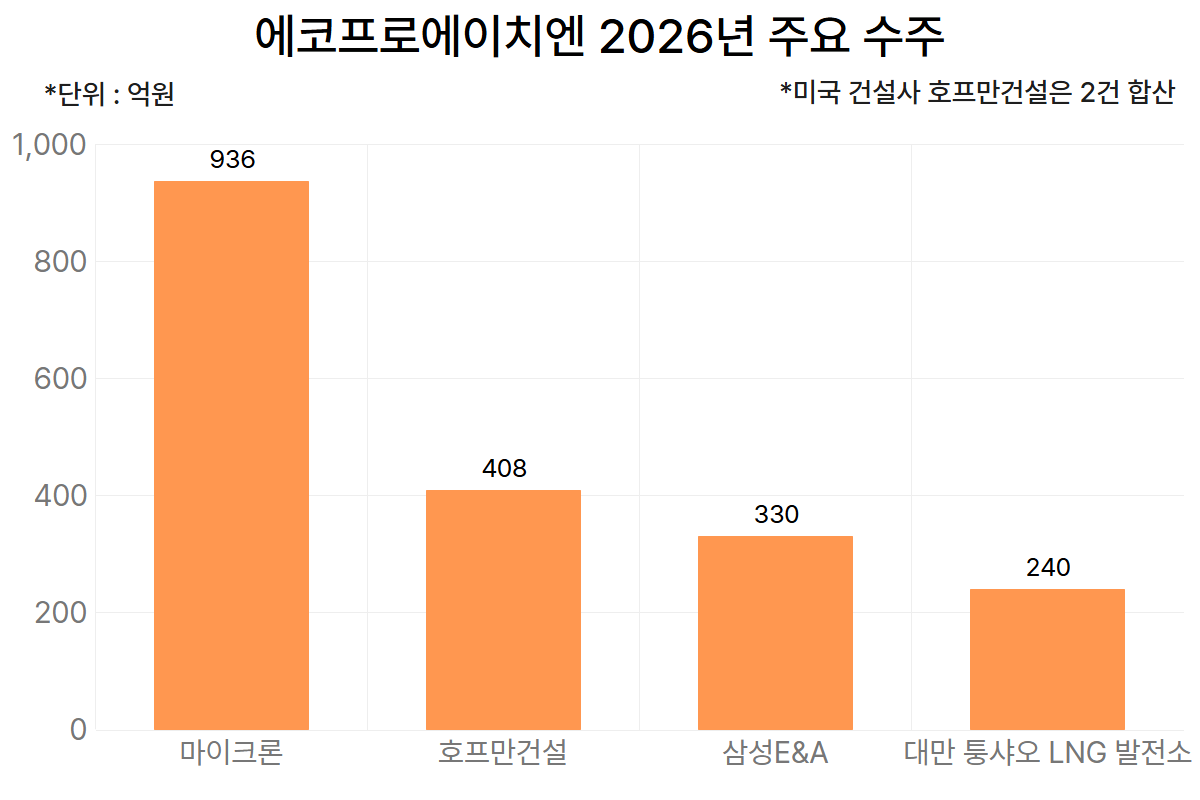
Semiconductor investment has been the engine behind the order expansion. Major contracts this year began with a 24 billion won deal in March related to a liquefied natural gas power plant in Tongxiao, Taiwan, followed by orders from Samsung E&A worth 33 billion won, US construction company Hoffman Construction worth 40.8 billion won, and Micron worth 93.6 billion won.
The Micron contract — a 93.6 billion won deal tied to the chipmaker's Singapore factory — was signed last month and represents roughly 66 percent of Ecopro HN's full-year sales last year, making it the largest single project in the company's history.
Ecopro HN has built up its track record in supplying catalytic combustion systems, known as RCS, primarily to Samsung Electronics semiconductor factories since signing a bulk supply agreement with Samsung Electronics for greenhouse gas reduction equipment in 2014.
![A small-scale direct air capture system undergoing pilot testing inside an Ecopro HN greenhouse at the Smart Farm Innovation Valley in Sangju, North Gyeongsang Province. Beyond semiconductor environmental equipment, Ecopro HN is expanding into carbon capture, water treatment and resource recycling. [Korea Research Institute of Chemical Technology]](https://wimg.heraldcorp.com/news/cms/2026/10/01/news-p.v1.20251001.90f0dbd1f6954005917e5c858706088d_P1.jpg)
RCS technology wins Micron — and opens the door to broader overseas expansion
The key product Ecopro HN supplies to Micron is its RCS, which processes greenhouse gases generated inside semiconductor factories. Unlike conventional setups where each piece of production equipment has its own separate gas treatment unit, the RCS collects gases from multiple machines and processes them together in a single high-capacity system. One RCS unit can handle the workload of roughly 250 individual treatment units.
The technology also cuts energy consumption. By recycling catalysts and heat, it lowers the operating temperature required for gas treatment from around 1,300 degrees Celsius to about 780 degrees, reducing fuel consumption by roughly 90 percent and operating costs by more than 30 percent compared with conventional methods.
The scope of Ecopro HN's work for Micron is also broader than its Samsung Electronics business. While it has primarily supplied core equipment such as RCS units to Samsung Electronics, the Micron project extends to related facilities and construction work as well.
Ecopro HN is pursuing a contract worth around 200 billion won to supply RCS units and clean-room chemical filters — which remove hazardous gases and contaminants from inside semiconductor factories — for Micron's new ID1 and ID2 factory projects in Idaho.
The growing global customer base is lifting the share of overseas orders. The proportion of overseas orders in the annual cumulative backlog is expected to rise from 22 percent in 2023 to 41 percent this year. The company plans to build out a customer service network centered on major semiconductor production hubs in the United States, Singapore and Taiwan to capture additional orders and maintenance demand.
![A honeycomb-shaped catalyst developed by Ecopro HN and the equipment that uses it to reduce greenhouse gas emissions from semiconductor manufacturing processes. [Ecopro HN]](https://wimg.heraldcorp.com/news/cms/2026/10/01/news-p.v1.20250525.3dfa6d5f73004938bd70efa37952bb85_P1.jpg)
From gas treatment to HBM materials — mass production targeted for Q2 next year
Ecopro HN is also accelerating efforts to translate its environmental equipment expertise into semiconductor materials. Drawing on chemical synthesis and purification technologies built up over the years, the company plans to move into advanced materials used directly in semiconductor manufacturing processes, developing them into a new growth pillar.
The company is developing functional materials for the HBM manufacturing process that temporarily bond thin wafers to prevent warping or cracking, then allow them to be cleanly detached after processing without damage. Because HBM is made by stacking multiple DRAM chips vertically, wafers must be processed to extremely thin tolerances, making stability at this stage critical to yield and quality.
A separate materials development program is also under way targeting next-generation HBM. As each new HBM generation delivers higher processing speeds and greater capacity, the performance requirements for materials used in manufacturing and packaging change accordingly. Ecopro HN is currently developing materials for HBM4E, the next-generation product, with an eye toward entering that market, and plans to follow up with high-value materials for HBM5 and beyond. The company said it would also consider mergers and acquisitions or joint ventures with relevant firms if needed.
Building recurring revenue — operational sales targeted at 55% by 2030
The push into materials is part of a broader strategy to reshape Ecopro HN's business model. The company currently derives most of its revenue from project-based equipment supply tied to new semiconductor factory construction, but it aims to grow the share of recurring revenue generated while factories are in operation — through materials supply, maintenance and consumables.
Environmental equipment such as RCS units requires regular inspections and catalyst replacements after initial installation, and clean-room chemical filters must be replaced periodically as consumables. Each new fab added to the customer base compounds not only initial equipment sales but also ongoing maintenance and catalyst and filter replacement demand. The company plans to raise the share of this recurring "operational revenue" — covering maintenance, catalysts and materials — to 55 percent of total sales by 2030.
Ecopro HN is also developing new businesses outside semiconductors. In the battery sector, it is working on additive materials for cathodes and electrolytes, and it is expanding into wastewater treatment, carbon capture, resource recycling and catalysts for eco-friendly vessels.
Over the long term, the company aims to diversify its revenue base by adding advanced materials and energy businesses to its existing environmental operations, targeting a 40 percent share of total sales from new businesses by 2030, a compound annual growth rate of 30 percent and an operating profit margin of at least 15 percent over the medium to long term.

kwater@heraldcorp.com