Industry group hails agreement to pursue Korea-US strategic investment projects
Calls deal key to maintaining competitive footing in top export market
Expects easing of trade uncertainty and stronger supply chain cooperation
Pledges to reinforce domestic production base alongside US investment push
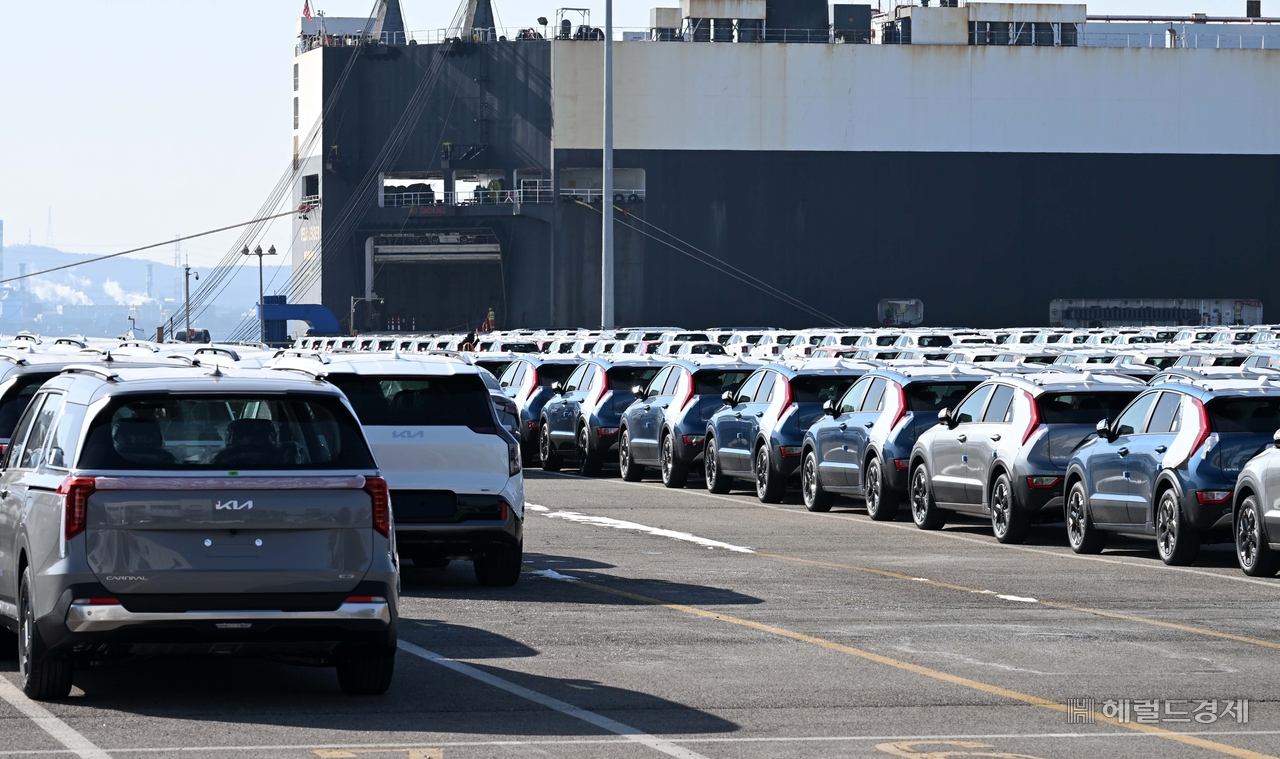
South Korea's auto industry welcomed the agreement between Seoul and Washington to pursue a strategic investment project targeting the US market, saying the deal lays the groundwork for competing on more equal footing with rival nations while reducing trade uncertainty.
The Korea Automobile Manufacturers Association (KAMA) issued a statement Thursday welcoming the agreement, saying it represented the industry's support for the two countries' decision to move forward with a US-bound strategic investment project.
KAMA said the agreement marks the first concrete step toward implementing the strategic investment framework the two countries reached last year. "We expect this agreement, as the first case of specifically carrying out the Korea-US strategic investment decided last year, to serve as an important milestone in advancing economic and industrial cooperation between the two countries to the next level," the association said.
"We also expect it to help ease trade uncertainty between Korea and the United States and to create stable conditions for Korean companies to advance into and export to the US market," it added.
The two governments announced Thursday that the first project under a strategic investment MOU would be "Project Star" — a gas combined-cycle power plant to be built in Encinal, Texas, at a total project cost of $22.3 billion. Plans for Korea-US nuclear power plant cooperation and an Alaska LNG project were also unveiled.
The auto industry particularly emphasized the significance of maintaining a stable trade environment in the US market.
"Particularly for the automotive industry, this means we can maintain a stable tariff and trade environment in our largest export market, the United States, and continue competing on equal terms with major rival nations," KAMA said.
A 15 percent US tariff on Korean passenger cars and parts has been in effect since November last year. Concerns had grown earlier this year that a Section 301 trade investigation by the United States could increase the tariff burden further, but the investment agreement is expected to keep the rate at the 15 percent level.
Beyond easing tariff uncertainty, the industry sees the deal as an opportunity to deepen Korea-US automotive supply chain cooperation. "As competition among national industrial ecosystems over technology and supply chains intensifies across the global auto industry, we believe this agreement carries great significance in strengthening supply chain cooperation between Korea and the United States," KAMA said.
The auto industry also said it would work to maintain its domestic production base alongside expanding investment in the United States.
"We hope the two countries will continue to create new opportunities for cooperation through this investment, and the Korean auto industry will actively work to strengthen the domestic production base — including revitalizing the home market and building a virtuous cycle within the parts ecosystem," KAMA said.
"We are grateful to the government and the National Assembly for their efforts to maintain a stable trade and industrial environment, and we look forward to the continued strength of Korea-US cooperation," it added.
kwater@heraldcorp.com