10-year yield tops 5.2% — now above stocks' earnings yield
The premium investors earn for taking on equity risk has all but disappeared
A rate move from 2% to 5% cuts the present value of future earnings by 25%
AI giants flooding bond markets make a rate retreat unlikely
Markets stay calm — but bonds are no safe haven either
![Traders work on the floor of the New York Stock Exchange. [AFP]](https://wimg.heraldcorp.com/news/cms/2026/10/01/news-p.v1.20260916.a4914b9bc9474e329b19aacaa4ae94f6_P1.jpg)
Imagine spending a year studying charts, tracking earnings reports and watching the news — only to end up with a 5 percent return on your stock portfolio. That feels like a win. But your friend put the same money in a bank deposit and earned 5.17 percent annually without glancing at a single chart, waiting for a single earnings release or worrying about losing a cent of principal. If your return is lower than your friend's, that 5 percent gain is closer to a loss than a success — because you gave up the interest you could have earned by simply leaving the money in the bank.
In financial markets, the role of the "bank deposit" is played by US Treasury bonds — specifically the 10-year note, which serves as the benchmark. Because the US government is considered virtually certain to meet its interest and principal payments, the 10-year yield is treated as the risk-free rate: the return an investor can earn without taking on any risk. Every risky asset's expected return is measured against it. The problem is that this "deposit rate" is now catching up with — and in some cases surpassing — what stocks can offer.
The return stocks can deliver is gauged by the earnings yield — a company's earnings divided by its share price, and the inverse of the price-to-earnings ratio.
Every Friday, the Wall Street Journal publishes PE ratios for major US indexes, citing data from Birinyi Associates. As of Friday, the S&P 500's 12-month forward PE stood at 19.94 times, implying an earnings yield of 5.02 percent.
A commercial property analogy makes this easier to grasp. A property worth 1.99 billion won ($1.47 million) that generates 100 million won in annual rent yields about 5.02 percent — exactly the relationship between the S&P 500's PE and its earnings yield. In simple terms, the yield rises only if earnings go up or the price of the asset falls.
On the same day, the US 10-year Treasury yield stood at 5.167 percent. That means a commercial property — one where tenants might leave or the building's value might fall — was yielding roughly 15 basis points less than a fixed-rate deposit with a guaranteed return. One basis point equals 0.01 percentage point.
Other indexes look even worse. As of the same date, the Nasdaq 100's PE was 24.15 times, implying an earnings yield of about 4.14 percent, while the Russell 2000 came in at 28.39 times, or roughly 3.52 percent. The gap between those yields and the Treasury rate exceeded 100 basis points and 160 basis points, respectively. Put another way: a 2.42 billion won property generating 100 million won a year in rent, while putting the same money in the bank next door would yield about 125 million won in interest.
Markets call this gap the yield gap — the earnings yield on stocks minus the Treasury yield, showing how much extra return investors receive for taking on the risk of owning equities.
According to calculations by Lee Jae-man, a researcher at Hana Securities, the S&P 500's yield gap narrowed to just 3 basis points on Friday — derived by subtracting the 10-year yield of 5.16 percent from the expected return of 5.19 percent based on a 12-month forward PE of 19.3 times. That is the lowest level since 2004. The exact figure varies slightly depending on the methodology, but the conclusion is the same: the appeal of stocks relative to bonds has fallen to its lowest point in more than two decades.
Lee described the current moment as one where the investment case for stocks over bonds is "on the verge of disappearing." Compared with the late 2000s and early 2010s, when the yield gap ran to several hundred basis points, the compensation investors receive for bearing equity risk has all but disappeared.
Rates keep pressing on stocks — and the pressure is not over
Rising interest rates hurt stocks not only because of the yield comparison, but for a more fundamental reason: stock prices reflect future earnings in advance. When rates rise, the discount rate applied to those future earnings rises with them, rapidly eroding their present value.
Consider a right to receive 100 million won 10 years from now. At an annual rate of 2 percent, that right is worth about 82 million won today — put 82 million won in the bank and it grows to 100 million won in a decade. If the rate rises to 5 percent, the present value shrinks to about 61 million won. At 10 percent, it falls to around 39 million won, less than half its value at 2 percent.
Apply that logic to the stock market: even if a company's earnings forecast 10 years out remains unchanged, a rate move from 2 percent to 5 percent alone cuts the present value of those earnings by roughly 25 percent. That is why share prices can wobble even when nothing has changed in a company's fundamentals. Because a stock price is essentially the present value of a company's future earnings, growth stocks — whose profits are concentrated further in the future — absorb the biggest shock.
Rates also look unlikely to fall easily, because bond supply keeps growing. Lee Jeong-hun, a researcher at Daishin Securities, noted that bond issuance by big tech companies investing in AI has grown to nearly 10 percent of all new investment-grade corporate bond issuance in the United States. Hyperscalers — operators of massive data centers — are sustaining capital expenditure well beyond their free cash flow. Their capital spending next year is forecast to reach $1.1 trillion, up 31 percent from this year.
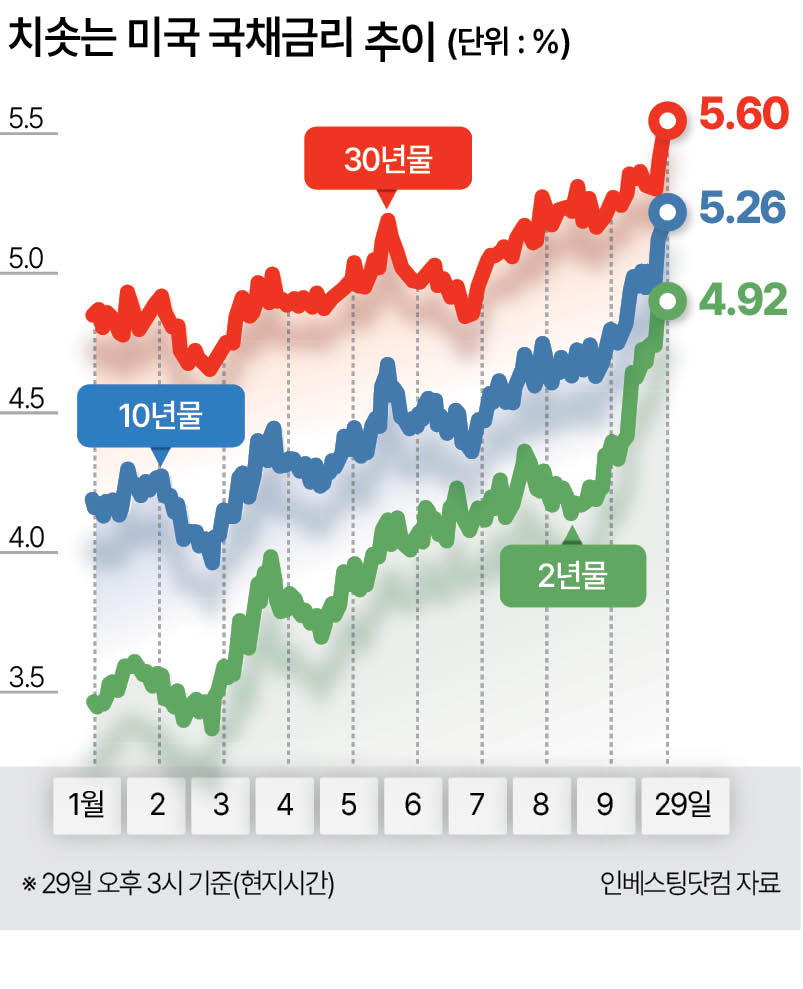
US Treasury yields have kept climbing. The 10-year yield crossed 5.2 percent on Monday, reaching 5.242 percent, and held above that level on Wednesday at 5.232 percent. The 30-year yield broke through 5.5 percent on Friday and stayed there, hitting 5.555 percent on Wednesday.
The speed of the rise is unsettling markets as much as the level itself. Analyzing data going back to 1990, Lee found that the probability of a stock market correction rises noticeably once the 10-year yield climbs about 100 basis points over a six-month period. The average probability of a 10 percent correction within four weeks is 18.4 percent, but it jumps to 22.0 percent when the six-month rise exceeds 100 basis points, and to 31.8 percent when it exceeds 125 basis points.
The 10-year yield has risen about 80 basis points from its six-month low. Applying that framework to the current period, Lee's analysis suggests that equity market stress could intensify once the 10-year yield moves above 5.2 to 5.3 percent — a threshold the market has already crossed.
Why markets are holding up anyway
None of this leads automatically to the conclusion that investors should sell stocks the moment the 10-year yield tops 5 percent. In fact, markets have reacted more calmly than many expected.
The last time the 10-year yield exceeded 5 percent was in October 2023, when the S&P 500 fell 10.3 percent and the Nasdaq dropped 12.3 percent. This time, with yields in the same territory, the S&P 500 has declined only about 3.2 percent and the Nasdaq about 4.1 percent.
The difference lies in the economic backdrop. In 2023, recession fears dominated sentiment, and surging long-term rates amplified anxiety about the growth outlook. Today, recession concerns are largely absent. How sensitive the economy is to rate shocks also matters — and AI investment, which is currently driving US growth, is a sector relatively insulated from market interest rates.
Markets also view bonds differently than before. A high Treasury yield does not automatically mean a compelling investment. In yield-gap analysis, Treasuries are treated as risk-free assets — but "risk-free" refers only to the near-zero chance of default on interest and principal. It says nothing about the risk that bond prices fall in the interim.
A 10-year Treasury yield of 5.17 percent means that buying at today's price and holding to maturity should deliver an average annual return of about 5.17 percent. The problem is that no one knows whether rates have peaked. If they rise further, the prices of bonds already issued will fall — because newly issued bonds offering higher yields cannot trade at the same price as older ones.
For example, if rates rise by another percentage point, existing 10-year Treasury prices could fall by around 7 percent. Holding to maturity still delivers the promised interest and principal, but selling before then turns a paper loss into a real one. A 5 percent-plus yield may look attractive, but that alone does not make long-term Treasuries an unconditionally safe or appealing investment.
A recent example of that risk materializing came in 2022. As the Federal Reserve raised rates, an index tracking US Treasuries with maturities of 20 years or more plunged more than 30 percent, shattering the conventional wisdom that government bonds are safe assets. The absence of default risk and the safety of price are two very different things.
Rotating from stocks into long-term Treasuries to capture bond price gains from falling rates requires a conviction that rates are near their peak. If rates instead keep rising, existing bond prices fall and paper losses mount before any gains materialize.
Market behavior already reflects a reluctance to treat bonds as a refuge. Since the pandemic, stock and bond prices have frequently moved in the same direction during periods of elevated inflation, breaking the traditional pattern in which bonds cushion equity selloffs. When bonds fail to act as a hedge, investors demand higher yields to compensate for holding long-duration debt.
Lee Jeong-hun pointed to the fact that foreign investors' purchases of long-term US securities this year have been tilted toward stocks rather than bonds, arguing that "the defining US asset right now is equities, not Treasuries."
Taken together, the picture looks like this: as long as concerns about further rate increases persist, a 5 percent-plus Treasury yield is hard to read as straightforwardly attractive. Because markets themselves no longer treat bonds as a safe haven, money does not automatically flow from stocks to bonds just because the Treasury yield has overtaken the earnings yield. A narrowing yield gap does not, by itself, mean the investment case for equities has collapsed.
Growth remains a variable. The cash flows from bonds are fixed, but corporate earnings can grow over time. If earnings rise while share prices stay flat, the earnings yield improves; if prices follow earnings higher, investors pocket capital gains.
It is similar to owning a commercial property where rents keep rising — judging the investment solely on today's rental yield misses the point. Today's 5 percent is both a warning that stocks are not offering enough return and a demand that corporate earnings growth close the gap going forward.
Lee Jeong-hun also sees growth as the ultimate deciding factor. "What ultimately matters for the stock market is the growth potential and profitability of industries," he said, adding that once rates stabilize to some degree, market attention will shift back to whether the AI ecosystem can prove its capacity for high growth and monetization. His reasoning: big tech companies are raising capital at 6 to 7 percent and generating profit margins of 30 percent, with revenue growth actually accelerating.
Lee Eun-taek, a researcher at KB Securities, added a caveat to that optimism. He said the reason markets are weathering 5 percent-plus rates is that the second condition for a bubble to burst — a sustained inflationary trend — has yet to clearly emerge. As long as underlying inflation remains subdued, he said, markets will find it hard to abandon the hope that "things will be fine once the Iran situation is resolved." He cautioned that recent strong economic data means investors "should stay alert to the possibility that inflation could re-accelerate."

th5@heraldcorp.com