Minister dismisses fears tariff rate could exceed 15% from overproduction probe; tariff relief secured for Alaska LNG project
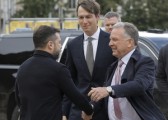
![Industry Minister Kim Jung-kwan (left) and US Commerce Secretary Howard Lutnick. [Yonhap]](https://wimg.heraldcorp.com/news/cms/2026/10/01/news-p.v1.20260917.6626ee638ce04200b6ba07b8c37509c8_P1.jpg)
The South Korean government said it secured the previously agreed 15% tariff ceiling from Washington alongside its announcement of a $200 billion US investment package, though it acknowledged the tariff rate was not explicitly written into the joint statement.
According to trade authorities, Industry Minister Kim Jung-kwan held a background briefing at Government Complex Seoul on Sept. 22, immediately after reporting to the National Assembly on the US investment negotiations. Kim said it was "not the right place" to spell out tariff figures directly in the investment project agreement, adding that the omission was regrettable. He said, however, that Washington had made clear it would maintain tariffs at the 15% level "whether through Section 301 of the Trade Act or any other mechanism."
The remarks were a direct rebuttal of concerns that tariffs on South Korean goods could breach the 15% ceiling depending on the outcome of a US Section 301 overproduction investigation.
The Trump administration has been reshaping its tariff policy using tools including Section 301 of the Trade Act since the Supreme Court struck down the reciprocal tariffs in February.
The Office of the United States Trade Representative launched investigations in March under Section 301 into overproduction and forced labor practices across 16 economies, including South Korea, China, the EU, Japan and India.
In July, the administration imposed new forced-labor tariffs of 10 to 12.5 percent on 60 economies, including South Korea and China. South Korea was hit with a 12.5 percent rate.
Concerns then arose that if additional tariffs from the overproduction probe were also imposed, the total tariff burden on South Korean goods could exceed the 15 percent level agreed between Seoul and Washington last year.
According to Bloomberg and other outlets, the Trump administration had originally planned to release a trade report on overproduction before the US-China summit on Thursday, but delayed the announcement to wait for the outcome of the summit.
South Korea pledged a total of $350 billion in US investment last year — including $150 billion in shipbuilding cooperation and $200 billion in strategic investment — in exchange for a reduction in tariffs from 25 percent to 15 percent.
The government confirmed the construction of a gas-fired combined-cycle power plant in Encinal, Texas (Project Star) as the first project under the $200 billion strategic investment initiative. It left decisions on two other projects unresolved, deferring them for future consultations: the construction of eight large nuclear power plants (Project Power) and the Alaska LNG development (Project North).
Kim described the US investment commitments as an unavoidable response to trade pressure from Washington, including arbitrary tariff hikes and import restrictions under Section 301 and other measures.
"If a project is not commercially viable, we should pull out and not put in money — but the problem is that under the MOU, withdrawing from a project triggers US retaliation such as tariff increases," Kim said. "That is why we used the expression 'a tilted playing field' in our negotiations."
"A key objective is to ensure that no further unfavorable trade regulations are applied to us," he added. "The road ahead in our trade relationship with the US should be seen as a continuous process of clearing one hurdle after another. That is the reality."
On the Alaska LNG development project, which Washington has pushed strongly, South Korea said it secured tariff relief benefits.
"For the Alaska project, we received a fairly concrete commitment on tariff reductions for Korean-made equipment and materials," Kim said. He added that steel tariffs were raised with US Commerce Secretary Howard Lutnick at every meeting, and that Seoul had obtained a commitment from Lutnick to address them.
Kim said there were no US demands for additional semiconductor investment during the latest round of negotiations.
"The MOU signed last year includes semiconductor language and various other items, but semiconductors were left out of the overall framework of this round of discussions," he said.
oskymoon@heraldcorp.com