Ministry of Trade says to await official announcement based on Sept. 22 National Assembly briefing
Feasibility review and legislative procedures still required before any commitment
Alaska project was also raised at 2017 Korea-US summit
Analysts see political motive tied to November midterm elections
Donald Trump could announce as early as Wednesday (local time) a package of South Korea's strategic investments in the United States, with speculation mounting that the roughly $54 billion Alaska liquefied natural gas project may be included — a potential discrepancy with what the South Korean government told the National Assembly just a week ago, when it listed the Alaska venture among projects still subject to further negotiation.
Reuters reported Tuesday (local time), citing multiple sources, that Trump may announce plans for South Korea to channel its strategic investment funds into major US projects, potentially including about $54 billion for the Alaska LNG development.
The South Korean government, however, said neither the timing of any US announcement nor South Korea's participation in the Alaska LNG project has been confirmed.
An official at the Ministry of Trade, Industry and Energy said the ministry understood that US internal procedures were still under way and that the two sides were in close communication, but added that no specific announcement date had been confirmed. "The Alaska project is something where we will decide on participation after reviewing commercial viability under relevant laws — nothing has been finalized," the official said.
A separate ministry official noted that Reuters itself had used the word "possibility." "Our position on that project remains, as we explained at the last briefing, that we are reviewing commercial viability," the official said, adding that the final outcome would have to wait until both governments confirm it.
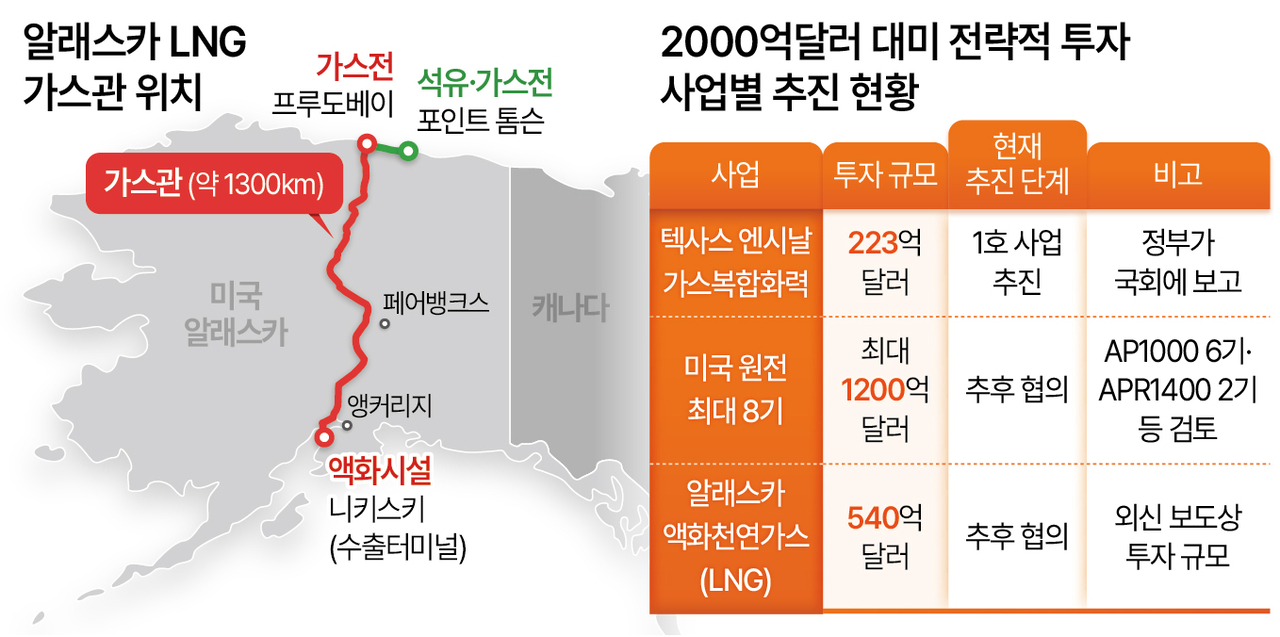
If the $54 billion figure cited by Reuters were confirmed as South Korea's share, it would represent about 27 percent of the $200 billion total strategic investment pledge. Adding the $22.3 billion Encinal gas-fired power plant in Texas — designated as the first-priority project — and up to $120 billion for the construction of as many as eight US nuclear power plants, the combined total would reach $196.3 billion, still within the $200 billion ceiling even if all three projects are executed at their maximum scale.
The National Assembly's fiscal and economic planning committee and its trade, industry, small business and venture committee were separately briefed in closed session on Sept. 22 on the government's confirmed first-priority US investment project and the plans for the second and third projects — receiving reports from Deputy Prime Minister and Finance Minister Lee Hyung-il and Industry Minister Kim Jung-kwan, respectively.
The first-priority Encinal project involves investing $22.3 billion to build a gas-fired combined-cycle power plant in Encinal, Texas. The second and third projects — construction of eight large nuclear reactors and development of Alaska LNG — were left unresolved, designated as subjects for further negotiation. The government chose not to commit to those two projects given their uncertain profitability, leaving them open to additional consultations and future legislative procedures.
A ministry official said at the time that "individual nuclear projects and Alaska must go through a commercial viability review under legal procedures, and the National Assembly must be briefed again on any decision to proceed." In other words, a feasibility review, related procedures and a further Assembly report all remain before Alaska LNG can be confirmed as an actual investment project.
Alaska is a competitive state in the US midterm elections scheduled for early November and one of Trump's top political priorities. Trump won Alaska by a wide margin in the 2024 presidential election, but a tight race is now under way between incumbent Republican Sen. Dan Sullivan and a Democratic challenger.
The Alaska LNG project was previously raised when Trump made his first state visit to South Korea on Nov. 7, 2017. In a joint press statement following his summit with then-President Moon Jae-in, the two sides announced that Korea Gas Corporation had signed an MOU with an Alaskan development company on establishing a framework for cooperation in developing natural gas infrastructure in Alaska.
Korea Gas Corporation had in fact signed an MOU with the Alaska Gasline Development Corporation (AGDC) in June 2017, five months before that summit. The project was a large-scale development with a total investment of $39 billion.
Korea Gas Corporation subsequently extended its MOU with AGDC twice but ultimately let the project lapse. The project involves extracting natural gas from Alaska's North Slope, transporting it roughly 1,300 kilometers by pipeline to a liquefaction facility near Anchorage, and then supplying it to end markets.
Three major US oil companies — ExxonMobil, BP and ConocoPhillips — had backed the project but withdrew one after another in 2016 amid growing concerns over costs. Management of the project then passed to the state-owned AGDC.
Trump has nonetheless revived the Alaska push ahead of the November midterms, with the move widely interpreted as an effort to boost Sullivan's reelection bid. Sullivan has been a vocal supporter of the Alaska LNG development, and Trump is reportedly planning a campaign visit to Alaska in October.
Trump had already signaled his intentions on Sept. 2 (local time), when he mentioned support for the Republican Senate candidate in Alaska during remarks at the White House. "You have Japan and South Korea — all these people are going to Alaska to load up fuel, load up oil, build pipelines and do everything else," he said, openly calling on South Korea and Japan to invest in the Alaska project.
South Korea, for its part, appears to have shifted toward a more serious examination of the Alaska project as a way to diversify its energy supply away from the Middle East, amid a deepening global oil and gas supply crunch driven by the ongoing conflict in the region.
Shipping LNG from Texas — close to shale gas production areas — to South Korea or Japan takes at least three weeks under normal conditions, and up to a month if the Panama Canal is blocked. From Alaska, the journey takes about a week. Large LNG carriers in particular often cannot use the Panama Canal and must take the route around Africa's Cape of Good Hope, a journey that can stretch to 45 to 50 days.
"Before the Middle East conflict, there was a largely negative view of the Alaska project, but now there is a mood to reconsider it from an energy security standpoint," a political source said. "Given the midterm elections and the desire to reduce South Korea's energy dependence on the Middle East, I think investment in the Alaska project could be on the table."
oskymoon@heraldcorp.com