![Laurence D. Fink, chairman and CEO of BlackRock. [Reuters]](https://wimg.heraldcorp.com/news/cms/2026/09/30/rcv.YNA.20260506.PRU20260506027601009_P1.jpg)
The universe of AI investment targets in the US ETF market is expanding rapidly. What began as a focus on AI semiconductors and data centers — led by companies like Nvidia — has since branched into power infrastructure, cooling systems, robotics and chip manufacturing. Now, a new category of ETF has emerged targeting not just companies that build AI, but those that use it to cut costs and grow revenue.
The iShares Future AI Beneficiaries ETF (AIBF), launched in September by BlackRock, reflects this shift. BlackRock, the world's largest asset manager, oversees $15.3 trillion in assets as of the end of June. Rather than limiting its holdings to AI technology companies, AIBF includes major positions in traditional industry names such as Walmart, Eli Lilly, AbbVie, Johnson & Johnson and GE Aerospace. The world's biggest fund manager has broadened its definition of AI beneficiaries from "companies that make AI" to "companies that use AI."
AIBF invests in US companies that can reduce costs or grow revenue through AI. BlackRock views cost reduction as the most important beneficiary factor while also incorporating AI-driven revenue growth into its investment criteria. The fund holds 100 stocks.
The portfolio makes the fund's character even clearer. Walmart carries the largest share at 4.02%, followed by Costco at 3.85%, Eli Lilly at 3.80%, AbbVie at 3.80%, Johnson & Johnson at 3.63%, Palo Alto Networks at 3.19%, Coca-Cola at 3.15%, GE Aerospace at 3.08% and Meta at 2.43%. The investment targets look markedly different from the chipmakers most investors associate with AI ETFs.

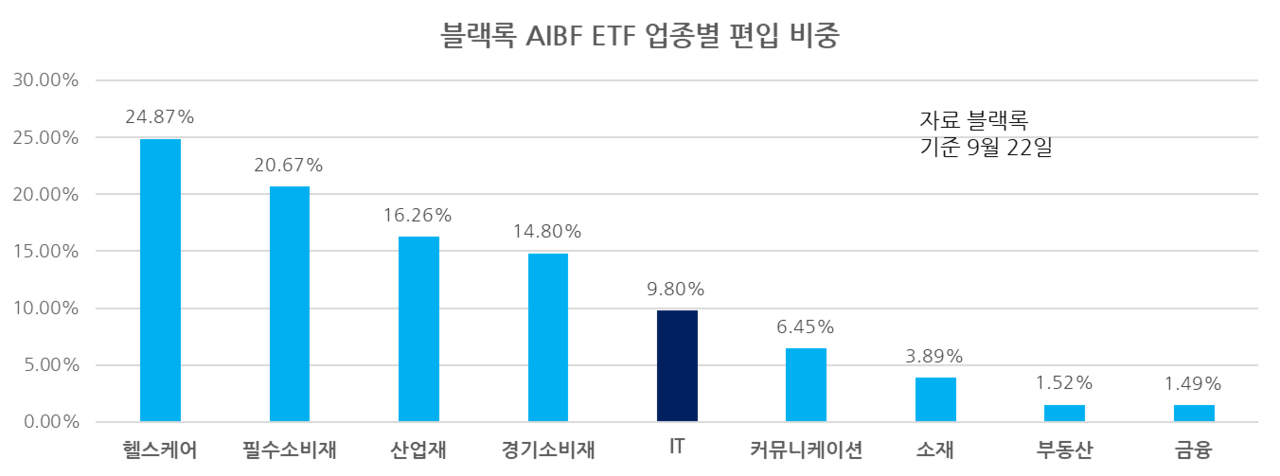
The fund's sector composition further explains how AIBF differs from conventional AI ETFs. Healthcare, consumer staples and industrials carry relatively high weightings, while IT has a comparatively smaller share. That is because the fund casts a wide net over companies that use AI to improve the productivity and efficiency of existing businesses, rather than those that sell AI technology directly.
Across the US ETF market, AI investment themes have been sliced ever more finely. Products targeting specific niches — data center power and cooling, robotics components, AI industry bottlenecks, semiconductor manufacturing — have followed one after another since the initial wave of AI chip-focused funds. The approach shifts from betting on AI as a single broad theme to asking which specific segments will actually profit as AI grows.
BlackRock believes AI investment opportunities will expand beyond semiconductor and data center infrastructure into real industries. Its view is that investors need to look beyond companies building AI technology to those using AI to cut costs and raise productivity.
BlackRock describes this expansion of AI investment opportunity in three stages: Build-out, Adoption and Transformation. The progression starts with building AI infrastructure — semiconductors, data centers and servers — moves to companies integrating AI into their operations and products, and culminates in businesses reshaping their entire operating models. Investment is currently concentrated in the infrastructure build-out phase, but as AI adoption accelerates, the range of beneficiaries could widen to encompass traditional industries.
AIBF is a product built on that investment thesis. Rather than holding companies that create AI technology, it holds companies positioned to benefit from applying AI to real business operations. BlackRock sees Walmart, Eli Lilly, GE Aerospace and similar companies as standing to gain tangible business benefits as AI spreads into retail, healthcare and industrials.
Walmart, the world's largest retailer, is deploying AI across its online shopping and purchasing processes. Customers who use its AI shopping assistant Sparky spend on average about 35 percent more per order than those who do not. The company has moved AI beyond product search and recommendations into the actual purchasing process, using it as a direct driver of sales growth.
Eli Lilly, one of America's leading pharmaceutical companies, is applying AI to drug development and medicine production. Eli Lilly and Nvidia have established a joint AI innovation laboratory and agreed to invest up to $1 billion over five years. The collaboration extends from using AI to identify new drug candidates to researching robotics and physical AI for pharmaceutical manufacturing.
GE Aerospace, the aircraft engine manufacturer, uses AI for engine inspection and maintenance. The technology identifies anomalies in engine components and analyzes engine condition to predict when maintenance will be needed. It is an example of AI moving beyond semiconductor and software companies to reduce time and costs on the manufacturing floor.
US cybersecurity firm Palo Alto Networks is targeting the growing security demand that AI proliferation creates. As AI is applied across a wider range of corporate operations, security vulnerabilities tied to AI systems are multiplying. Palo Alto Networks is pursuing this new market with security services that use AI models to detect weaknesses in enterprise systems.
US food company Kellanova offers a case study in using AI to cut manufacturing costs. According to BlackRock, Kellanova invested $4 million to $5 million in AI to improve the quality of its potato chips, achieving a 10 percent improvement in quality and a 13 percent reduction in waste. BlackRock said the return on investment reached 40 percent.
From Walmart to Eli Lilly to GE Aerospace, the sectors differ, but the common thread is clear: none of these companies builds AI — instead, each applies AI to existing operations to lower costs, raise productivity or create new revenue opportunities.
"Does investing in AI mean the same thing as creating value through AI?"
Jay Jacobs, BlackRock's head of US thematic and active equity ETFs, posed that question, adding that "the AI investment opportunity is shifting from a concentrated technology build-out to a broader set of opportunities that are increasingly closer to the real economy." While Microsoft, Amazon, Alphabet and Meta pour vast sums into data centers and computing infrastructure, Walmart is using an AI shopping assistant to lift purchases and Eli Lilly is applying AI to drug development and production. The moment when investors need to distinguish between companies spending money to build AI and companies using AI to deliver business results is drawing closer.


kacew@heraldcorp.com