Climate Response Committee reviews 2025 greenhouse gas reduction targets and national plan implementation
Net emissions last year reach 590.9 million tons, exceeding reduction target by 4.3%
Annual average cut of 5.9% needed through 2030 to meet NDC goal
![[123RF]](https://wimg.heraldcorp.com/news/cms/2026/09/30/news-p.v1.20260930.24a9730c8e5042a48e2b713d6b0ad2e8_P1.jpg)
South Korea exceeded its greenhouse gas reduction target last year, but the year-on-year reduction rate has slowed for three consecutive years, according to a government review.
The National Climate Crisis Response Committee said it reviewed and adopted the results of the 2025 greenhouse gas reduction target and national basic plan implementation check at its fourth plenary session of 2026.
The review found that the country's net greenhouse gas emissions last year stood at a provisional 590.9 million tons, surpassing the annual reduction target of 617.6 million tons by 4.3%. However, the reduction rate compared with 598.9 million tons in 2024 came to just 1.3%, continuing a slowdown that has persisted for three consecutive years.
The emissions decline was attributed mainly to lower output in heavy-emitting industries such as steel within the industrial sector, as well as increased renewable energy generation in the power sector.
However, the committee said the industrial sector's reduction was heavily influenced by external factors such as falling output due to an economic slowdown, and that structural efforts to cut emissions need to be strengthened.
By contrast, emissions in the power and buildings sectors rose from the previous year, while the transport, agriculture and fisheries, and waste sectors all fell short of their reduction targets.
The committee said the review showed that climate policy momentum had been restored — with the establishment of the 2035 nationally determined contribution (NDC), the drafting of carbon neutrality basic plans by local governments, an upward revision of the renewable energy supply target to 100 gigawatts by 2030, the finalization of the fourth emissions allowance allocation plan with a higher share of paid allocations, and the enactment of a special law for the steel industry. It assessed that the groundwork had been laid for an energy transition centered on renewable energy and a green transformation of industry.
However, the committee said some areas fell short, including the rollout of zero-emission vehicles such as electric and hydrogen cars, which missed its target, and delays in designating special zones for a just transition.
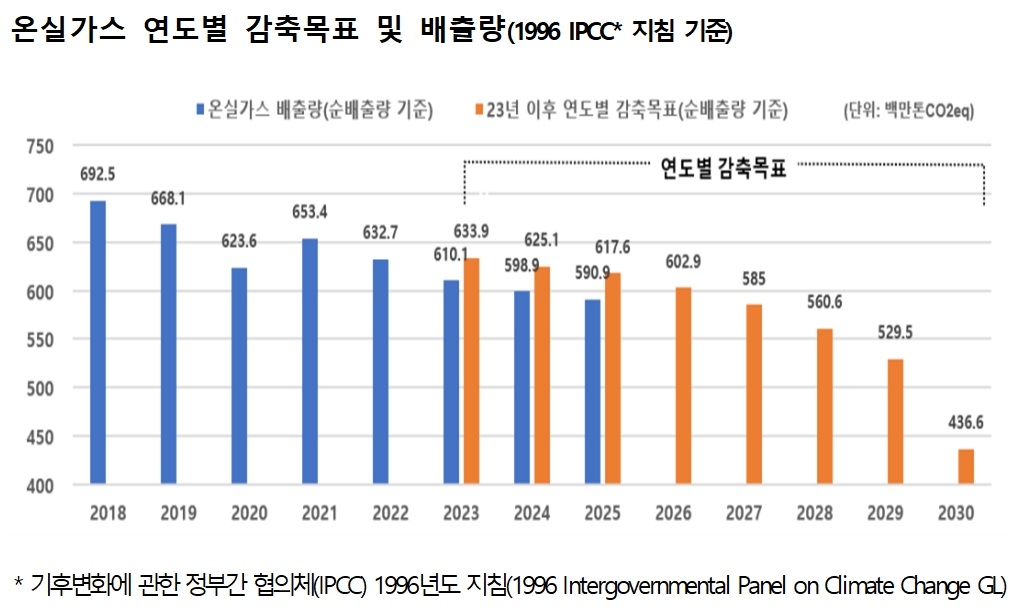
The committee said an additional reduction of 154.3 million tons is needed by 2030 to meet the 2030 NDC, requiring an average annual reduction rate of 5.9% going forward. It outlined sector-by-sector improvements needed to accelerate decarbonization.
In the power sector, the committee called for expanding the supply of carbon-free energy through faster deployment of renewable energy, conversion of coal-fired power plants, and timely completion of nuclear power plants. In the industrial sector, it said sector-specific reduction roadmaps should be developed to reduce the impact of economic fluctuations on emissions and promote structural cuts.
The transport sector needs measures to accelerate the spread of zero-emission vehicles and demand management through greater use of public transit. The waste sector requires concrete target management to reduce landfill and incineration volumes, while the agriculture and livestock sector needs practical reduction alternatives, including support for low-carbon farming practices.
In the climate adaptation area, the committee called for expanded support for climate-vulnerable populations. On just transition, it urged the swift designation of special zones. In the area of regional leadership, it called for stronger communication and cooperation between the central government and local authorities, and for the public disclosure of local government implementation results to build regional carbon neutrality capacity.
To strengthen implementation, the committee also emphasized the need to improve alignment between the forthcoming second national basic plan and the NDC, and to expand civic participation through measures such as activating climate citizens' assemblies.
Lee Chang-hoon, the committee's civilian co-chair, said the 2030 NDC has a back-loaded reduction structure in which targets rise sharply as the 2030 deadline approaches, making more intensive efforts increasingly necessary. "Now is the golden time to achieve the 2030 NDC target," he said. "Meaningful reductions can only be achieved when government policy support, structural transformation and technological innovation by industry, and carbon neutrality practices in everyday life all come together."
thlee@heraldcorp.com