35 years after local councils were restored, no independent law governs them — assemblies demand greater autonomy over organization and budgets
Policy aides capped at one per two lawmakers, delegates say, calling for overhaul of legislative support system
PPP floor leader Kim Gil-young: 'We must restore the standing of local assemblies to enable real oversight'
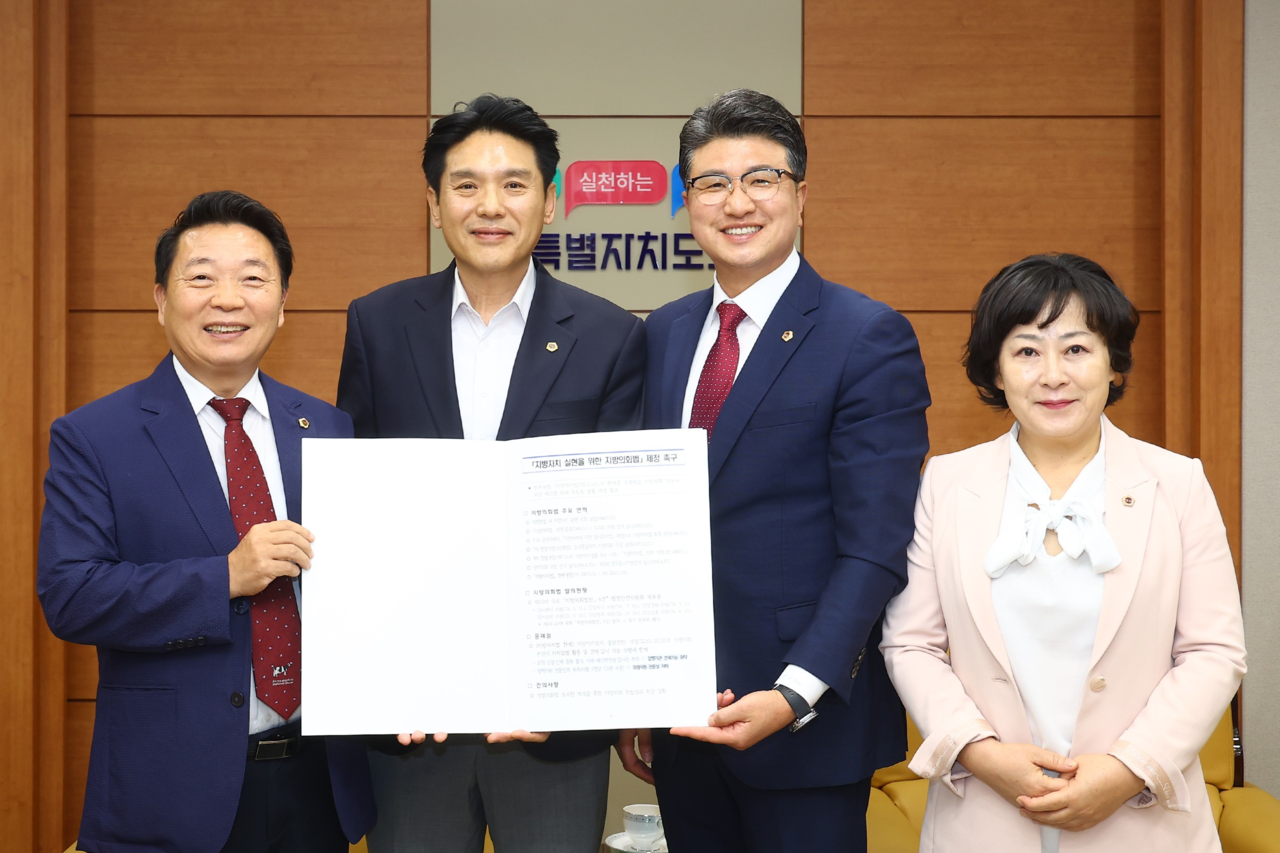
Thirty-five years have passed since local assemblies were restored in 1991. Their responsibilities have grown to include enacting ordinances, reviewing budgets and conducting administrative audits — yet no independent legal framework has been established to underpin that expanded role. The People Power Party floor leaders of four metropolitan assemblies, including Seoul's, have agreed to mount a joint push for the enactment of a dedicated "local assembly law" that would give local councils greater autonomy over their organization, budgets and staffing.
The Seoul Metropolitan Council's PPP caucus said Monday that it held a meeting with PPP floor delegations from the Gangwon, Gyeonggi and North Chungcheong provincial assemblies at the Gangwon Special Self-Governing Provincial Assembly, where the groups agreed to build a cooperative framework for strengthening local assembly authority and enacting a local assembly law.
The core of the discussion centered on establishing the institutional foundation needed for local assemblies to function as independent representative bodies rather than as subordinate arms of executive agencies.
The current Local Autonomy Act governs the composition, powers and legislative activities of local assemblies, but participants said that for local assemblies to effectively check and oversee executive agencies, they need a significantly higher degree of autonomy over their organization, budgets and professional staffing.
Participants also agreed that just as the National Assembly operates an independent legislative system grounded in the National Assembly Act, local assemblies should have their own separate law that clearly defines their authority and responsibilities.
Overhaul of staffing and budgets: 'Beyond policy support to full legislative assistance'
The meeting took up a range of priorities: securing local assemblies' independent authority over organizational structure and budget planning, establishing their own audit bodies, overhauling the professional staffing system for legislative support, and creating a legal basis for appointing specially designated civil servants suited to the nature of assembly work.
The most heavily emphasized issue was the professional staffing that supports lawmakers' legislative activities.
Article 41 of the current Local Autonomy Act allows local assemblies to appoint policy support specialists up to half the total number of council members. Implementing regulations further define those specialists' duties as centered on collecting, researching and analyzing legislative materials, and supporting work related to ordinance drafting and revision, budget and settlement reviews, and administrative audits.
The metropolitan assembly delegations said this arrangement amounts in effect to one policy aide for every two lawmakers — a structure they said is inadequate to handle the growing complexity of local administration and legislative demand. They called for a shift away from simple policy-material support toward a system that provides comprehensive, professional assistance across all aspects of a lawmaker's legislative work.
Expanding flexibility in staffing composition was also on the table. The proposal was to establish a legal basis allowing assemblies to employ specially designated civil servants — not just general-track staff — based on the specific nature and needs of their work, in order to raise the level of expertise.
Kim Gil-young, the PPP floor leader of the Seoul Metropolitan Council representing the Gangnam 6 district, said the current "two lawmakers, one aide" system — effectively 0.5 aides per lawmaker — "is a deeply abnormal structure that undermines the professionalism of local assemblies." He said the local assembly law must explicitly provide for what he called "legislative aide integration," enabling close support across all legislative activities rather than limited policy assistance, as well as a "specially designated civil servant track" tailored to the nature of assembly work.
At the heart of the discussion is how far to institutionalize the independence of local assemblies. If local assemblies' demands for expanded authority over organizational structure and budget planning are realized, they would have a broader foundation to design their own organizations and staffing more proactively. How to ensure accountability and transparency commensurate with that expanded authority is also a matter to be addressed during the legislative process.
The PPP floor delegations of the four metropolitan assemblies plan to continue their joint response as the legislative debate over a local assembly law moves forward. Their aim is to go beyond the demands of individual assemblies, consolidate common institutional reform priorities across metropolitan councils, and make their voices heard in the National Assembly's legislative process.
Kim said the PPP metropolitan assembly delegations would "unite as one to restore the standing of local assemblies over their 35-year history and lead the enactment of a genuine local assembly law, so that real checks and oversight of executive agencies can be achieved."
As local assemblies mark 35 years since their restoration this year, attention is turning to how much of their longstanding institutional demands — over organizational authority, budget planning and personnel powers — the local assembly law debate will ultimately address.
7toy7@heraldcorp.com