Wang Huning, No. 4 in party hierarchy, issues public warning
Vows to oppose 'outside interference' in apparent dig at US
Xi had pressed Trump on Taiwan at White House meeting
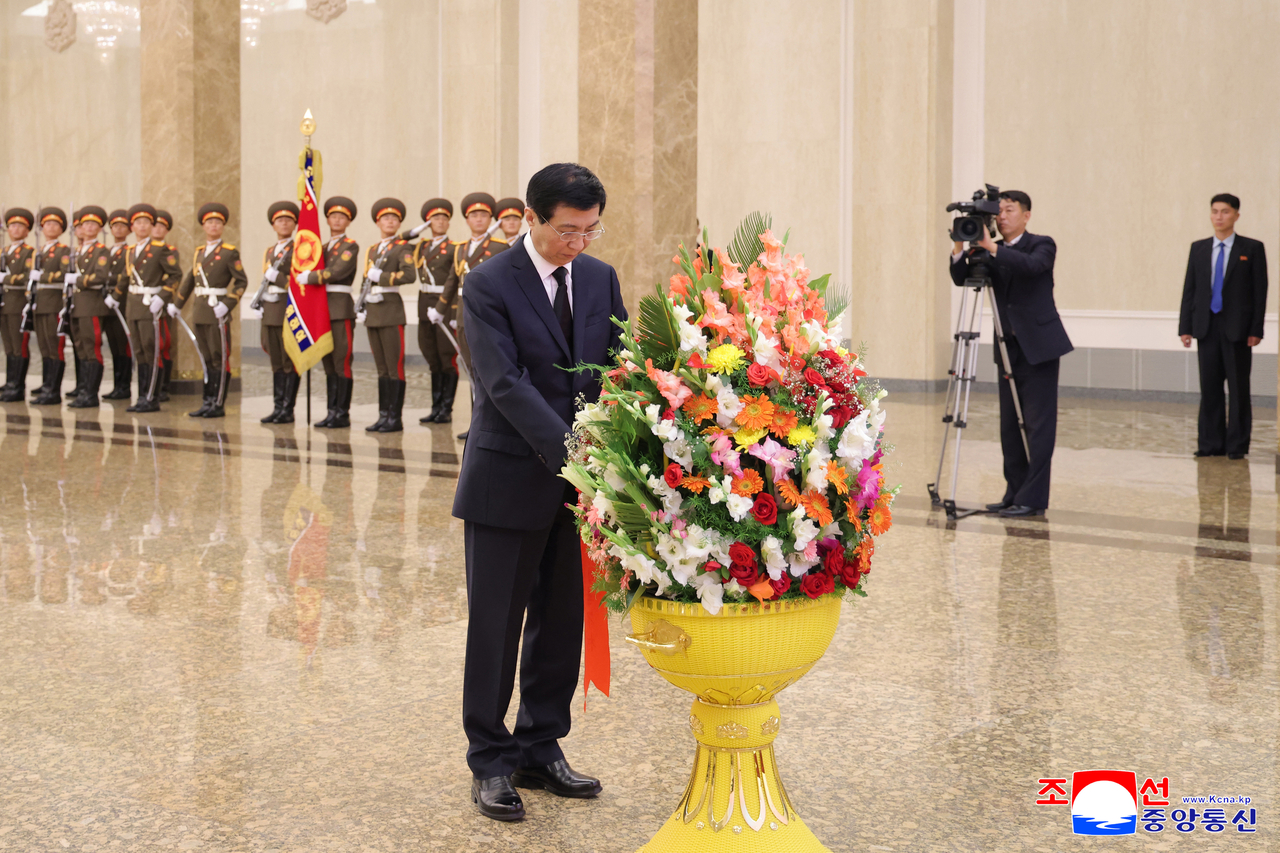
China's leadership publicly restated its red lines on Taiwan immediately after the conclusion of a US-China summit, with the official overseeing Beijing's Taiwan policy vowing to "resolutely strike" pro-independence forces and reject outside interference in the island's affairs.
Wang Huning, chairman of the Chinese People's Political Consultative Conference (CPPCC) and the fourth-ranked member of the Communist Party's Politburo Standing Committee, made the remarks Monday at a reception held at the Great Hall of the People in Beijing to mark the 77th anniversary of the founding of the People's Republic of China, according to China's state-run Xinhua News Agency.
Wang serves concurrently as a member of the party's top decision-making body and as CPPCC chairman, giving him overall responsibility for China's Taiwan policy.
Wang said China would "thoroughly implement the party's overall strategy for resolving the Taiwan question in the new era" and uphold both the one-China principle and the "1992 Consensus."
The 1992 Consensus refers to an understanding reached between China and Taiwan that year in which both sides acknowledged the existence of one China while reserving the right to use their own names for it. Beijing treats the consensus as the political foundation for cross-strait relations, but Taiwan's ruling Democratic Progressive Party does not recognize it.
Wang said China would "deepen cross-strait exchanges, cooperation and integrated development, resolutely strike Taiwan independence separatist forces, and oppose interference by outside forces," adding that Beijing would "unwaveringly advance the great cause of national reunification."
The reference to opposing "outside interference" was widely interpreted as directed at the United States, which continues to supply arms to Taiwan.
Wang's remarks drew particular attention because they came immediately after last week's US-China summit in Washington.
Xi Jinping met Donald Trump at the White House on Thursday and raised the Taiwan issue directly. Xi said China's position on defending national unification and territorial integrity was "very clear" and urged Washington to handle the Taiwan question with care.
Xi also said he hoped the United States would "uphold its correct position of opposing Taiwan independence."
China has long defined the Taiwan question as a core interest and a red line on which it will not yield in its relationship with the United States. The summit effectively reaffirmed Beijing's standing principles on Taiwan, separate from the economic agenda — including trade, tariffs and advanced technology — that dominated the two countries' talks.
With Wang, the official in charge of Taiwan policy, publicly echoing the summit's hard line by calling for strikes against independence forces and opposition to outside interference, China appeared to be signaling that it would maintain its tough stance on Taiwan even after the talks concluded.
Wang also reaffirmed Beijing's governing principles for Hong Kong and Macau, stressing the "one country, two systems" framework and the principle of "patriots governing Hong Kong and Macau." He said China would strengthen rule-of-law governance in both territories and promote their economic and social development.
Wang added that Beijing would support Hong Kong and Macau in better integrating into and contributing to the country's broader development.
sjy@heraldcorp.com