Concerns over drop in local allocation tax, added burden on local budgets
Government says local allocation tax will be higher in 2027 than this year
Investment expansion planned for regional industries, talent and essential healthcare
Local governments have sought allocation tax rate adjustment for 20 years
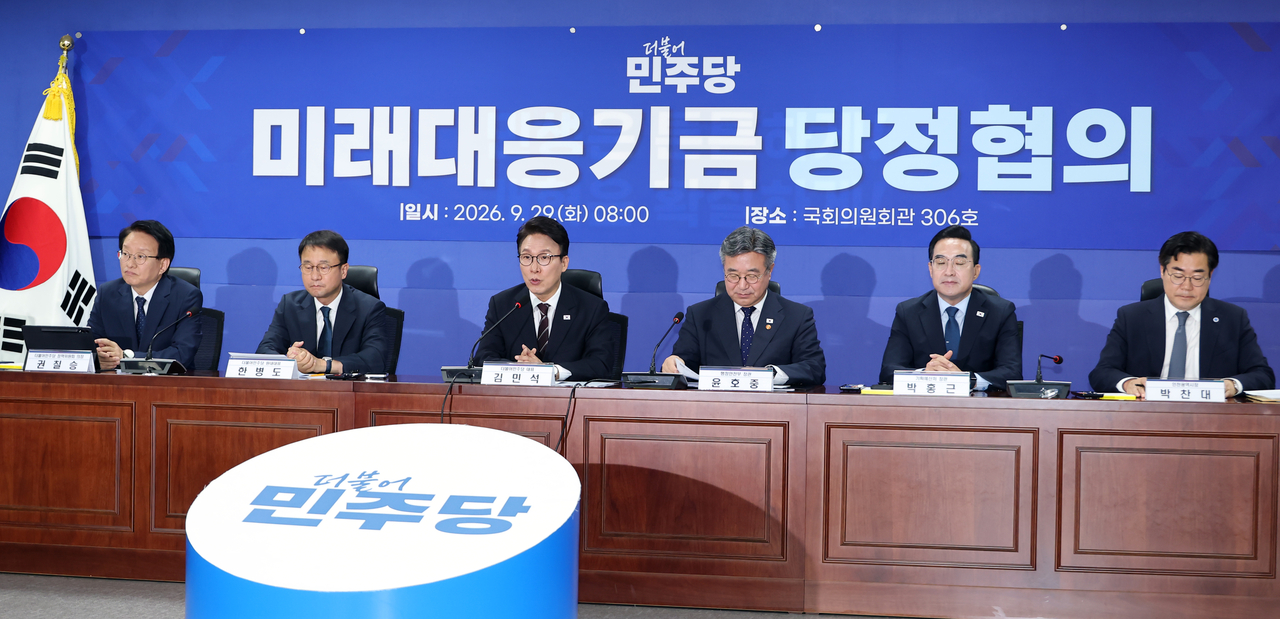
The Democratic Party of Korea and the government moved Tuesday to address concerns that the creation of a new Future Response Fund could reduce local allocation tax revenues, pledging to refine the fund's design and usage. Local governments called for adjustments to the local allocation tax rate — unchanged for 20 years — arguing that any recovery in tax revenues should also benefit local coffers.
The Democratic Party and the government held a party-government consultation on the Future Response Fund at the National Assembly on Tuesday morning, discussing ways to ease the fiscal burden on local governments. Democratic Party leader Kim Min-seok said the entire increase in national tax revenues would not be deposited into the Future Response Fund, but added that concerns about local tax shortfalls and the erosion of local fiscal autonomy must be heeded. "We will fully discuss and reflect the concerns and proposals from local governments through consultations between the party, the government and local authorities," he said.
The Future Response Fund is designed to set aside resources accumulated during periods of rising tax revenues for investment in future growth areas, while also serving as a buffer against tax revenue volatility. The government plans to channel investment into four priority areas — youth, growth engines, regional development and education talent — to underpin future growth.
However, local governments have raised concerns that the fund's design could result in a smaller-than-expected local allocation tax, which is linked to domestic tax revenues.
Floor Leader Han Byung-do said he had heard repeatedly — including through budget policy consultations — that local governments were deeply worried about a potential cut to local allocation tax and an increased burden on local budgets. "We will carefully reflect these concerns during the upcoming budget and legislative review process to strengthen the Future Response Fund," he said.
Minister of Interior and Safety Yun Ho-jung said the fund is designed so that local allocation tax in 2027 will be higher than this year, though he acknowledged a gap between that projection and local governments' expectations. He said he hoped Tuesday's discussions between the party, the government and local authorities would allow further refinements to the fund's design and implementation.
The government also stressed that the Future Response Fund is not intended to reduce local government finances. Ministry of Planning and Budget Minister Park Hong-keun said support for local governments "will never be thinned out," and pledged to expand investment in regional industrial hubs, talent development and essential healthcare.
Park added that the government would establish a local account within the Future Response Fund and expand investment to actively meet local demand — including through local future growth grants and multipurpose community convenience centers. "We will make local governments' voices our top priority throughout the National Assembly deliberation process," he said.
Incheon Mayor Park Chan-dae, who chairs the Council of Metropolitan and Provincial Governors, said local allocation tax had fallen for consecutive years due to the large-scale tax shortfall under the previous Yoon Suk Yeol administration. "Local governments have barely held on by drawing down their reserves, issuing local bonds and deferring projects promised to residents," he said.
Park called for an adjustment to the local allocation tax rate, saying that as tax revenues recover, local governments should receive their share to replenish depleted reserves. "The local allocation tax rate has remained unchanged since 2006 — for 20 years," he said. "We hope the rate adjustment will be discussed in line with the government's own policy agenda of fiscal decentralization."
thanks@heraldcorp.com