Democratic Party, Fair Trade Commission align at party-government meeting
Statute of limitations extended to 15 years; price re-determination order planned
Kwon Chil-seung: 'Habitual cartel operators must be driven out of the market'
Ju Byung-gi: 'Fines exceeding illicit gains will become the new standard'
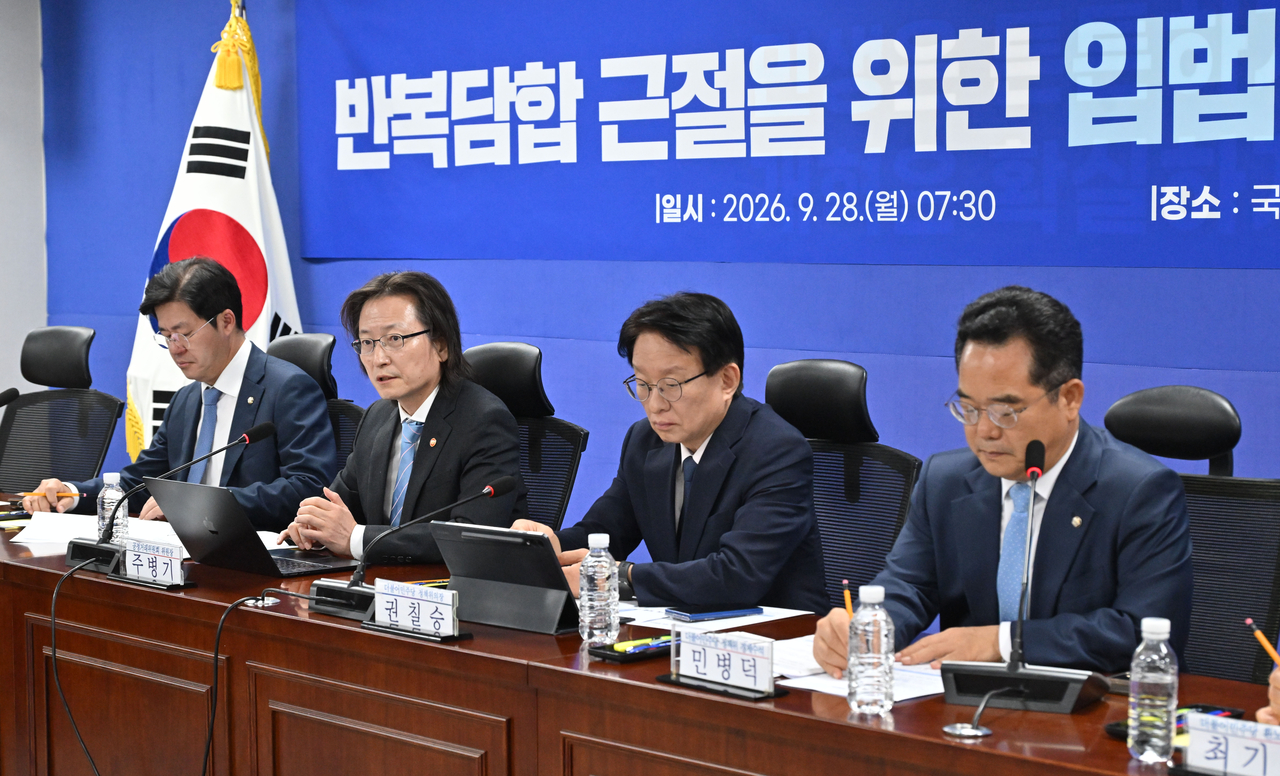
The government and ruling party have unveiled a sweeping set of measures to expel businesses that repeatedly engage in price-fixing in sectors closely tied to everyday life — including food ingredients, education, energy and residential services. The centerpiece is a legal framework that would allow the Korea Fair Trade Commission to request the cancellation of registrations or suspension of operations against businesses found to have colluded two or more times within five years.
The Democratic Party of Korea and the Fair Trade Commission held a party-government consultative meeting at the National Assembly on Monday to align on legislation to eradicate repeat collusion.
Democratic Party Policy Committee Chairman Kwon Chil-seung said institutional safeguards must be put in place to drive habitual cartel operators — who undermine market trust and damage the national economy — out of the market entirely. "We must root out the collusion that is rampant in our economy," he said. "We will expand monitoring systems to keep a closer watch on areas affecting children's education, such as bid-rigging on school uniforms and educational materials, and introduce more effective tools to correct distorted prices."
Fair Trade Commission Chairman Ju Byung-gi warned that long-running, repeated collusion in sectors central to daily life does more than distort prices and burden households — it risks fundamentally eroding the health and growth potential of the national economy by tempting companies to seek opportunities for exploitation rather than productive competition. "If these reform measures lead swiftly to legislation, the recognition that collusion poses an existential threat to a business will spread across our economy, and a market environment governed by healthy competitive order will take shape," he said.
The core of the measures announced Monday is the introduction of a regime allowing the cancellation of registrations and licenses, or the suspension of business, for repeat cartel offenders. The Fair Trade Act will be amended to allow the Fair Trade Commission to request that relevant administrative agencies cancel registrations or licenses, or suspend operations, for businesses in 17 sectors — including safety, energy, transportation and the environment — that have colluded two or more times within five years. Individual laws governing those sectors are also set to be revised.
The party and government also agreed to pursue an extension of the statute of limitations for collusion sanctions, integration of the Bid Rigging Indicators Analysis System (BRIAS) with regional education offices, a legal basis for price re-determination orders, and the exclusion of voluntary reporters from corrective-measure exemptions.
The statute of limitations for collusion sanctions will be extended from a maximum of 12 years to 15 years. The pre-investigation period — currently seven years from the date the violation ended — will be extended to 10 years. Combined with the existing five-year post-investigation period, the maximum statute of limitations rises to 15 years. The change is intended to increase the likelihood of detection, given the secretive and prolonged nature of cartel activity.
Monitoring of bid-rigging in the education sector will also be tightened. Under current law, regional education offices are not required to submit data to BRIAS. The government plans to make them mandatory participants, strengthening oversight of bid-rigging on school uniforms, educational materials and similar procurements.
In addition, a legal basis will be established for "price re-determination orders" that can compel businesses to lower prices inflated through collusion. Democratic Party Policy Committee Senior Vice Chairman Min Byeong-deok said it was unacceptable for artificially raised prices to remain in place after a cartel is uncovered. "We must be able to issue price re-determination orders for consumers, and only then can consumers escape the grip of price-fixing," he said.
The scope of leniency for voluntary reporters will also be narrowed. The fine reduction program for businesses that self-report collusion will be retained, but the Fair Trade Act will be amended to ensure that such businesses can no longer receive exemptions from corrective measures such as price re-determination orders.
Financial penalties will be toughened as well. Chairman Ju said criticism has long existed that sanctions against collusion are too weak. "If the law is enforced rigorously, fines that significantly exceed illicit gains will become the new standard going forward," he said.
The party and government plan to begin substantive legislative discussions after the national audit, which starts next month. Park Sang-hyeok, a Democratic Party lawmaker who leads his party's side on the National Assembly's Political Affairs Committee, said budget and legislative discussions would begin in earnest once the audit concludes. "Eradicating collusion is an important issue directly tied to the livelihoods and welfare of consumers, so we will work to move quickly," he said.
thanks@heraldcorp.com