Service draws on citizen-recorded foliage data alongside plant phenology standards to show predicted peak dates for any location
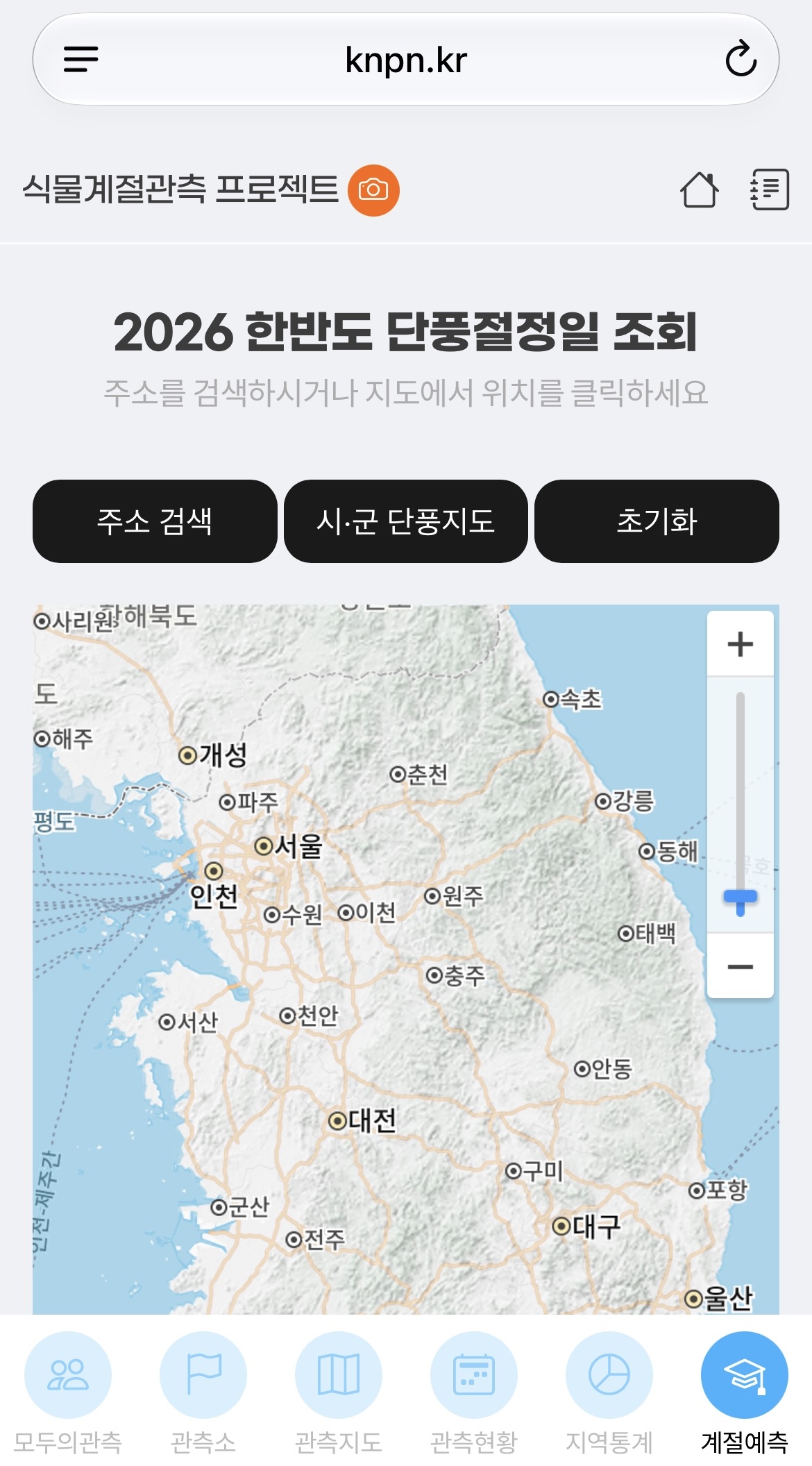
The National Arboretum under the Korea Forest Service on Tuesday launched a fall foliage peak search service, allowing users to look up the predicted peak foliage date for any location on the Korean Peninsula by entering a street address or building name.
The Korea Forest Service released its "2026 Korean Peninsula Fall Foliage Peak Prediction Map" on Sept. 22, offering a broad national overview of peak foliage timing. The new service lets users search for specific destinations and check the predicted peak date for that area.
Users can enter the street address or name of an arboretum, park, mountain, tourist site or other autumn outing destination to find the expected peak date. The National Arboretum defines peak foliage as the point at which 50 percent or more of a tree's leaves have changed color, in line with plant phenology observation standards.
The service also incorporates foliage observations recorded by citizens across the country. A plant phenology observation project that began Sept. 25, 2025, drew 2,806 citizen scientists over the following year, and foliage data submitted by 829 of those participants through the "2025 Fall Foliage Yeonga Project" served as the foundational dataset for developing the service.
Participants observed and photographed the progression of autumn color on trees, in parks and in forests near their homes. The accumulated data fed into regional foliage timing analysis and ultimately into a publicly accessible information service. The National Arboretum said it plans to continue building on citizen observation data to improve the accuracy of regional seasonal forecasts and to track long-term changes in plant phenology driven by climate change.
"The foliage records left by 829 citizens from across the country came together to create information that anyone can use," said Jang Gye-seon, head of the arboretum's Forest Biodiversity Conservation Research Division. "We hope this service not only provides useful information for autumn outings but also sparks interest in citizen science — directly observing and recording the seasonal changes of plants around us."
The fall foliage peak search service is available through the National Biological Species Knowledge Information System's plant phenology observation service, under the "Observation Records > Seasonal Forecast" menu.
kwonhl@heraldcorp.com