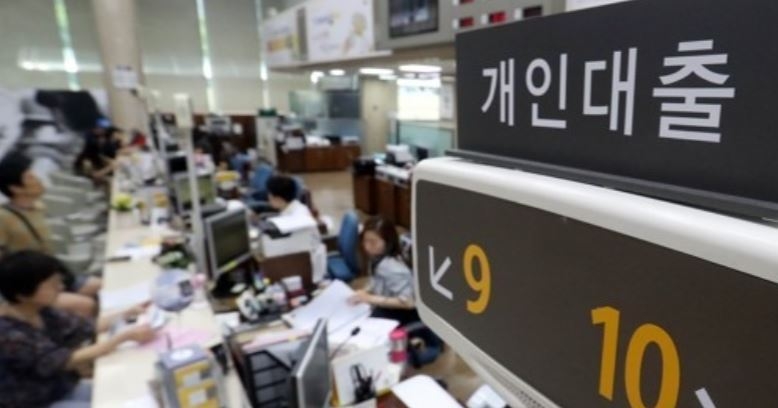
Major banks have been raising deposit and savings rates this month, raising the prospect of heavier interest burdens for borrowers with variable-rate home mortgages. When higher bank funding costs feed into the Cost of Funds Index (COFIX), variable-rate mortgage rates could climb further.
Variable-rate mortgage rates at major banks have already risen more than 0.3 percentage points over the past two months. With variable-rate loans accounting for nearly 70 percent of new mortgages, all eyes are on where COFIX heads next.
Bank time-deposit rates in the mid-3 percent range as lenders raise rates this month
NH NongHyup Bank raised rates on its installment and fixed-term deposit products by 0.20 to 0.25 percentage points starting Wednesday, according to financial industry sources. The one-year rate on its flagship "NH All-One e-Deposit" product rose to 3.55 percent per annum. NH NongHyup Bank had already raised rates on the same product on Sept. 11.
Benchmark time-deposit rates at KB Kookmin Bank and Woori Bank also climbed to 3.50 percent per annum. KB Kookmin Bank lifted the one-year rate on its "KB Star" time deposit to 3.40 percent on Sept. 14, then raised it again to 3.50 percent on Monday. Woori Bank also raised the rate on its "WON Plus Deposit" to 3.50 percent per annum.
Hana Bank raised the one-year rate on its "Hana Time Deposit" from 3.30 percent to 3.40 percent per annum on Tuesday. That marked the second adjustment this month, following a move from 3.20 percent to 3.30 percent on Sept. 10.
Online-only banks joined the rate-hike wave as well. Kakao Bank raised its one-year time-deposit rate by 0.10 percentage points, from 3.60 percent to 3.70 percent per annum, starting Wednesday.
The recent rise in market interest rates has driven the deposit rate increases. As funding costs on bank bonds and other market instruments have climbed, competition among banks for deposits has intensified, pushing time-deposit rates into the mid-3 percent range.
Higher deposit rates to feed through to COFIX
Rising deposit rates benefit customers who park money at banks by boosting their interest income, but the effect on borrowers can cut the other way.
COFIX is calculated as a weighted average of the rates that major domestic banks pay to raise funds. It reflects the actual funding costs on instruments such as time deposits, installment savings accounts and financial bonds. COFIX serves as the primary benchmark for setting variable-rate mortgage rates across the banking sector.
The new-loan COFIX for August held steady at 3.18 percent per annum, unchanged from the previous month. It had risen 0.13 percentage points from 3.05 percent in June to 3.18 percent in July before the upward momentum stalled.
The outstanding-balance COFIX rose 0.05 percentage points in August to 3.05 percent per annum, while the new-outstanding-balance COFIX climbed 0.06 percentage points to 2.71 percent.
The deposit and savings rate increases banks have made this month have not yet been reflected in the August COFIX figure. How much the higher funding rates recorded in September have affected banks' actual borrowing costs will become clear when the next COFIX reading is released next month.
Mortgage rates already up 0.33 percentage points in two months
Mortgage rates have already been trending higher.
As of Tuesday, variable-rate mortgage rates at the five major banks — KB Kookmin Bank, Shinhan, Hana Bank, Woori Bank and NH NongHyup Bank — ranged from 4.35 percent to 6.72 percent per annum. Compared with the 4.02 to 6.37 percent range recorded on July 15, the floor rate has risen 0.33 percentage points in roughly two months.
Even a 0.33-percentage-point difference adds up significantly over the life of a long-term mortgage.
Consider a borrower who takes out 300 million won ($221,000) on a 30-year equal principal-and-interest repayment plan. At a rate of 4.02 percent per annum, the monthly payment comes to about 1.44 million won. At 4.35 percent, it rises to about 1.49 million won — a difference of roughly 58,000 won per month, or more than 20 million won in total interest over the life of the loan.
Looking only at the first month's interest on the 300 million won principal, the charge comes to about 1 million won at 4.02 percent and about 1.09 million won at 4.35 percent — an increase of roughly 82,500 won.
A Bank of Korea analysis estimated that a 0.25-percentage-point rise in housing-related loan rates would add about 1.8 trillion won to the annual interest burden across all borrowers. On a per-borrower basis, the annual interest cost would rise by an average of 296,000 won.
Seven in 10 new mortgages now on variable rates
A growing share of borrowers choosing variable-rate mortgages adds to the concern.
According to the Bank of Korea, variable-rate loans accounted for 68.1 percent of new mortgages issued in July — the highest share in 12 years and five months. Roughly seven out of every 10 new mortgage borrowers opted for a product whose rate moves with market interest rates.
Many borrowers chose variable rates because the initial rate is often lower than fixed-rate alternatives, but a prolonged period of rising rates could push up their interest costs each time their loan is repriced.
Fixed and hybrid mortgage rates have already moved higher on the back of rising market rates, and bank deposit rates are now following suit. Should COFIX rise again next month, upward pressure on variable-rate mortgages is expected to intensify further.
rainbow@heraldcorp.com