Busan, Daegu receive smaller share of donated food than their share of vulnerable residents
Final distribution data needed to confirm actual support gap
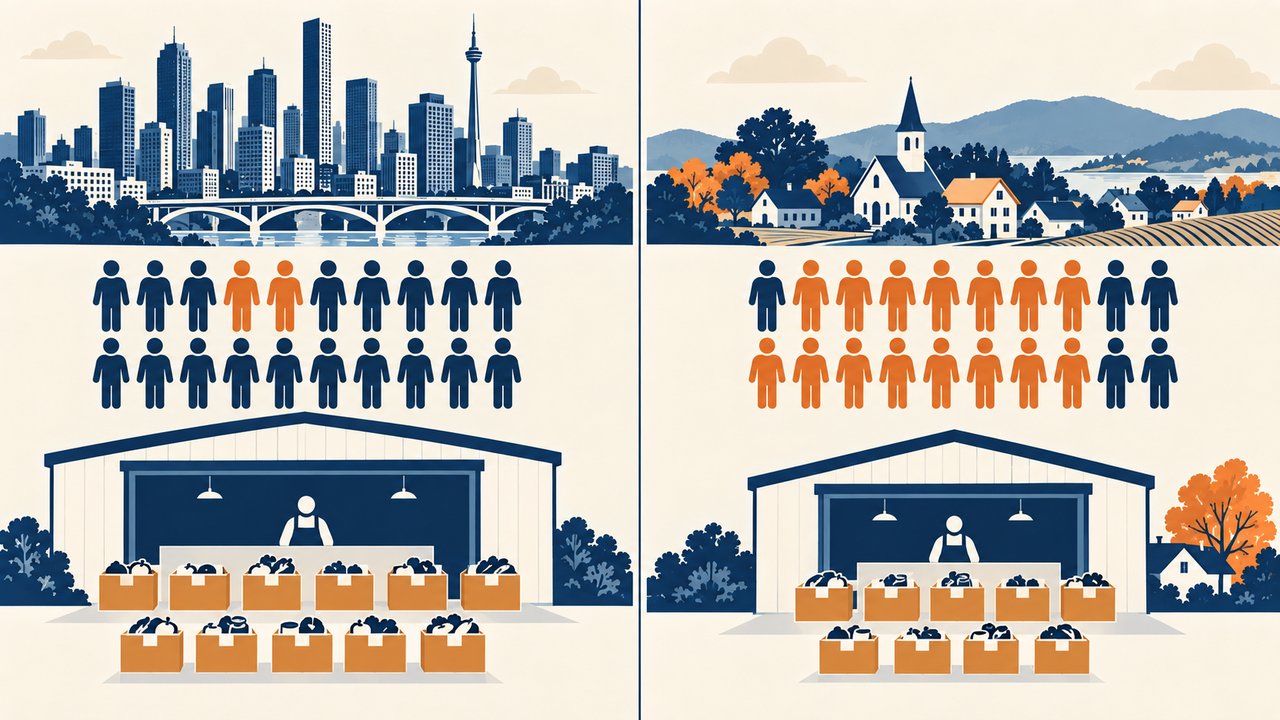
More vulnerable residents live outside the Greater Seoul area than within it, yet food banks have received more than half of all donated food by value from the metropolitan area, a new report shows. However, the region where food is received does not necessarily reflect where it is ultimately distributed, meaning distribution records must also be examined to assess the true regional support gap.
According to the National Assembly Research Service's "2026 National Audit Issue Analysis" released Saturday, the total number of vulnerable people nationwide in 2024 — combining basic livelihood security recipients, near-poverty households and emergency welfare support recipients — stood at about 3.48 million. Of those, about 1.99 million, or 57.2 percent, lived outside the Greater Seoul area, while about 1.49 million, or 42.8 percent, lived within it.
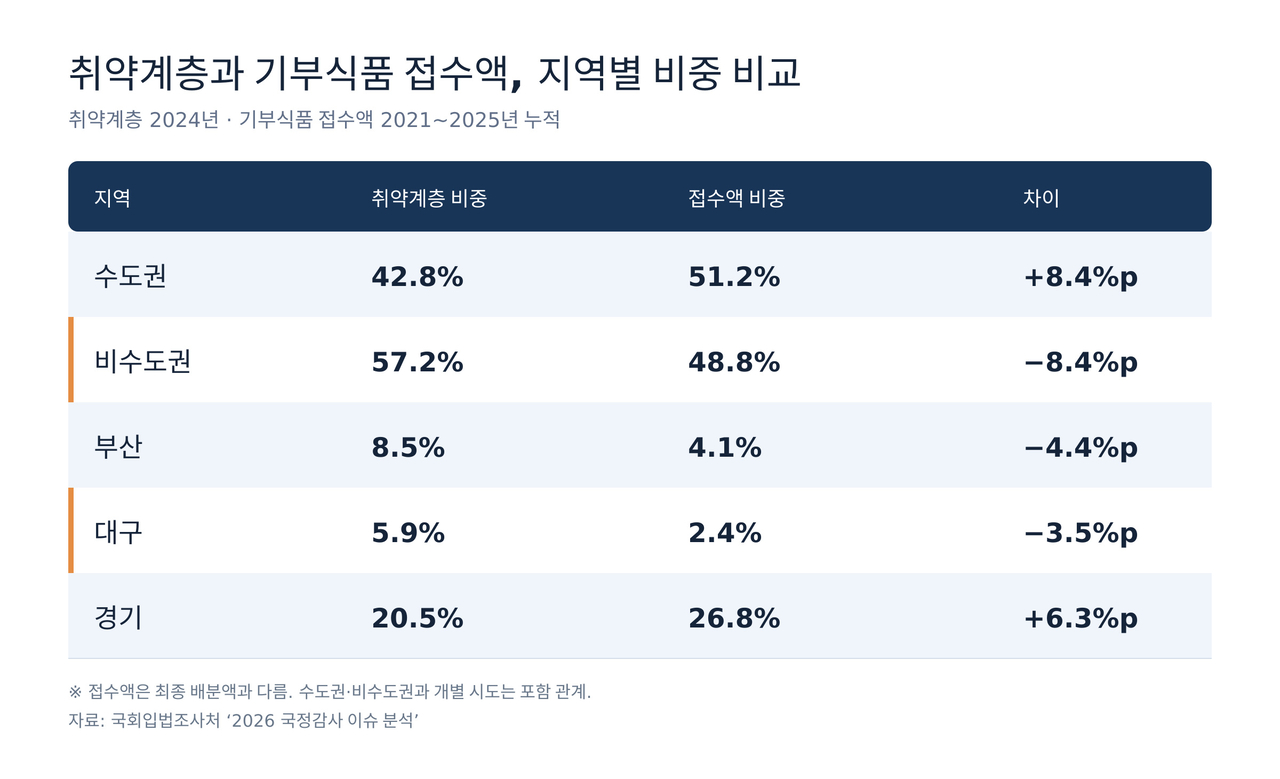
By contrast, of the 1.26 trillion won ($929 million) worth of donated food received by food banks from 2021 to 2025, the Greater Seoul area accounted for 646.2 billion won, or 51.2 percent. The rest of the country received 616.8 billion won, or 48.8 percent — the inverse of the regional breakdown of the vulnerable population.
At the regional level, Busan is home to 8.5 percent of the country's vulnerable population but accounted for only 4.1 percent of donated food received. Daegu similarly had a 5.9 percent share of the vulnerable population but only 2.4 percent of received donations. Gyeonggi Province, meanwhile, had a 20.5 percent share of the vulnerable population and a 26.8 percent share of received donations.
Regional disparities were also found in the cold-chain infrastructure used to transport and store donated food.
The Research Service counted 2,590 refrigerated and frozen vehicles nationwide from 2023 to 2025, with 1,159, or 44.7 percent, in the Greater Seoul area and 1,431, or 55.3 percent, outside it. By region, Gyeonggi Province had 754 vehicles, Busan had 87 and Daegu had 60. Transport capacity outside the metropolitan area — where food often needs to travel longer distances — warrants closer scrutiny, the report said.
The received-value figures alone, however, cannot determine how much food actually reached end users. Food received at central logistics centers can be transferred and distributed to other regions. Direct comparisons also require caution, as the vulnerable population figures are based on 2024 data while the donated food totals are cumulative figures from 2021 to 2025.
The Research Service recommended distributing donated food in a way that reflects regional demand — including the size of the vulnerable population in each area — and strengthening support for transport infrastructure, including refrigerated and frozen vehicles.
fact0514@heraldcorp.com