Ruling party voices support for postponing virtual asset taxation
Voices within the ruling party are calling for a delay in implementing the digital asset tax scheduled for next year, saying the groundwork has yet to be laid. They argue that the legal framework and investor protections must first be established through a basic digital asset law, with taxation to follow only once overseas transaction data can actually be obtained.
Democratic Party of Korea lawmaker Min Byeong-deok said Tuesday in a Facebook post that he was proposing to defer the start of taxation until after the passage of a basic digital asset law. "To escape the criticism that our country is slow with laws but fast with taxes, I propose that the timing of taxation be set for after the Digital Asset Basic Act is passed," he wrote.
Min said he agreed with the principle that income should be taxed and that digital assets could be no exception, but stressed that "to tax by the book, the foundation for fair collection must come first."
He identified the biggest problems with the current tax framework as the difficulty of obtaining overseas transaction data, the absence of loss carryforward provisions, and uncertainty over the basis for calculating acquisition costs.
One key concern is the mismatch between when overseas transaction data will become available through the Crypto-Asset Reporting Framework, or CARF, and when the tax is set to take effect.
"The first data exchange under CARF will take place in 2027," Min said. "If taxation begins in January 2027, only the income of users on domestic exchanges will be captured — the income of users on overseas exchanges will be invisible."
He added that the structure would in effect mean only those who traded through domestic platforms would pay taxes. "This would push trading overseas, potentially reducing not only the digital asset income tax but also corporate taxes from domestic operators and VAT on transaction fees," he said.
Min also pointed to the lack of loss carryforward provisions as a fundamental flaw in the current tax structure. He gave the example of an investor who posts a loss of 10 million won ($7,220) in the first year and a gain of 10 million won in the second year. "The net result over two years is zero, but under the current system, the investor would owe 1.65 million won in taxes in the second year," he explained.
Under the planned tax regime, a 22 percent rate — combining a 20 percent miscellaneous income tax and a 2 percent local income tax — would apply to annual digital asset income after deducting a basic exemption of 2.5 million won. In the example Min cited, the taxable amount would be 7.5 million won, leaving the investor with a tax bill of 1.65 million won.
"The United States and the United Kingdom apply capital gains rules to digital assets and allow loss carryforwards," Min said. "We should introduce a minimum five-year loss carryforward deduction as well."
Min also called for improvements to the rules governing how acquisition costs are calculated. "The system must not be so unclear that investors end up paying more tax than they owe or are left bearing responsibility for filing errors," he said.
He further urged the government to disclose both the projected tax revenue and the administrative costs of implementing the levy. "The UK, in anticipating up to 315 million pounds ($399 million) in tax revenue by 2030 from the introduction of CARF, also disclosed the government's implementation costs of 69 million pounds alongside the burden on businesses," Min said. "Our government should immediately compare the projected tax revenue and make public the administrative costs and the reporting burden on investors."
He closed by saying the goal was not to avoid taxation. "The aim is to implement it in line with when overseas transaction data is actually secured, while having the National Assembly and the government jointly set completion deadlines and verification standards for each task — so that the delay does not become open-ended," he said.
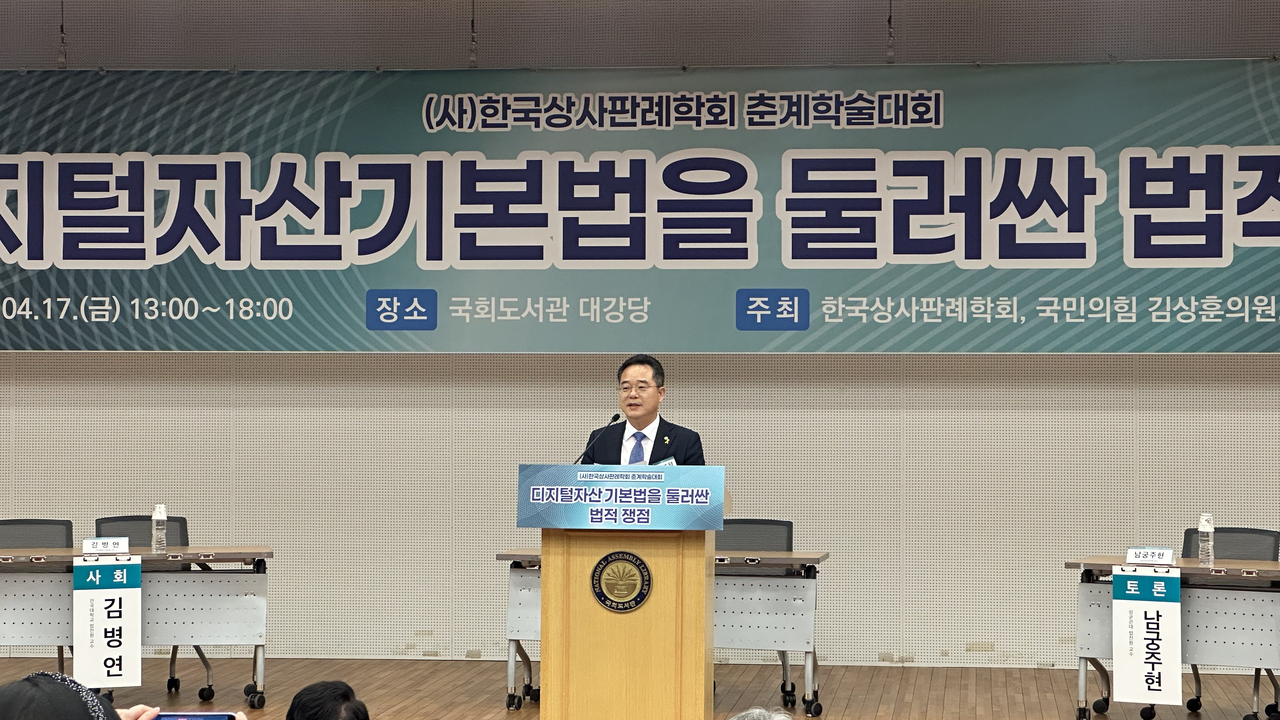
On Monday, a policy forum on improving the digital asset tax system was held at the main National Assembly building, co-hosted by the opposition party and the Digital Asset Exchange Alliance, known as DAXA. The People Power Party urged a reconsideration of the January tax rollout, citing concerns over tax fairness and the risk of capital flight overseas.

kyoung@heraldcorp.com