Approved at Cabinet meeting Tuesday … fuel prices at 226 highway gas stations to drop 100 won per liter during holiday
![Vehicles line up on the southbound Gyeongbu Expressway near Jamwon IC in Seocho-gu, Seoul, on May 1. The government approved a nationwide expressway toll waiver for the Chuseok holiday period, from Thursday through Sunday. [Newsis]](https://wimg.heraldcorp.com/news/cms/2026/09/22/news-p.v1.20260502.c6f5436fdeaf43089d543102b5bc5868_P1.jpg)
Expressway tolls across the country will be waived from Thursday through Sunday for the Chuseok holiday period. The exemption covers privately operated toll roads as well.
In addition, fuel prices at 226 expressway service stations will be cut by 100 won per liter during the same period.
The Ministry of Land, Infrastructure and Transport said Tuesday that the measures were discussed and finalized at a Cabinet meeting to ease the public's transportation costs during the Chuseok holiday.
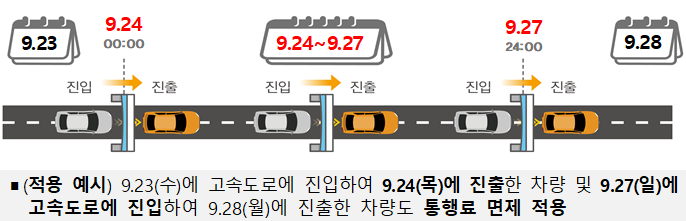
The toll waiver period has also been expanded beyond the holiday itself. Vehicles that pass through a tollgate on Wednesday — the day before the holiday begins — and exit on Thursday will also be exempt, as will vehicles that enter on Saturday and exit on Sunday. The ministry said the waiver applies to all vehicles using any part of the expressway network from midnight Thursday through midnight Sunday.
Drivers passing through a tollgate during the waiver period will hear a terminal announcement confirming that a toll of zero won has been processed. Vehicles not equipped with a Hi-Pass transponder can receive the exemption by taking a ticket at entry and submitting it upon exit.
The ministry said it has waived expressway tolls during major holidays since 2017, with cumulative exemptions totaling 1.04 trillion won ($755 million) across 14 Seollal and Chuseok holidays.
To ease fuel costs for holiday travelers, the government will use Korea Expressway Corporation revenue to sell fuel at 226 publicly operated expressway stations at prices 100 won per liter below the Sept. 17 retail price. Stations on privately operated expressways are excluded from the measure.
Based on Sept. 17 prices, the average retail price was 1,844 won per liter for gasoline and 1,834 won for diesel. Under the measure, prices from midnight Thursday through midnight Sunday will be set at 1,744 won per liter for gasoline and 1,734 won for diesel.
"We hope the toll waiver and fuel price reduction will ease the burden on people traveling home for the holidays and help them enjoy a happy Chuseok," a ministry official said. "We will work closely with relevant agencies to manage traffic carefully, particularly around interchanges where demand is expected to rise."
Meanwhile, although expressway toll reductions have been implemented every holiday season, the government has never reimbursed the Korea Expressway Corporation for the lost revenue. Rep. Bu Seung-chan of the Democratic Party of Korea, a member of the National Assembly's Land and Transport Committee, said cumulative toll exemptions eligible for public service obligation (PSO) compensation under the Korea Expressway Corporation Act — covering 2009 through 2025, when the legal basis for PSO reimbursement was established — total 5.45 trillion won, yet not a single won of government budget has been allocated for reimbursement over that period.
Bu said the Korea Expressway Corporation has consistently requested budget compensation through the Ministry of Land, Infrastructure and Transport to the Ministry of Economy and Finance each year — except in 2024 — based on the legal framework, but has been excluded every time during the budget drafting process. "Korea Railroad Corporation (Korail) has received around 400 billion won in annual PSO funding from the government over the past five years (2021–2025) for fare reductions for senior citizens, people with disabilities and veterans," he said. "The government should actively consider providing PSO budget compensation to the Korea Expressway Corporation in a manner consistent with the legal basis and the principle of equity."
smh@heraldcorp.com