Three Korea Journalists' Union officials, including EBS branch chief Kim Sung-kwan, received a 'no crime' ruling from the Goyang branch of the Uijeongbu District Prosecutors' Office in August
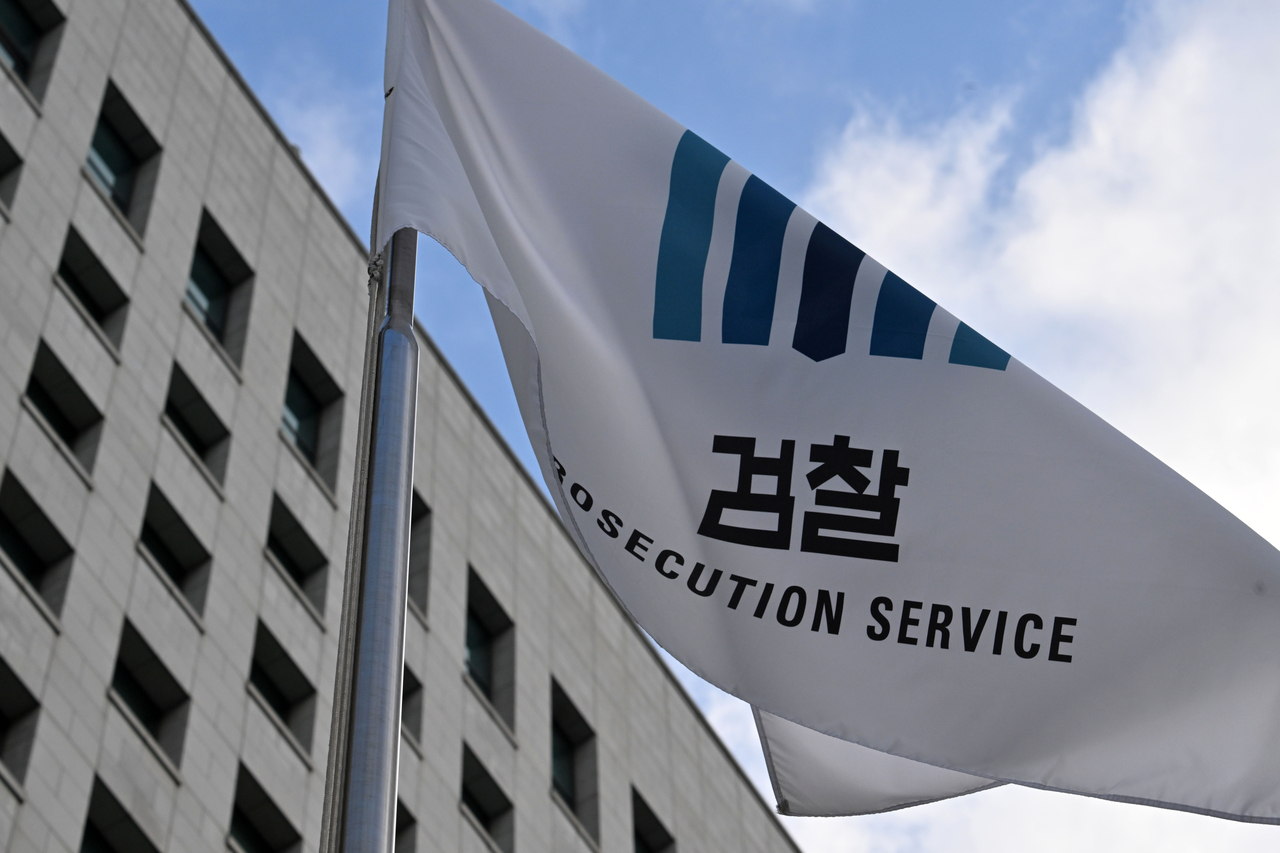
Prosecutors have declined to indict Korea Journalists' Union officials, including EBS branch chief Kim Sung-kwan, who had been investigated on charges of obstruction of business after blocking former announcer Shin Dong-ho from entering the EBS (Korea Educational Broadcasting System) building to take up the presidency.
The second criminal division of the Goyang branch of the Uijeongbu District Prosecutors' Office, headed by Chief Prosecutor Hong Sang-cheol, issued a "no crime" ruling on Aug. 24 against Kim, Korea Journalists' Union Secretary-General Yoon Sung-gu and KBS chapter head Park Sang-hyun — all three of whom had faced obstruction of business charges.
A "no crime" ruling is a form of non-indictment decision. Under the Prosecutors' Case Procedure Rules, a ministerial ordinance of the Ministry of Justice, it applies when the alleged conduct meets the elements of a criminal offense but circumstances exist that negate the formation of a crime under law.
Prosecutors determined that the three officials' actions in blocking Shin's entry constituted a justifiable act under the Criminal Act — one that did not violate accepted social norms — and that their conduct was therefore not unlawful. The determination took into account, among other factors, that the officials had a practical need to participate in the demonstration at the very moment Shin was attempting to enter the building.
Prosecutors also found that the officials' opposition to Shin's arrival was not driven by personal grievances or private interests, but by their belief that the appointment process had been fundamentally flawed and their desire to demand its correction. On that basis, each of the three received a non-indictment ruling.
The Korea Communications Commission had voted to approve Shin's appointment as EBS president — to succeed outgoing President Kim Yu-yeol — at a plenary session held in March last year under a two-member structure consisting of then-Chairwoman Lee Jin-suk and then-Vice Chairman Kim Tae-gyu, both of whom are now People Power Party lawmakers.
The decision triggered a fierce backlash inside EBS: 52 of the broadcaster's 54 senior managers resigned in protest.
That same month, Kim and the two other union officials gathered in front of the EBS building as Shin attempted to report for work, holding placards reading "We reject the illegally appointed president" and "We reject illegal parachute Shin Dong-ho," chanting the same slogans and physically blocking his entry.
The conservative civic group Jayu Daehan Hogukdan subsequently filed a complaint against Kim and the others on charges of obstruction of business. The Ilsandongbu Police Station, which handled the investigation, referred the case to the Goyang branch of the Uijeongbu District Prosecutors' Office in September last year, and prosecutors ultimately closed it with a non-indictment ruling.
Meanwhile, shortly after the KCC voted to approve Shin's appointment, outgoing EBS President Kim Yu-yeol filed a lawsuit seeking to nullify the appointment and applied for an injunction to suspend its effect. A court granted the injunction in April last year. Under the relevant law, which holds that a predecessor remains in post if no successor has been duly appointed, Kim returned to EBS.
The Seoul Administrative Court's second administrative division, presided over by Chief Judge Kong Hyun-jin, ruled in favor of Kim in March in the main nullification suit. The court found that the KCC's approval of the presidential appointment by only two commissioners failed to meet the required quorum and was therefore invalid, and that the appointment must be rescinded due to a serious procedural defect. However, the court stopped short of declaring the appointment void ab initio.
bell@heraldcorp.com