Park Eun-hwan has lived with her mother, who has had dementia for nine years, as her only child
'I couldn't believe it when Mom was first diagnosed'
Programs at the Mapo-gu Dementia Care Center have helped both mother and daughter stay healthy
She compiled their shared moments into a picture book
'I hope our society becomes one where dementia patients can live alongside others'
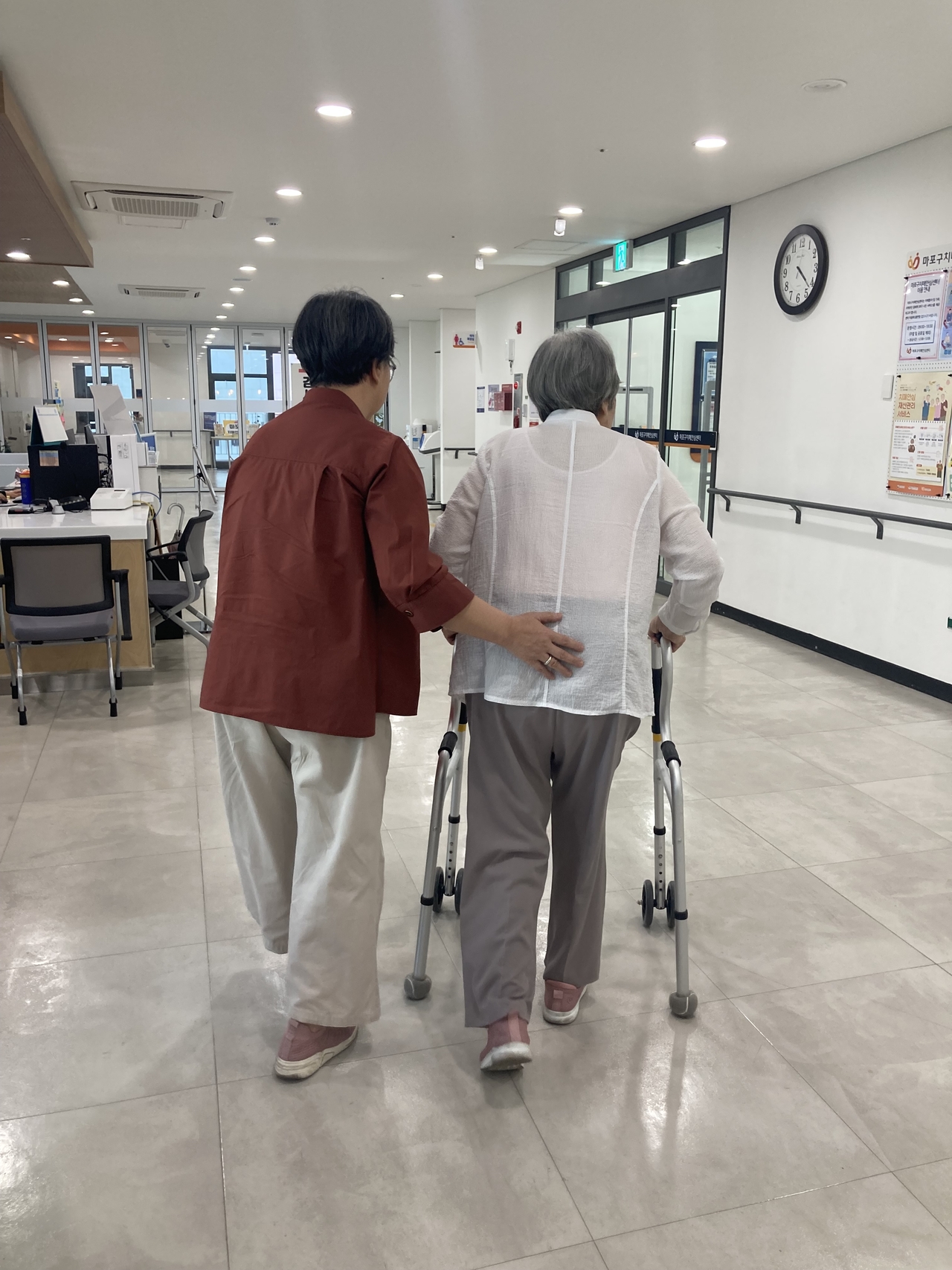
Her 86-year-old mother, once in good health, had begun losing her balance and falling repeatedly. First her ankle broke, then her hip, and she ultimately needed surgery. After the operation, the doctor suggested the falls were not simply a balance problem and recommended a dementia screening. The diagnosis came back: Lewy body dementia. It was a devastating blow. The second most common form of degenerative dementia after Alzheimer's disease, Lewy body dementia is characterized by cognitive decline, visual hallucinations, REM sleep behavior disorder and Parkinson's-like symptoms. It is estimated to account for about 3.8 percent of all dementia cases.
In February 2018, Park Eun-hwan (pseudonym, 62) became a family caregiver. Meeting with a reporter Monday at the Dementia Care Center in Mapo-gu, Seoul, Park recalled that her mother had already been showing early warning signs. "Mom would say things like, 'It's so hot — summer must be coming,' even though it was autumn, and she had trouble remembering the date," she said. "Everyone gets a little forgetful with age, so I didn't think much of it. But I suppose all those little things were the clues."
When Park asked the doctor what would happen to her mother, the doctor said her condition would likely worsen in about five years. Hearing that, Park steeled herself. She was the only family member who could care for her mother.
An only child, Park had lost her father early and had been living alone with her mother ever since. After taking early retirement from her job in 2014 and working as a freelancer, she gave up work entirely after her mother's hip surgery in 2024 and has been by her side full time.
At first, she brought a caregiver to the house. Three times a week, the caregiver would spend three hours a day with her mother — going for walks, doing puzzles and chatting. But when COVID-19 arrived in 2020, home visits became impossible. With less social interaction, her mother's condition gradually worsened. Park said she felt a growing sense of urgency that she could no longer keep her mother confined to the house.
That led her to look into a day care center. Her mother's reaction, however, was not good. "Mom got furious and accused me of trying to abandon her there," Park said. "Her condition kept getting worse, and my own life was slowly disappearing — I was so overwhelmed that all I could do was cry."
Park then turned to the Dementia Care Center near her home in Mapo-gu. Unlike a day care center, which requires patients to stay all day, the center's program runs three afternoons a week for three hours at a time — and it turned out to be a perfect fit for her mother.
The center's cognitive health programs cover a wide range of activities beyond language exercises, including physical exercise and musical instrument sessions. More than anything, joining more than 10 other elderly people living with dementia has been a strong help in rebuilding her mother's social connections.
The center has also been a source of comfort for Park herself. Caregivers who accompany their loved ones meet others facing similar challenges, sharing encouragement and practical information. "Even with a very close friend, there are things you simply cannot share if they have never cared for someone with dementia," Park said. "Their words of comfort can actually feel uncomfortable at times. But here, everyone is going through the same experience with dementia, so you can open up completely — and you end up feeling, 'I'm not the only one struggling.'"
The center has also offered Park concrete, practical help. "Mom has trouble remembering the date, so I asked what to do about it, and one caregiver told me she puts a calendar out and tells her child every morning, 'Today is this date,'" Park said. "After hearing that advice, I have Mom write down the month and day every day. There are so many tips here that are more genuinely useful than any dementia textbook."
The center runs programs not only for dementia patients but also for their caregivers. Last year, the caregivers took part in a theater performance. Park said everyone initially shrank back, saying, "How could I possibly act?" — but once it was over, they all said they could not imagine having missed it.
"Like all caregivers, I have to be mentally and physically healthy myself before I can properly care for someone else," Park said. "Caregivers who first came to the center looking utterly devastated seem to find strength here by sharing their worries with others and lifting each other up."
Park recently gathered her experiences caring for her mother and turned them into a picture book. To mark Dementia Awareness Day, observed every year on Sept. 21, the Mapo-gu Dementia Care Center is running a "Memory Reading Room" exhibition, displaying picture books made by dementia caregivers at Mapo Central Library and other venues.
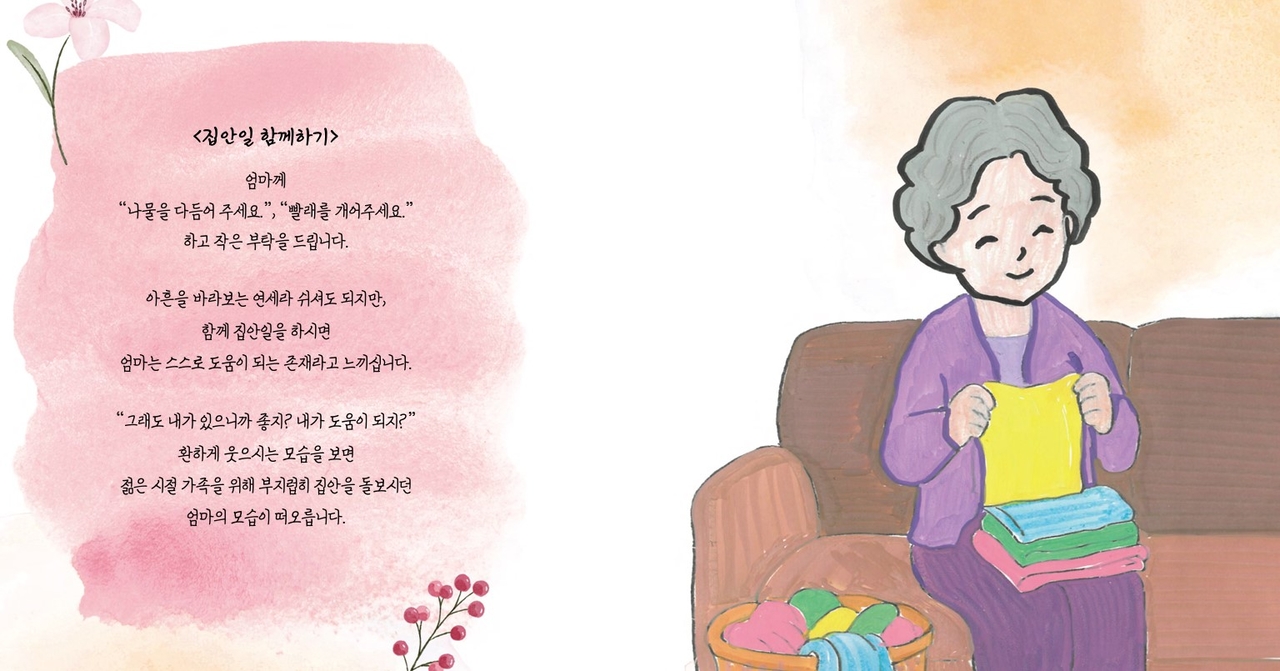
Park's picture book, titled "How to Spend a Happy Day with Mom," captures in illustrations the routines she developed while caring for her mother over the years: starting each day by writing down the date and day of the week, copying down one memorable sentence a day, taking a trip down memory lane, keeping a daily record, doing household chores together and sharing warm physical affection.
"After I finished the book, I showed it to Mom and she looked through the whole thing and said, 'This is nice,'" Park said. "In that moment, I had the feeling — just briefly — that she was herself again."
Fortunately, her mother's condition has not deteriorated as much as feared since the initial diagnosis. But Park knows that, however slowly, the dementia will continue to progress.
"The hardest part is not knowing when it will end," she said. "It's difficult to gauge when Mom's condition will get worse, or how long I'll be able to care for her at home." She added that as the hours of caregiving have grown longer and her own time has shrunk, she sometimes feels angry. "But while I'm with Mom, giving my best feels like my destiny," she said.
Park also expressed a broader hope. "Unless a patient's dementia is so severe that they become violent, I'd like to see dementia patients be able to live at home and go about their daily lives," she said. "It seems like staying connected with others in everyday life is what keeps the symptoms from getting worse. I hope our society can become that kind of environment."
Asked what she most wants to do with her mother, Park gave a quiet smile. "I had always planned that after I retired, Mom and I would travel all over and have a wonderful time — but I've let go of that," she said. "Now, I think just taking a walk hand in hand with Mom is enough."
Nine years into life alongside a mother with dementia, Park is fighting — and finding her way through — the disease with a resilience few could match.
ikson@heraldcorp.com