System trained on 500,000 past cases, laws and rulings; 'Nongsikpum AI Minjeon 365' now fully operational
AI recommends responsible department and provides supporting legal references
Expected to cut roughly 3,000 annual response extensions; tracks farmland complaint trends
An AI system will now read the roughly 17,000 public complaints filed with the Ministry of Agriculture, Food and Rural Affairs each year in real time, identify the responsible department and draft an initial response. The system was trained on approximately 500,000 data points — including past complaint responses, laws and court rulings — to cut processing time and improve the accuracy of replies.
The ministry announced Thursday that it had built the generative AI-based complaint-handling support system, called Nongsikpum AI Minjeon 365, and launched it for full operation this month after a pilot run.
Under current rules, complaints submitted through the government's public petition portal must be processed within seven to 14 days of filing, depending on their type. In practice, however, additional fact-checking often pushes processing beyond that window, resulting in roughly 3,000 response extensions at the ministry each year.
To reduce that backlog, the ministry built Nongsikpum AI Minjeon 365 using about 500,000 records, including past complaint responses, laws, court rulings and project implementation guidelines.
Once a complaint is received, the AI analyzes its content in real time, recommends the most appropriate department to handle it and explains its reasoning. The system is designed to support staff who would otherwise have to review each complaint individually to determine which unit is responsible.
The assigned department then receives an AI-drafted response along with references — past cases with similar content and relevant laws and rulings — so that the staff member writing the final reply can directly verify what the AI has suggested.
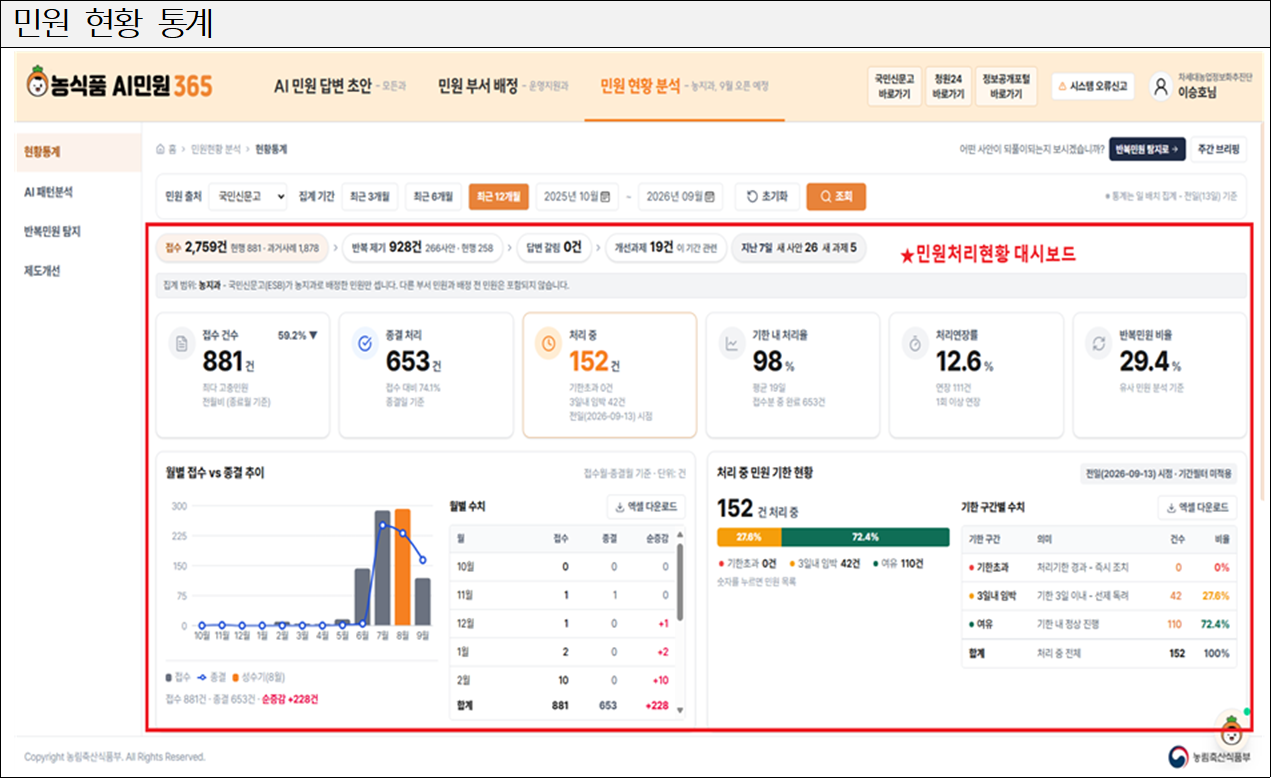
The system also feeds complaint data into policy work. The AI analyzes farmland-related complaints in real time and displays trends and recurring issues on a dashboard. Key terms frequently raised by complainants and monthly complaint volumes are also visualized.
The ministry said it expects the system to ease the workload of staff drafting responses while at the same time improving reply quality and shortening processing times.
"We will continue to accumulate and refine data to improve response accuracy, and listen to the public's voice within complaint data to deliver better agricultural policy benefits and systems," said Hong In-gi, the ministry's policy planning officer.
adastra@heraldcorp.com